
‘Power to the People’: John Lennon & Yoko Ono’s NYC Rent Party on the Big Screen
Expanded footage of a historic benefit show is manna for Beatlemaniacs
Post-Beatles, John Lennon was never the tireless road dog that Paul McCartney was (and incredibly remains). He was more comfortable holing up in a studio or just soaking up everyday life unhampered by the rigors of touring. John made some furtive forays onto the stage here and there, but his August 30, 1972 One to One show at Madison Square Garden with Yoko and the Plastic Ono Band is the only proper, full-length après-Fabs concert he ever performed.
Power to the People ★★★ (3/5 stars)
Directed by: Simon Hilton
Running time: 80 mins
A shorter version of the One to One Show was released back in the ’80s. Now, Power to the People producer Sean Lennon (John and Yoko’s son) and director Simon Hilton have given this slice of ’70s music history a new coat of paint. Re-edited and restored as a feature-length concert documentary, it captures the electric connection between John and his fans.
In ’72, a young Geraldo Rivera televised an exposé about Staten Island’s Willowbrook State School, a residential institution for children with mental disabilities, uncovering grievous neglect and manifold abuses. The story went viral, and next thing you know, John and Yoko were moved to gather up some high-powered peers (Roberta Flack, Stevie Wonder, Melanie, Sha Na Na) and put on a big benefit show to support the kids.
But the story behind the event isn’t what Power to the People is about. For that and the context of the life the Ono Lennons were living at the time, check out Kevin MacDonald’s 2024 documentary One to One: John & Yoko. Hilton’s film presents the straight-up show, and not only do we hear and see it better than ever before, we also get more of it on film than ever (though a couple of Yoko’s tunes, including the righteously conceived but unfortunately titled “Woman is the N***** of the World” remain unseen).
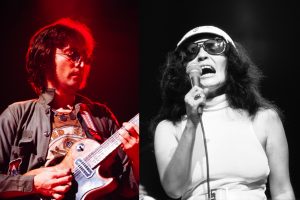
We get to watch what happens when the man who was arguably ’60s pop culture’s largest-looming figure fully slides into ’70s mode. Dominated by his early-’70s solo albums, the setlist shows how he’d grown far more politicized lyrically but was embracing simpler musical forms than in his days of psychedelic exploration. There’s still very much a hippie holdover vibe — small tambourines had been passed out to the audience, who hit them jubilantly throughout — but it’s coming from a slightly matured perspective in accordance with the new era.
John and Yoko are backed by Elephant’s Memory, a pre-existing NYC band who became the latest version of The Plastic Ono Band for the studio album Some Time in New York released earlier that year. Besides being a blistering gang of rockers, they’re an epically mutton-chopped, gloriously berobed bunch who couldn’t look more ’70s if you gave them their own Saturday morning Sid and Marty Krofft TV show.
Saxophonist Stan Bronstein (a glam-rock vision in leopard print and black-and-red satin) and guitarist Wayne “Tex” Gabriel are the MVPs, doing a lot of the heavy lifting and never letting up. The band comes off tight, punchy, and well prepped, but Lennon can’t resist deflating the proceedings by commenting, “We’ll get it right next time… glad you liked the rehearsal” after a slightly iffy ending to “Instant Karma.”
The hard-charging “New York City” packs almost a proto-punk energy, as Lennon lays out his current lifestyle, namechecking NYC friends like Rivera and musician David Peel along the way. And the minimalist punch of earlier solo tunes like “Well Well Well” and “It’s So Hard” is intensified onstage.
Yoko sits behind an electric piano during John’s tunes, stepping up to the spotlight for her own compositions, some taken from her own catalog. Ono had a long history as a multimedia avant-garde artist before ever meeting John, and her experimental vocal ululations have long been unfairly satirized. But hearing her belt out uncompromising tunes like “We’re All Water” and “Open the Box,” you can make a case for her prefiguring everyone from punk pioneers X-Ray Spex to experimental hellraiser Diamanda Galas.
Between Yoko’s deftly deployed vocal wail and John’s primal scream therapy-inspired delivery on tunes like “Mother” and “Cold Turkey,” it’s expressionism a-go-go on the Madison Square Garden stage. Especially when Bronstein’s squealing sax gets into the act on the latter tune as things take a left-field turn.
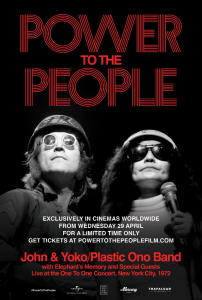 As far as his famous past went, the man who sang “I don’t believe in Beatles” on his first solo album seems still to be mostly in scorched-earth mode, though beginning to open up just a bit. “We’ll go back to the past for just one,” he allows while making a comic throat-cutting motion before launching into a fierce, almost feral take on “Come Together” where the double drummers (Jim Keltner joined the regular Elephant’s Memory crew) really earn their money. We’re reminded that America hadn’t yet extricated itself from Vietnam when John shouts “stop the war” mid-song.
Speaking of timely amendments, when Lennon extends a line in “Imagine” to “a brotherhood and sisterhood of man,” however ungrammatical, it’s as if he’s compelled to come out on the right side of history no matter how much updating it requires.
For the encore, during which everyone inexplicably dons hard hats emblazoned with Japanese lettering, the band lays into “Law and Order,” a two-chord, syncopated funk vamp over which Yoko reads Adolf Hitler quotes from 1932 that sound unsettlingly Nixonian, before it all transforms into “Give Peace a Chance,” with John and Yoko both flashing double-fisted peace signs as they lead the audience in the now-legendary pacific chant.
It turns into an all-hands finale as the other acts from the bill (plus additional friends) step out onstage and join in. It eventually gets endearingly surreal watching Stevie Wonder, Melanie (whose keening tones sound not unlike Yoko), Bowzer from Sha Na Na, Allen Ginsberg, and Phil Spector stand shoulder to shoulder.
We know now that Lennon was at an artistic apex in the early ’70s, and he would do some personal and musical wandering in the wilderness in the time to come. So, this expertly souped-up snapshot of him at the peak of his powers in his only “real” solo show seems especially precious.
Correction: April 27: The second drummer was Jim Keltner, not Jim Gordon.
You May Also Like
-
 September 24, 2020
 -
 December 8, 2020
 -
 May 1, 2022

Quick correction: the second drummer is Jim Keltner, not Jim Gordon.
Thanks Tom – checked with Jim and corrected.