
Rebecca, Martha, Emily and Julia
Writing about women writing and how they changed work and the world
41-year-old Julia Cooke has written an often-engaging biography of three pioneering journalists, Rebecca West, Emily Hahn, and Martha Gellhorn, who in the years leading up to the Second World War, traveled to dangerous war zones providing Americans with firsthand coverage on what was going on in a world that seemed ready to explode. In Starry and Restless: Three Women Who Changed Work, Writing, and the World, Cooke attempts to paint the picture of these women’s daredevil lives but falls short at times, seemingly held back by her own inner constraints and a seeming desire to heroize them rather than reckon seriously with the messy contradictions of their lives.
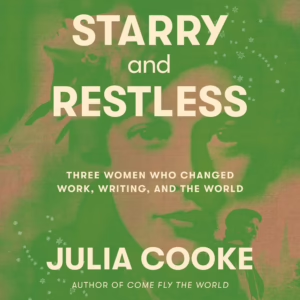
Starry and Restless: Three Women Who Changed Work, Writing, and the World
By Julia Cooke
Farrar, Straus and Giroux; 448 pages
The journalists Cooke writes about were often reporting from the front line. Gellhorn was on Omaha Beach on D-Day hiding in a bathroom on a hospital boat. Hahn lived in Japanese-occupied Shanghai while writing pieces for The New Yorker about how wartime impacted the lives of one modern Chinese family. Later, West covered the Nuremburg trials. All three reporters wrote in a first-person style that made their prose easily accessible to hungry readers anxious to understand what was happening overseas. Their writing appeared on the pages of The New York Times, The Atlantic Monthly, Collier’s, The New Yorker, and Vogue.
Cooke explains how they prepared for their trips abroad. They knew to travel light and keep copious notes on those they met who made a significant impact on them for later reference. Most importantly, they knew they must look out for themselves.

But Cooke fails frequently to make the imaginative leap a biographer must make to bring her subjects to life. Often, in place of insights she falls back on banalities that don’t even seem to further her narrative. For example, Cooke writes, “Not one of these women wrote like a man, nor did they live like men. Alongside their careers, their lives reveal an intimate map of new territories for women. Each compared the stereotypically feminine — motherhood and marriage, homemaking and caregiving and fashion — with decidedly masculine-seeming tendencies. They were sometimes angry. They were often outspoken. They did not let anyone tell them who they were.” There is an irritating vagueness present here. Each of these women were surely more than the decisions they made as women and those they declined.
Of the three, only the description of Emily Hahn grabs our attention. Hahn came from an artistic leaning family in St. Louis and her father, who was a wholesaler, was often away on business. Cooke conveys Hahn’s mother’s concern about her daughter’s obsession with reading and writing, thinking it somehow unseemly. Yet, Hahn was a fearless child who became a daring young woman. In 1930, she left on her own to go to the Belgian Congo with a contraband gun tangled up inside a dress in her luggage. Predictability bored her; travel was her passport elsewhere and away from her overbearing mother.

When Hahn arrived in Shanghai in 1936 she set the city buzzing by arriving at several prestigious luncheons with a pet gibbon on her shoulder, tongues began wagging. Cooke tells us about the rumors that chased her regarding the men she might have been sleeping with. And Cooke brings us to a Shanghai that was “brimming with poets and revolutionaries, opium addicts, and millionaires, its international territories fixed like a crown around a Chinese walled city, pleasure was paramount.” Hahn wrote to her sister in St. Louis, “I haven’t any desire to go anywhere else — well, not much.” China had become the center of the world’s attention, and many were talking about the country’s recent Communist revolt.
Hahn begins a love affair with Shao Xunmei, an aristocrat’s son, who was also a poet who dressed lavishly and published one of Shanghai’s smartest magazines. Hahn fell hard for Xunmei, the two of them traveling about, smoking opium, and talking late into the night with his wide array of intellectual friends. Hahn was charmed by his ability to make everything Western feel Chinese somehow. She embraced his contradictions as if they contained some sort of hidden magic. He claimed not to be interested in politics, yet his circle of friends were revolutionaries and bureaucrats. He could spend hours indulging his passion to think abstractly and tried to get Hahn to relax and enjoy her life more. Together, Hahn and Xunmei began publishing a bilingual monthly magazine.
 Cooke’s account of Hahn comes with an intensity and perceptiveness along with a sense of abandon missing from her accounts of the other journalists. Cooke feels fully engaged; unafraid to imagine what the two lovers in Shanghai might have been like for each other, and how much attention probably shadowed them. Cooke tells us that Hahn had found something special with Xunmei that was like nothing she had experienced before. Cooke describes it for us as “a complicated happiness in Shanghai. She was stimulated, challenged, revered, disdained. Contentedness became barbed with boredom, frenzy, or fear: in the silences at dinners with Xunmei.”
Cooke loses a certain restraint that squelches much of her narration elsewhere. She is willing to dream, imagine, and fantasize alongside what she perceives to be Hahn’s reaction to Xunmei during their passionate love affair. And in allowing herself to do so, we readers feel we come closer to the truth of Hahn’s essence, and to Cooke’s presence on the page which has often been absent. The pages Cooke writes on Emily Hahn feel like a conversation of sorts between author and subject, and we readers are riveted to the page.
By 1937, Hahn and Shao were over, and Hahn went to Hong Kong where she would meet her future husband, a British intelligence officer, whom she would marry after the war, and he would become the father of her two daughters. Despite Hahn’s apparent domestication, Cooke maintains the same level of candor. She writes movingly about Hahn’s withdrawal from opium and we learn about her complicated relationship with motherhood which would haunt her throughout her life. Her second daughter never forgave Hahn for what she believed to be her mother’s maternal neglect. We find out about Hahn’s unorthodox marriage. Her husband lived in London; she in New York; the children generally in boarding schools. The family would gather intermittently for holidays and vacations. Again, we feel Cooke loosening her grip on Hahn as she writes and it’s in this more relaxed hold that a more nuanced portrait emerges.

Her reluctance to ponder West and Gellhorn’s complex emotional realities in the same ways, and across all sorts of unexpected circumstances, hinders an otherwise interesting chronicle in which Cooke flips back and forth between the three women’s lives.
Which brings me to the importance of a narrative voice in biographical writing. It is important to be engaged with subjects in a way that transcends the historical or chronological or merely factual. A great biographer must allow themselves to be vulnerable to what they might be missing about their subject, and sensitive to their own inner blockages. Decades back, Edmund Morris was so overwhelmed writing a biography of Ronald Reagan, Dutch: A Memoir of Ronald Reagan, that he dared to write himself into the story as a fictional character who was a contemporary of Reagan watching the future President lead his gargantuan life. Historians were horrified at such a transgressive act, but many were impressed by his bravado. Biographers must remain open to wonder, to things they don’t know, and to imagining what it might actually feel like to stand in someone else’s shoes. Cooke showed us a taste of this with her stories about Emily Hahn. We only wish she had given us a little more.
You May Also Like
-
 February 28, 2023
 -
 December 4, 2023
 -
 July 20, 2021
