
The Kurtzman Era of Star Trek Boldly Goes Into the Trashcan
How to understand the demise of NuTrek
Earlier this year, Paramount unceremoniously destroyed all of its Star Trek sets. While the NuTrek era of Star Trek isn’t quite over yet (the fourth season of Strange New Worlds comes out on July 23, with a fifth season returning next year), for now NuParamount has given up on the franchise.
The ongoing merger drama at Paramount is at least part of the problem. It’s impossible to guess at this point who’s going to be running Paramount this time next year, or for that matter, whether the corporation will still be stuck in regulatory purgatory. Greenlighting new Trek projects was a messy business even before these executive ambitions: that’s one reason why no one was ever able to make a fourth reboot film. Alex Kurtzman, who wrote the first reboot film in 2009, was put in charge of NuTrek production to streamline the process, but the effective cancellation of his era of the franchise isn’t a vote of confidence that he ever really knew what he was doing. So what went wrong?
The popular use of the phrase NuTrek itself tells at least part of the story. The original series of Star Trek ended in 1969. While the franchise remained in the popular consciousness thanks to a combination of syndicated reruns and theatrical films, it was a full 18 years before Star Trek came back to TV with The Next Generation in 1987. New cast notwithstanding, The Next Generation and the three subsequent sequel series (Deep Space 9, Voyager, Enterprise) all had a pretty straightforward formula based on the original series: Pseudo-naval officers on a spaceship (or in the case of Deep Space Nine, a space station) would meet and negotiate with strange alien races through various political or scientific conflicts. The self-contained narrative structure was designed so that new viewers could watch an episode without necessarily having to see all the previous ones.
As blasé as this description of a TV show might sound, NuTrek was conceptualized as a means of transcending that structure to tell more complex, season-long stories in the Star Trek universe. Kurtzman was in many ways a logical choice for the project. A short four years after the cancellation of Enterprise, the final second generation Star Trek show, the Star Trek reboot film seemed to invigorate the brand. More intense, action-centered portrayals with drama unfolding over a series brought the intellectual property into the age of post-Sopranos TV, where a dedicated serial format presumed cultural significance, with episodic television banished to low-brow culture like police procedurals.
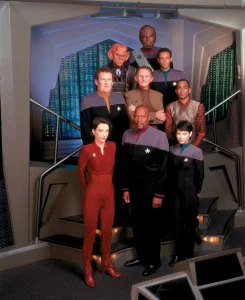
The main complaint fans have had about NuTrek is that it doesn’t “feel” like Star Trek. What exactly this means differs a lot depending on the specific thing being complained about, although the most common frame is the lack of general optimism about the future. Anyone with any familiarity with the franchise though, can immediately tell how the show is different, from the very start of Discovery in 2017. Mainly it’s just really high-stakes, to a degree so extreme it nearly borders on self-parody. You might think that a show titled Discovery would be about, you know, discovering things. But the first episode immediately jumps headfirst into a war. There’s barely even been any time to establish the personalities of the characters before action, anger, special effects blow-ups, and constant disorienting camera angles quite literally take over the entire presentation.
Discovery simply doesn’t look like older Trek, not just because the costumes are shinier and the makeup is more elaborate, but because it’s almost never filmed at a static angle. The major reason why the bridges of various starships in the Star Trek franchise are so iconic is because they are almost always filmed from the exact same shot. This was initially a cost-cutting measure, but over time became a critical part of the Star Trek aesthetic. The visual language made the show easy to understand if you were just flipping channels and happened to run into a random episode. Despite the speculative nature of the premise — voyagers out in the unknown parts of the universe — Star Trek is fundamentally a comfortable show to watch: it’s easy to place characters and understand what motivates them.
Discovery doesn’t work that way at all.
But, despite aiming to break away from the standards of Star Trek, the show was deeply, even obsessively, committed to Star Trek lore and continuity. The main character of Discovery, Michael Burnham, is Mr. Spock’s adoptive sister, a woman who was raised by ultralogical Vulcans. The Klingon War, the Mirror Universe, and Section 31 — all are referenced as if they are obvious things we should all know about despite being marginal lore. The Klingon War is backstory in the original series, never elaborated upon in depth, it just explains why the Klingon race is antagonistic to the Federation. The Mirror Universe, origin of the infamous “evil version of character with goatee” trope, was the topic of Season 2, Episode 4 of the original series, while Section 31 is introduced near the end of the Deep Space Nine series as a special ops unit of dubious moral authority working within the Federation.
Further complicating the relationship of Discovery to the existing lore is that this reboot chronologically predates the original series by about ten years. So not only does it have to do explain all of this world-building in its own context, it had to explain why nothing the Discovery crew did in relation to this continuity was important in the context of the other shows. The show never really attempted to do either though because, and I cannot emphasize this enough, Discovery is scripted more like a film than a TV show, with action-focused and emotional character-based set-pieces having a higher priority than the philosophical and logical quandaries for which the franchise is best known.
By its third season, Discovery was able to evade the frustrations of fans on these continuity questions by causing the crew and ship to jump ahead 900 years in the future, far beyond any established continuity. This solved the specific continuity problem but not the broader one, which is that the characters of Discovery specifically seem disproportionately far more important than anyone else in the setting. Notably, this specific problem isn’t localized to Discovery itself. The second NuTrek series Picard had similar problems, despite the fact that it could lean on iconic characters like Patrick Stewart’s Captain Picard and Jeri Ryan’s Seven of Nine. There were still too many fast takes, too many long takes about nothing, too little discussion of the underlying moral and ethical quandaries of the situation, and too much leaning on the script stating that ongoing events have galaxy-wide implications when the stakes are only barely even established on the local level.
NuTrek promised engaging season-long mysteries, but more often than not, its characters would spend far more time discussing their feelings than doing their jobs. Paradoxically, for a brand that came to prominence precisely because you could catch a random episode on cable and generally enjoy yourself, NuTrek came to demand more investment in the Star Trek brand than seemed reasonable even to Trekkies. Ironically, while NuTrek had trouble posing philosophical questions, its very existence begs questions of what modern fandoms are and what corporate IP holders think they are.

Much criticism of NuTrek, especially early on, was dismissed out of hand because fans were hyper-critical of early seasons of other Star Trek shows too. But where even the often maligned-then-canceled Enterprise has its defenders, NuTrek years later still hasn’t reached that point. Some fans insist that the third season of Picard is good and you can easily skip the first two, but even this is a weak endorsement as the main accomplishment of the third season of Picard was getting the entire original cast of The Next Generation to reprise their roles for one final adventure.
NuTrek was perhaps best represented by the animated series Lower Decks which ran for five seasons until 2024. Its cancellation is still largely a mystery, although given what we know now, Paramount was likely already anticipating a retool. Lower Decks appealed to the Trekkie demographic, but often at the expense of any other possible audience. This is a show for people who can remember offhand what musical instrument William Riker plays on The Next Generation. Its sheer irreverent referentiality in general is evocative of adult animation like Family Guy, pretty much requiring that you at least feel like you’re in on the joke for it to be at all amusing.
In general NuTrek intentions appear to be all over the place, which can make it misleading to refer to a coherent Kurtzman era. A second animated show, Prodigy, was explicitly designed for children, featuring cadets with alien designs too impractical for live action television who were thrust far away from home. Because the reserve necessary for a kid’s show feels a lot like the constraints of 1960s television, Prodigy is probably the closest to the first two generations of Star Trek in terms of tone. While Star Trek was never a kid’s show, it generally avoided overly shocking imagery and is to this day still labeled as G for General Audiences when it airs on television.
But Paramount couldn’t even figure out how to market Prodigy, quickly giving up on the show and just selling it off to Netflix. This is the single oddest thing about NuTrek, is just how genuinely hard it was to get find a broader audience beyond Trekkies. The shows are nominally designed for the widest possible audiences yet consistently fail to land with any of them. About the only nice thing anyone had to say about Starfleet Academy — another recent NuTrek series — was about Robert Picardo’s excellence in reprising his role as the holographic doctor from Voyager, his character now several centuries older in the Discovery continuity and a jaded immortal.
The philosophical ramifications of the ancient doctor are, unsurprisingly, sidelined in favor of more high-stakes action and special effects. One of the many ironies of NuTrek is that despite the expense of the series being a consistent problem, producers seemed to go out of their way to avoid the kind of cost-cutting that would make the shows affordable, having somehow concluded that shiny spaceship battles are what people love most about the brand.
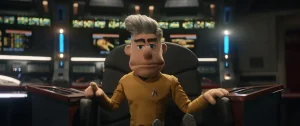
Strange New Worlds has been the main show of NuTrek to buck this trend, and not coincidentally, also has the simplest pitch. It’s the adventures of Captain Pike on the Enterprise, immediately before the iconic Captain James T. Kirk took over. Strange New Worlds has some genuinely excellent classic sci-fi moments: going into concepts like scientific predestiny or a planet that distorts memory in such a way that anyone who visits is inevitably enslaved in a warped feudalism. Unfortunately, the modern need for high stakes action and in-franchise-referentiality still tends to creep in. So the seasons include episodes about doctors going on commando raids against the Klingons or the crew turning into muppets.
A lot of NuTrek’s problems aren’t the fault of Kurtzman or even Paramount at large being a dumpster fire. Rather, they are symptomatic of how contemporary owners of intellectual property are focusing on branding, which tends to presume that the value of a franchise is proportional to how many clicks it can inspire. Strange New Worlds doing anything with Kirk prompts clicks, for example, the result being that even a show that’s theoretically trying to move away from a Kirk-centric conceptualization of the U.S.S. Enterprise keeps dragging him back in anyway.
In this regard, I doubt it’s really possible for whatever comes next for the Star Trek franchise to escape any of the problems that plagued NuTrek. Perversely, the very self-importance of the franchise at this point makes it quite difficult to imagine someone pitching an idea as simple as, “what if a widower accepted a promotion to a backwater space station?” (DS9) What if a starship got thrown far, far away from Federation space and just couldn’t get back any time soon? (Voyager)
The drama in this kind of genre fiction derives more from characters developing in unexpected ways, which just isn’t something that can be done if a full season outline with maximized universe-ending Hollywood climax potential needs corporate approval before anyone even attempts to produce anything.
You May Also Like
-
 March 21, 2022
 -

-
 November 5, 2020
