
The Long, Poisonous Roots of Conspiracy Theories
In his ‘Hidden History’ Andrew McKenzie-McHarg goes back to Machiavelli and wide to ‘Yankees and Cowboys’
Truthers. Birthers. Flat-earthers. The Deep State. False flag operations. Crisis actors. Fake news. Climate change. The Great Replacement. Chemtrails. Pizzagate. QAnon. Anti-vaxxers. The Plandemic. Stop the Steal.
It’s likely you’ve heard of most of these conspiracy theories, and it’s likely you know people who believe one or more of them. (Hopefully you don’t believe any of them yourself. If you do, you may as well stop reading now.) Either way, while they were once consigned to the fringe, conspiracy theories now infect our daily lives.
Because conspiracy theories don’t just ruin the conversation at the holidays. They cause real damage. Consider the parents who, after their children were murdered at Sandy Hook, suffered harassment from the cretins who believe the massacre was faked. Or the people who died during the pandemic because they wouldn’t get vaccinated. Or the ten people murdered in a supermarket frequented by the Black community of Buffalo, New York, in 2022.
The Hidden History of Conspiracy Theory
By Andrew McKenzie-McHarg
Princeton University Press; 696 pages
You get the idea.
It’s tempting to give into a sense of frustrated helplessness in the face of such madness. But we have seen some interesting reporting and research about conspiracy theories, including the emotional needs they fulfill and how we might combat them. I doubt we’ll ever get rid of them entirely, but we do have more tools for understanding the phenomenon.
And there’s still a lot to uncover. One such avenue is explored in a new book from Andrew McKenzie-McHarg, a historian who trained at the University of Erfurt and who researched conspiracy theories at the University of Cambridge. His book, The Hidden History of Conspiracy Theory, has a marketable title, but it’s really a work of serious scholarship — a “conceptual history,” or an inquiry into “how conspiracy theory entered our conceptual vocabulary.” (The list that begins this review is adapted from one that appears in the book.)
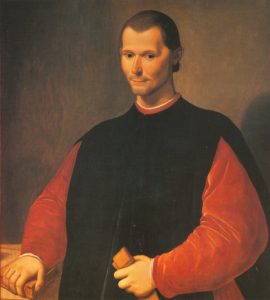
 McKenzie-McHarg sees conspiracy theories as “the entanglement of two distinct traditions: namely apocalyptic prophecy and political analysis.” As illustration, he recounts when young Niccolò Machiavelli went to observe and report on the sermons of Girolamo Savonarola, a Dominican friar and extreme ascetic, who, in the 1490s, preached against earthly corruption and prophesied that Florence, once cleansed, would become a “New Jerusalem.”
Machiavelli was unimpressed, writing to a papal representative that Savonarola divided the world into “two companies: one which serves under God, namely, himself and his followers; the other under the devil, namely his opponents.” (Sound familiar?)
Machiavelli would of course go on to write The Prince, the ultimate how-to guide for achieving and maintaining political power. He also wrote The Discourses on Livy, another political treatise that drew on the history of Rome, with its longest chapter devoted to the nature of actual conspiracies, including how they worked and why they usually failed.
Machiavelli’s political analyses were of course dispassionate, even amoral at times. Which is perhaps why in later centuries he himself turns up as an exemplar of despotism. In 1864, a Frenchman named Maurice Joly anonymously published his Dialogue in Hell between Machiavelli and Montesquieu, one of those texts that critique contemporaneous figures — in this case, Napoleon III — by employing ones from the past.
“I won’t destroy institutions,” Joly has Machiavelli (representing Napoleon III) saying. “Rather, one by one, I will secretly tamper with each of their mechanisms.”
A few decades later, entire passages from Joly’s work were lifted for the ur-text of conspiracy theories, that is, The Protocols of the Elders of Zion, the antisemitic hoax about a Jewish plot to control the world. Indeed, Hannah Arendt herself dismissed The Protocols as “second-rate Machiavelli”; nevertheless, you can still find hateful cranks all over the Internet claiming it’s a document of real historical value.
It’s a fascinating bit of cultural detective work, following the thread of Machiavelli from thinker to symbol, and the appropriation and degradation of his ideas. But conspiracy theories are slippery things, and they can’t only be defined by thematic entanglements. McKenzie-McHarg has another lens: we can see them as emulating “casework,” that is, the forensic analyses common to legal, medical, or criminal cases, only with the reasoning “unmoored from the attitude of neutral detachment.”
 The description makes sense, especially when you consider the “crazy wall,” the notes pinned to a board with overlapping strings to show the “connections.” But there’s an etymological origin as well. In the nineteenth century, the phrase “conspiracy theory” did not yet suggest outlandish speculation. It was actually a way of theorizing about a crime — for instance, an 1881 editorial entitled “The Conspiracy Theory,” which appeared in the St. Louis Daily Globe-Democrat, dismissed the idea that President Garfield’s assassination was the result of a power struggle within the Republican Party, rather than the result of lone gunman. (Sound familiar?)
The coinage of the exact term “conspiracy theory” is often credited to the philosopher Karl Popper, who used it in a 1948 lecture, “Prediction and Prophecy in the Social Sciences.” However, Popper wasn’t talking about tinfoil hats; he was critiquing the “conspiracy theory of society” as exemplified by the specific teleology of Marxism: “the view that the story of mankind has a plot, and that if we succeed in unraveling this plot, we shall hold the key to the future.”
In a similar vein, the political scientist Franz Neumann critiqued the “conspiracy theory of history” in a 1953 lecture at the Free University of Berlin. Neumann was inching closer to how we currently define conspiracy theories by outlining the similarities of logic, or illogic, in supposed conspiracies by Jesuits, Freemasons, Communists, Capitalists, and Jews.
Here, I should add a tangent illustrating the fascinating ironies that accompany any study of conspiracy theories. Neumann started his career as a labor lawyer in the Weimar Republic. When the Nazis took power, he saw the writing on the wall and fled to England, then the U.S., before eventually ending up at Columbia University. Among his many achievements was Behemoth, a study of the power structures that supported Nazism. During World War II, he worked for the OSS, the precursor to the CIA, and then, in 1950, his name was number 59 out of 81 on the list of “loyalty risks” compiled by Senator Joseph McCarthy.
Neumann’s friends and colleagues were indignant. But after the fall of Communism, when the Soviet archives were opened, there was indeed documentary evidence that he spied for the Soviets. In Neumann’s defense, he wasn’t very good at it: one handler complained that he was “a bit of a coward” who did “practically nothing.”
Back to the task at hand: how did “conspiracy theorist” become shorthand for the basement-dwelling obsessive? McKenzie-McHarg suggests it was partially due to Neumann’s younger Columbia colleague, Richard Hofstader, and his 1964 Harper’s essay, “The Paranoid Style in American Politics.” While Hofstader was building on some of Neumann’s ideas, he was adding psychiatric concepts in an admittedly pejorative sense. According to McKenzie-McHarg, it was this connection between social science and individual psychology that eventually led to the idea of “conspiracy theorists” as a kind of aberration. The “paranoid style” wasn’t merely a perceptive descriptor; it was also a diagnosis. And after the Kennedy assassination and the proliferation of “theories” about the murder, it became easy to use the term “conspiracy theorist” with dismissiveness.
Of course, I’m simplifying McKenzie-McHarg’s own perceptive arguments in the interest of brevity, and those who are interested in the topic will learn a lot from this lengthy book. Bear in mind, though, that The Hidden History of Conspiracy Theory is an example of academic writing. The author frequently (a) reminds you what he wrote about, (b) tells you why he wrote about it, then (c) tells you what he will write about next. He includes quite detailed intellectual biographies of Neumann and Hofstader, as opposed to just pointing out the relevant bits of their work; and, along with these heavies, he gives equal weight to Carl Oglesby, whose “Yankee and Cowboy Theory” attempted to explain American power in terms of Eastern old money (the Yankees) and Sun Belt new money (the Cowboys). I’m not sure why Oglesby’s own conspiracy theory warrants so much attention.
One final point: McKenzie-McHarg rightfully adds that many academics eschew the term “conspiracy theory” because it has the pejorative baked into it. I get it: it’s difficult to claim objectivity if your term for the object of study is dismissive, much like religion scholars avoid the term “cults” for harmful sects.
However — and this is beyond the scope of the book — I would add that conspiracy theories are not just an intellectual failing. They are a moral failing as well. Of course, conspiracies are a real phenomenon. (Look up the tobacco industry or the Tuskegee Experiment.) But conspiracy theories, for want of a better term, also cause great harm. Measles, among other preventable diseases, has come roaring back due to vaccine hesitancy; “Stop the Steal,” a.k.a. “the Big Lie,” inspired a violent attack on the Capitol Building. And somewhere in America, some enraged crank is consuming content about the “Great Replacement” and polishing his long gun.
You May Also Like
-
 October 25, 2021
 -
 November 19, 2025
 -
 March 17, 2025
