
Calling all Byrd Watchers
A Sarah Jessica Parker production portrays the sex-positive influencer who preceded social media
There’s a scene in Bang My Box: The Robin Byrd Story where Annie Sprinkle tells Byrd she needs to think about her legacy — that she’s a sexual pioneer, that some college should be preserving her archive, that this is a woman who spoke out during the AIDS crisis and fought for free speech while a lot of people shut up and did what Reagan told them. Byrd did not. She called herself the “Orgy Queen,” swam against the mainstream in her crocheted bikini and gave the world everything she had on public-access television — to the agony of the Republican Party.
The thing about Robin Byrd is that you probably don’t know her. And yet she’s the prototype for internet culture.
Premiering June 30 on HBO and streaming on Max, Bang My Box: The Robin Byrd Story chronicles the life and legacy of the New York public-access host whose late-night call-in show became an unlikely home for free speech, LGBTQ visibility, sex-positive conversation, and AIDS education during the culture wars of the 1980s and ’90s. Directed by Jyllian Gunther and Stephanie Schwam and executive produced by Sarah Jessica Parker, the documentary blends archival footage from Byrd’s more than 600 episodes with present-day interviews as she reflects on her career while caring for her husband, Shelly, who is living with dementia.
The immediate assumption from the trailer is that it’s going to be one long sex-fest, something graphic every five minutes. It’s not that at all. It’s a love letter to Byrd’s place in history and her imprint on the culture. Though still not widely known, she was pushing for gay and transgender visibility long before it was mainstream, and doing the same for adult entertainment, and for all the “Orgy Queen” bravado, the film has a ton of heart.
What I loved about the documentary was that it allows Byrd to breathe, to be comfortable showing her life now, but also have a large love for her past, too. I was also impressed with how the filmmakers constantly dodged a straight line of the obvious one note idea of “sex, sex, sex” but instead humanized Bryd as someone who needs to be celebrated. Sarah Jessica Parker getting involved was a curveball I wasn’t expecting but honestly, she’s a New Yorker, so that makes perfect sense as it’s a part of her culture. (I’d feel the same way about Chicago’s iconic Svenghoolie.)
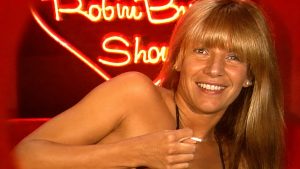
Because here’s what the documentary quietly argues: public-access television was the original social media. The internet likes to think it invented authenticity, parasocial relationships, and creator communities. Robin Byrd was doing all three decades before anyone begged for a like and a follow. Byrd wasn’t just a public-access host — she was doing, in the 1980s and ’90s, exactly what creators do today. Building a personal brand. Talking directly to her audience. Taking live calls. Mixing activism with entertainment. Building a community around a personality instead of an institution. Her audience wasn’t tuning in for a network or a brand. They were tuning in for her. That’s the DNA of today’s creator economy.
But because Byrd was the first to do many of these things, she had none of the global support that helps today’s creators. She was a New York legend, an outsider who crashed into the lives of the five boroughs. For more than 600 episodes, until she stepped away on her own terms — facing an aging body and, honestly, just getting tired — she turned Channel J into a late-night dance party, a call-in confessional, a place where strippers and porn stars and lonely insomniacs could talk openly about sexuality before anyone carried a camera in their pocket. It wasn’t a hard-hitting news magazine. It became something just as culturally valuable: a space where outsiders could see themselves reflected at a time when mainstream television wanted nothing to do with them.
You May Also Like
-
 June 11, 2024
 -
 November 23, 2018
 -
 April 17, 2023
