

Office Worker Goes Crazy To Uncover a Chair Conspiracy
If not simply funny, Tim Robinson remains our most anxious prophet of modern absurdity.
Celebrity comedians aren’t exactly relatable figures, as was seen by the recent controversy over the Riyadh Comedy Festival. Regardless of where you stand on the ethics of celebrities getting paid to entertain in feudal oppressive states thus legitimizing/liberalizing them, it showed how comedians, at least the successful ones, have trouble presenting themselves as down-to-earth folks when their actual motivations are incomprehensible to their audience. Tim Robinson of I Think You Should Leave fame is an anomaly in this context. He’s a successful comedian, but not only is he not relatable, his bits are so panicked and specific, it’s not clear that cares if anyone else is in on the joke.
This is the backdrop from which The Chair Company on HBO Max is best understood. There Tim Robinson plays Ron, an older guy pushing at higher management at the property development firm Fisher Robay. Ron doesn’t exactly love his job — indeed, a flashback in one of the newer episodes shows him, in an ambiguously half-joking tone, shouting about killing himself if he ever had to go back to work there. But, in the way that most people tolerate workplaces to earn a living, Ron can tolerate Fisher Robay.
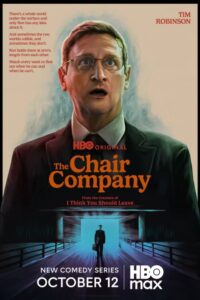 What makes Ron go crazy isn’t the job itself, which he muddles through surprisingly well given his increasing psychosis. Rather, he becomes obsessed with the titular chair company, TECCA, which produced a chair that inexplicably collapsed under his weight at a big company presentation. The social blowback to Ron from that presentation was minimal. What starts to drive Ron crazy is how impossible it proves for him to send a formal complaint to the company that makes the chairs? What are they hiding? And why are they threatening him?
Most of us have not, in fact, gotten into a protracted customer service dispute with a chair company. But many of us have gotten into a protracted customer service dispute with some company which might have theoretical contact information yet never responds to our calls or e-mails, and just lets us linger in robot hell indefinitely. And, despite the weirder elements of The Chair Company, whether it’s tearaway shirts, or podcasts about guys yelling angry insults at nothing in particular, or porno based on A Christmas Carol, Ron’s anxious panic continues to ground The Chair Company in the real world.
How do any of us function in a world where any sort of incidental action prompts either a complete overreaction or is just completely ignored by someone who doesn’t think they owe anyone an explanation? Ron’s genuinely otherworldly encounters with convoluted threats from TECCA are sharply contrasted with weird, petty subplots at work, like the exhausting and pointless human resources meetings Ron has to attend after accidentally seeing up a co-worker’s skirt. Or an employee adamant about getting people to attend his party, where they will be allowed to commit mistakes.
Fisher Robay isn’t The Office, a workplace where quirkiness is fun and typically features no consequences worse than a Jim reaction shot. The quirkiness is deeply weird and uncomfortable, coming from each individual character’s motivations which are mostly unknown because they’re all co-workers, not friends. Plus, unlike The Office, Ron understands that he’s their boss.
The cold open for the sixth episode breaks this format of enforced ignorance, as it provides the background explanation for why Ron’s own boss, Jeff Levjman (played by Lou Diamond Phillips) is suddenly demanding a new direction for the property development project that he seems entirely incapable of articulating or explaining. This background is nowhere near as helpful as it initially seems — the short answer is that Levjman has his own anxieties, he’s just better at hiding them. Any long answer remains obscure.
Hiding one’s anxieties seems to be a prerequisite for functioning in the modern world. And Robinson shows that to best comic effect in the first episode when the janitor becomes convinced that Ron is the guy complaining about his use of the wheelbarrow. Why a janitor would want to use a wheelbarrow is no mystery, it’s a helpful tool for moving large objects around. Yet all it takes is one person giving the janitor a hard time about wheelbarrows, and boom. Anxiety, and even existential dread about just how many other people are suffering from similar anxieties, is oddly funny because of course the situation may seem deadly serious to the janitor, but to Ron, or pretty much anyone else, it’s impossible to imagine how anyone could care so much about anything so petty and specific.
One of the neater aspects of The Chair Company in regard to Robinson’s oeuvre is that pretty much every other character gets their own Robinsonesque style subplot, where they’re just really obsessed with something and struggling to come up with a plausible excuse to explain themselves. This puts the actual Tim Robinson in the funny metatextual place of frequently being the straight man in his own style of comedy. But, as is typical for those bits, merely being exposed to other characters’ anxieties doesn’t do much to get Ron to empathize with their strange problems.
This, even as Ron continues to fixate on the chair company more than his job or his family, both of which he genuinely cares about, because the chair company feels like an all-encompassing explanation and solution to every incomprehensible mystery of his daily life. Which is also why conspiracy theories appeal to people in general. It’s deeply unsettling that people like Jeffrey Epstein could exist, but the existence of evil alone isn’t a new idea. The real fear is that no one will do anything about evil, because our society is set up in such a way that no one can.
A chair company that makes defective chairs and goes to weirdly elaborate lengths to pretend to be an accountable corporate entity isn’t exactly functioning as Hitler’s handmaiden. Nevertheless, Ron thinks he might at least be able to do something about the chair company: something meaningful in a meaningless world. Trying to manage this same anxiety through taking action is what animates countless unironic thrillers about older men abruptly uncovering a conspiracy of some sort and becoming an action hero.
The big difference between The Chair Company and, say, Total Recall, aside from all the obvious ones, is that Ron is motivated less by the power fantasy and more by the existential horror of the fact that his awkwardness isn’t just his awkwardness. Someone, somewhere, forced him to be like this. And it would be comforting for him to have some idea why.
You May Also Like
-
 November 7, 2018
 -
 February 24, 2019
 -
 January 16, 2019
