
Ari’s Flying Monkey Ride Through Oz
Audiences leave this ‘Wicked’ sequel feeling more pink-and-green than truly emerald
We’re off to see the Wizard one more time, movie fans. Wicked: For Good has arrived to complement and complete last year’s box office hit Wicked: Part One, which was famously only the first act of Broadway’s enduring mega-musical. And while the crossover theater crowd might adore this glitzy Act Two, general audiences won’t be quite as goosified or obsessulated. Wicked: For Good suffers from a weak story that barely develops the vigorous plotting and subversive themes of its plumped-up predecessor.
The diminished sequel rehashes the same frenemy tensions between beloved try-hard Glinda (Ariana Grande) and goth rebel Elphaba (Cynthia Erivo), trumps up the political manipulations from the charmingly wily Wizard (Jeff Goldblum) and mendacious Madame Morrible (Michelle Yeoh), while wedging Kansas transplant Dorothy and her trio of incomplete men into the background narrative like a Frank L. Baum-icized Rosencrantz and Guildenstern.
Wicked: For Good ★★★ (3/5 stars)
Directed by: Jon M. Chu
Written by: Winnie Holzman, Dana Fox
Starring: Cynthia Erivo, Ariana Grande, Jonathan Bailey, Ethan Slater, Bowen Yang, Marissa Bode, Michelle Yeoh, Jeff Goldblum
Running time: 137 mins
“Beware the Wicked Witch!” declare fliers showered upon fellow Ozians, whose Emerald City is covered in propaganda banners touting GLINDA THE GOOD and THE WICKED WITCH in respectively preppy pink and green. The bitch is back, in other words, as the green-skinned, black-bedecked, broomstick-flying terrorist continues to run amok — this time, doing her best to sabotage the building of the Yellow Brick Road, a major civic construction project involving beasts of burden whipped and abused into forced labor.
Elphaba continues her animal rights activism in vain. EXPOSE THE WIZARD, we see in big red letters on the wall of her cluttered forest lair: SAVE THE ANIMALS. Why she has these slogans emblazoned on her home is anybody’s guess — self-actualizing statements on her vision board? — but she’s one person against an indifferent Oz, and her pleas fall on deaf ears. The animals, vilified as a scary “other” that the populace needs to fear, are fleeing Oz in droves through a tunnel that leads to a desert land beyond. Elphaba can’t convince them to remain, and they keep telling her to leave with them. Why should the Wicked Witch stay in Oz? It’s a fair question. Elphaba’s response: “There’s no place like home.” Cute callback, but kind of unconvincing.
She keeps trying to sway public opinion and finds it tough to do while dressed in black and soaring over people’s heads on a broom, skywriting dark declarations like “OUR WIZARD LIES.” And that’s before the scheming Morrible magically alters her message to read “OZ DIES.” Meanwhile, Elphaba’s sister Nessarose is now the new governor of Munchkinland, having been elected to that position after their broken-hearted father died of shame from Elphaba’s antics. Nessa is hardly an enlightened ruler: She feels obliged to pass xenophobic anti-animal legislation in order to curry favor with the Wizard and, when her hard crush Boq (Ethan Slater) admits that he doesn’t love her and wants to break up, Nessa passes a law forbidding Munchkins like him from leaving without proper documentation. Carrying out cruel, vindictive, and personal legislation — what a wicked thing to do! At least in the latter case we can blame heartbreak.
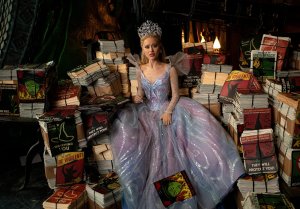 Boy trouble is at the core of Wicked: For Good, not only for Nessa — whose vengeful acts against Boq lead to her becoming the Wicked Witch of the East — but for Glinda and Elphaba too. Those two end up fighting over hapless hunk Fiyero (Jonathan Bailey), since he refuses to be forced into wedlock with Glinda and would rather duet with Elphaba in her boho boudoir. Get ready for bared green legs, sexy midnight lingerie, and a bedroom confession: “Now I do feel wicked,” she says with a smile. ZING!
The Wizard, as he himself tells them, is the carny selling the blarney, but he’s essentially powerless compared with the truly sorcerial Elphaba. Powerless too is unmagical Glinda, whose charisma is her only talent. Morrible gives her a vehicular spherical globule — aka the bubble she uses for transit — as a way of making the public think that Glinda actually has magical abilities. “Let them assume!” says Morrible, who also gives her a prop wand to really sell it. It’s not lying, we’re told; it’s just looking at things in a different way.
Morrible is the true power broker who controls Oz. But Elphaba possesses the Grimmerie, the Wizard’s ancient spellbook, and Glinda enjoys the love and fidelity of the people. They could both take down the Wizard and Morrible, yet they seem more fixated on fighting over Fiyero and feeling victimized by their circumstances. The only tragic dimension to the story is the fact that Elphaba’s powers are directly responsible for creating the Tin Man and the Scarecrow.
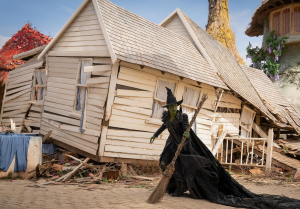 Speaking of which: both Glinda and Elphaba seem annoyed by Dorothy and her travails, each of them delivering cheeky asides to her whenever she’s conveniently off-camera. “Bye Dorothy! Bye Toto! It’s just the one road the whole time,” Glinda says at one point. That kind of lip service to Baum’s iconic characters trivializes the source material, especially when that original story gets braided so artlessly into the musical.
The production wavers in intensity. Elphaba has no castle guards in her empty castle, Munchkinland has no Munchkins surrounding Dorothy’s house. The locations are oddly bereft, as the film focuses its maniacal attention on the same four characters. Glinda and Elphaba should team up to defeat the Wizard and Morrible, but their reticence is never really convincing. The power duo would rather just sing weepy songs about their own lot in life. “They need someone to be wicked, so you can be good,” Elphaba tells Glinda at the end, as both accept their fate with defeated shrugs.
In what seems to be a blatant play for a Best Original Song Oscar, Wicked: For Good debuts two new tunes, one of which is the Stephen Schwartz-penned Glinda ballad “The Girl in the Bubble.” It’s a charmingly corny on-the-nose sentiment for the character. But it’s also a pretty fair way to describe the film’s hermetic lack of perspective on its own story. So much for “looking at things in a different way.”
You May Also Like
-
 April 1, 2021
 -
 November 22, 2021
 -
 June 24, 2024
