
Michael Cunningham Writes the ‘Unsayable’
The Pulitzer winner for ‘The Hours’ looks back on a life of authorship
Now 76, Michael Cunningham who grew up in sunny Southern California, became a literary superstar at the tender age of 46 for his Pulitzer-Prize winning novel The Hours when it became a hit film starring Julianne Moore, Meryl Streep, and Nicole Kidman as Virginia Woolf. It closely follows the harried lives of three women over the course of a single day across different eras: Woolf in the 1920’s, a frustrated suburban housewife based on Cunningham’s mother from the 1950s, and a modern-day editor in 1988 who all struggle with the impossible demands of womanhood. One wonders if winning the Pulitzer so fast was as much a curse as a blessing. What could possibly constitute a successful encore?
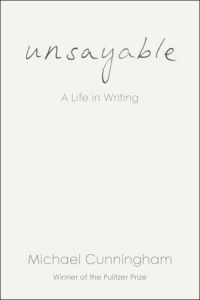
Cunningham’s new work of nonfiction, Unsayable A Life in Writing attempts to tell us how he fared. The book contains a series of short, moving meditations, generally no more than two to three pages, in which he tries to recall the emotional impact of certain events throughout his tumultuous life. Cunningham knows — as many older people do — that remembering can be dangerous, and we watch him dip his toe into forgotten waters and pull back when things feel too treacherous.
Even though he concedes that all his fiction is imbued with autobiographical elements, his work here as a memoirist often feels like uncomfortable territory for him. Cunningham admits he has ambivalent feelings about this new work, and we wonder if he is being prodded to do this by an overeager editor since there are strands of reluctance throughout his remembrances. Despite his hesitation we learn soon enough that Cunningham is a marvelously engaging writer whose sentences are filled with sensitivity, lyricism, and unbridled empathy.
Unsayable A Life in Writing
By Michael Cunningham
Random House; 304 pages
He begins with a beautifully tender story about his childhood fascination with Tupperware remembering “the endless delight the tiny suction sound each piece emitted when I pried it off.” His beloved mother would leave the Tupperware containers strewn about on the floor so he could see them when he came downstairs. Cunningham believes it was primarily his mother who was responsible for giving him a healthy dose of compassion. She also was instrumental in helping him develop his love of language: identifying for him every object he noticed when they took walks together. He recognizes they had a special connection: “I don’t think we spoke — we understood, even then, that some of my desires could be satisfied but were better left unnamed.”
 Cunningham would grow up to be a gay man forced to navigate treacherous waters during the height of the AIDS catastrophe. We can hear in this stunningly moving piece Cunningham’s sense that his mother understood him long before he understood himself and how this later helped him face innumerable hurdles as a gay man.
Other pieces are less successful. In one recollection, he describes his family which consisted of him, his sister and their parents as outwardly unremarkable. It bothered him that his father was “present but not present.” His mother whom he thought to be a tragic-looking beauty would talk anxiously non-stop during family dinners as if her voice alone could keep their family from imploding. But her charade didn’t always work, and sometimes his father would break into a rage, castigating her for coming from a lower-class family. We want Cunningham to linger here to show us how this pivotal scene of family disintegration was a precursor of some of his later dysfunctional relationships, but he shows no inclination to do so. It’s obvious he doesn’t want our sympathy or perhaps he even fears it. Regardless, he flies away from this most disturbing revelation as if the memory itself still possessed the power to dismantle him.
Cunningham is more interested in survival and tells us how he managed to overcome his own childhood trauma often by inventing tall tales about his family when he was an undergraduate at Stanford. He considers why he might have felt compelled to do so: “I suspect many of us reinvent our families as we grow up. We consider them either more or less than they were, more harmonious or more embattled, more neglectful or solicitous. The only difference with writers is we set down our imaginings as the official version. It’s probably best, for families, if none of their children grow up to be writers.” Cunningham seems to find more fertile ground for personal exploration in his fiction that allows him to express his personal angst under cover.
Cunningham’s aim here is not to write an autobiography but rather search his mind for transcendent moments that had an impact on all that followed. He wants to find “the essential details of my life” or the “integral parts of my autobiography.” But this sounds like a cop-out of sorts. We often find ourselves wanting more. We miss the grounding and context a more traditional autobiographical rendering allows us. We want the opportunity to bond more deeply with him, and these often too brief reminiscences leave us feeling shorted.
Furthermore, only his point of view is presented, and this too is a serious loss for the reader. When he mentions his partner of over 40 years, Ken Corbett, a psychoanalyst, he describes their union as happy and creative and leaves the intricacies of their long-time partnership absent from these pages. He briefly tells us about earlier relationships that quickly dissipated. He doesn’t explain their love, or how it is experienced in real time. Corbett remains unknowable and this makes it difficult for us to envision who they are together as a couple and why they have endured. It feels strange to leave Corbett out in the cold when he is clearly a seminal player in the author’s life. We aren’t sure what prompted Cunningham’s decision to do so. Is it out of respect for their privacy? Or are their other concerns? Whatever the reason, it leaves a gaping hole that begs to be filled.

There’s one story from this collection that grabs hold of us and doesn’t let us go. It has to do with his first close friend Elliott and how they bonded at summer camp over their shared enjoyment of Bob Dylan and The Doors. Cunningham realizes he was always in love with Elliott, recalling how it was Elliott who volunteered to drive him to Stanford and left him there with a limp good-bye. He never saw him again.
When he appeared at Elliott’s funeral years later, he recalls speaking with Elliott’s beautiful wife Suzanne who seemed not to know who he was. It stung Cunningham that Elliott wouldn’t told his wife about their searingly close adolescent friendship. Despondent, he walks back to his car only to hear a moment later Elliott’s wife whisper to someone that perhaps he was “that Michael.” But he doesn’t turn back. He drives away. There’s something about this recollection that is so poignant it tears at your heart and makes you want to tell him that within this remembering are all the essential components he might need for his next novel.
But Cunningham returns to a more banal voice soon enough. He writes about giving advice to upcoming writers. He tells us how we must find palpable details in our character’s lives. He stresses the importance of having your protagonist want something. He admits writing never gets any easier. He believes workshops and seminars are helpful telling us about his own productive experience at the Iowa Writer’s Workshop when he was 26. He recalls the thrill of being published in The Atlantic, and then in The Paris Review. Readers might also be familiar with some of Cunningham’s other novels written after The Hours, such as A Home at the End of the World (1990), which is about two childhood friends, one straight and one gay, who bond with an eccentric lady named Clare. And his 2010 novel Nightfall which chronicles the life of a middle-aged man consumed with lust for his wife’s younger brother. His stories are often about characters who step out of bounds.
But we aren’t listening to his final tidbits of counsel. We just want to know more about Elliott.
You May Also Like
-
 October 15, 2021
 -
 September 20, 2018
 -
 January 21, 2019
