‘Brailled It’ Shows the Unusual Possibilities of Blind Filmmaking
New doc captures the awkwardness of being a blind teenager at the 2024 Braille Challenge
At first glance, the very concept of a film from the perspective of blind students at a national Braille typing competition seems intrinsically flawed. Film is, after all, an inherently visual medium but one of the first things Brailled It establishes is that despite the fact that blind people can’t see, this doesn’t alter how they think about the world as much as you might expect. I did a double take when one early conversation between students features them using the word “see” for “understand” despite the fact that they cannot, in fact, “see” anything.
Directors David Grabias and Brendan Schulze took a novel approach to filming the 2024 Braille Challenge. They handed out a number of cameras including ones to Salome Cummins, Isaiah Gauthier, and Christopher Morgan, and just told them to turn the cameras on and off whenever they felt like it. Those three came up with the most compelling, usable material, meaning their stories are spotlighted, while other competitors only make brief cameo appearances.
Brailled It ★★★★ (4/5 stars)
Directed by: David Grabias, Brendan Schulze, Salome Cummins, Isaiah Gauthier, Christopher Morgan
Running time: 73 minutes
Most notable of these cameos is Brooke Petro, because she has adorable footage of her conversations with Morgan. These chats reveal their obviously huge crushes on each other but — in the crowded context of a hotel-hosted Braille typing competition — these stolen pretexts to talk to each other are about all they can do.
Cummins features a different kind of teenage angst, as the hypercompetitive overachiever is obsessed with being the best and trying to work out which appropriate rival she must overcome to win. I was surprised at how mingled my feelings of disgust and sympathy were while witnessing her in the final stages of the competition. I can remember being the kind of obnoxious teenager who over-obsessed about setbacks that no one else cared about. But, along with the film’s audience, I slip more easily now into the role of the adult trying to convince her to simmer down without sounding condescending.
There’s an art to capturing these teenage mindsets. Except for Gauthier, the kids in Brailled It are messy, awkward, and weird. He isn’t quite through puberty yet, and it shows. Not just because his camera hangs unfortunately low and rarely captures anyone’s face, but just because he has a sunnier, more optimistic disposition about everything. He’s still a kid who’s just happy to be here!
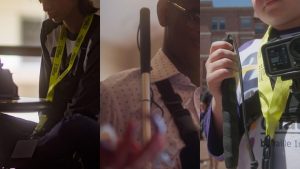
Brailled It says almost nothing about what it’s like to be blind in the abstract nor anything about the competition at the ostensible heart of the film. After watching the film I barely understand how braille typewriters work. Nor do I really understand the exact rules, I only know that they’re logical and fair to the competitors because they never complain about them. But it does capture the feelings of these teens.
Despite the seemingly exotic presentation of Brailled It — its exclusive use of amateur photography by teens who quite literally can’t see what they’re doing, and its use of closed captioning in the form of a narrator describing all the visuals, everything about the way these kids behave feels natural. They read more as typical teenagers than as blind teenagers. Well, at least, typical for teenagers nerdy enough to be national qualifiers in a fundamentally academic competition.
But none of this stems fundamentally from the fact that they’re blind. The main influence being blind has on their attitudes is to the extent they’ll make dumb jokes about it, in ways that might come off as offensive if a sighted person were to say it. Like say, the old Scripture verse about the blind leading the blind. Brailled It is also, incidentally, a spotlight on religious teenagers, who are also fairly underrepresented in media at large, and treated fairly ignorantly on the rare occasion they do show up.
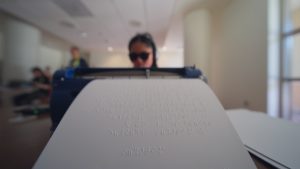
The teens in Brailled It, though, are self-deprecating about their identities without letting those identities define them. They bicker with siblings and treat their canes as extensions of themselves rather than symbols of adversity. It’s telling that of all the characters, Cummins is by far the most stressed, but her frustration is not that her eyes don’t work, but that she might not be the absolute best at the Braille Challenge.
Brailled It isn’t perfect. At the end of the day, it looks entirely unlike other films, but there are lots of technical drawbacks. Though edited by Grabias and Schulze this is a documentary made up entirely of footage that was shot by blind people. The opening crawl straight up has to apologize for the fact that a lot of the footage is bouncing around at chest level. By complete accident some of the hotel footage gives off liminal space vibes simply because this kind of mundane material isn’t usually put on film even though any non-blind person who has ever stayed in a hotel knows what a hotel is supposed to look like.
Grabias wisely keeps the runtime short, the 70 minute runtime making the most of the best footage and keeping the gimmick from outstaying its welcome. Grabias also has the class to extend co-director credit to his three blind stars. This explicitly signifies what is already quite obvious in the film itself. That they are collaborators in this project, not subjects who are being passively observed by all-seeing sighted people.
You May Also Like
-
 March 13, 2025
 -
 April 16, 2021
 -
 March 11, 2020