‘Defying Tyrants’ Asks What is Christian Nationalism Anyway?
Matthew D. Taylor’s new book blames the antichrists (sic)
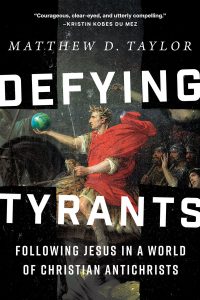
Over the past three decades, Christian nationalism has gone from being considered an extremist fringe to being included in extremist mainstream party coalitions. Recently, the movement has largely thrown its lot in with MAGA, while elements have even deified convicted rapist Donald Trump, which can lead to absurd imagery. Defying Tyrants, the new book by Matthew D. Taylor, a visiting scholar at Georgetown University’s Center on Faith and Justice, looks at the movement by taking a deep dive into what it even means to be Christian.
Taylor argues that Constantine’s famous conversion in the fourth century wasn’t just Christianity going mainstream, but the first step in a long-running theological reversal of Jesus’s original anti-Caesar messaging, a theme easily understood by early Christians used to speaking in code to avoid antagonizing the Roman Empire but largely lost in the present day.
It’s strange that we don’t generally think of the New Testament as being anti-Caesar. By any reasonable reading of the text, this is a story about Jesus preaching against the oppression of the Romans against the Jews and eventually being killed for that defiance. Later interpretations have, if anything, treated Pontius Pilate sympathetically as a random bystander while the Jews demand his crucifixion. It’s a very odd way to frame an extremely cruel, casually inflicted method of execution which by all accounts the Roman Empire often used at the slightest excuse to terrorize its colonized population into compliance.
Among other culprits, Taylor points the finger at Martin Luther for this peculiar interpretational shift. The Protestant Reformation was a big influence on the then-ongoing 15th century European game of thrones where claiming to inherit the spiritual mantle of Rome was a powerful political argument for legitimacy. By shifting blame from the powerful Roman Empire to the occupied Ancient Israelites, Christians like Luther could cozy up to power by picking on a weak minority and validating rule by force. The long dark arc of this philosophical argument unsurprisingly arrives at Godwin’s law. Even if you couldn’t really call the Nazis Christians, Taylor shows, they literally cited Luther as a source to justify their antisemitism in the early days of what would become the Holocaust.
Defying Tyrants
Matthew D. Taylor
Broadleaf Books; 246 pages
In Taylor’s conceptualization of Christianity, based on a strict, 1st century CE interpretation of the text, the message of Jesus is purely anti-hierarchical. Less against Rome than against Caesar. Here, Taylor contextualizes the very early days of Christianity in terms of the Roman state religion. It wasn’t just a matter of the Roman religion being polytheistic. It was also a matter of the Roman Emperor literally being a God in His own right.
Taylor goes into the full ritualized state religion of Rome, which didn’t just worship gods like Jupiter and Pluto, but treated Caesar himself as a deity. The coins with a Caesar on them are a form of idolatry. In Taylor’s telling, these coins are symbolic of Christ’s message about how the Roman Empire is corrupting the entire world with its brutal cruelty, forcing people to buy into a polity or face being nailed on a cross to die horribly for their defiance against the state.
Taylor discusses at length the famous passage of “render unto Caesar what is Caesar’s” and argues that this not a simple message to just pay your taxes but rather a comment on the separation of religion and state in an Empire where the head of state was a god. Jesus, by contrast, is God incarnate because it is the act of the suffering which is truly divine providence. Emperors come and go, as do their empires. But suffering is eternal. And only a truly divine figure can put an end to that cycle once and for all as Jesus did.
What then, do we make of Constantine’s conversion to Christianity? As was noted by other Christians at the time, Constantine did not end the Roman Empire. At best, he just ended the persecution of Christians. This obvious contradiction is how Taylor explains the existence of Christian nationalism, not as a particularly new idea, but a theological quandary that’s been around since Constantine. Christian nationalism in this context could perhaps be better understood as Christian-flavored Nationalism: not a religious movement, but a nationalistic movement where the trappings of Christianity are repurposed to enhance state credibility.
In addition to being critical of Luther, Taylor also takes a dim view of the various Protestant schisms of the Reformation, noting that their main grievance with the Catholic Church was less to do with belief or institutional hierarchies and more to do with wanting more power or money. Greedy figures like Henry VIII and John Calvin just wanted more stuff for themselves, and openly described as themselves entitled to more by divine providence.
By using the excuse of being God’s anointed Calvin took over Geneva, and Henry used a new twist on the Divine Right of Kings to place himself as both head of state and head of the newly-established Anglican church. This entire self-authorizing line of thought was the premise of Caesarian rule. It’s why caesars described themselves as gods. Taylor notes, incidentally, that to describe the caesars as gods isn’t entirely wrong. They were, from the perspective of ordinary people, pretty indisputedly all-powerful. To paraphrase a more recent caesarian figure, the Roman emperor could stand in the middle of the Second Temple and kill somebody, and they wouldn’t lose any support. This was indeed, pretty much exactly what happened, though the killing was by the son of the Emperor.
Taylor chooses 1st century history for good reason — the original audience of New Testament writings would have been well aware of the context of the daily lives of its characters. The scribes who put it out did not need to describe explicitly the tremendous power imbalance. First because it didn’t really need to be, and second because early Christians made a point of coding their language so that they wouldn’t be crucified themselves as long as Roman authorities were unsure whether Christian writings were attacking the Roman state. Taylor even manages to make the notorious Book of Revelation quite coherent in this historical context, contrasting it to the Jewish tradition of apocalyptic literature, noting that tyrants like Nero (“Nero Caesar” transliterates into Hebrew as nrwn qsr whose numerical values add up to 666.) are self-destructive in the long run.
Seemingly easily defined terms like “Roman” or “Christian” are muddied in this context. Taylor describes the competing theological ideas here as more like “Caesar” and “anti-Caesar” to describe what Jesus was talking about. Namely, that the caesars presented themselves as the original messiahs, the original creators of euangelion, the “good news” that we today understand as a purely Christian invention. Jesus stole this messaging and inverted it. He was the true God, not because of his power, but because he could endure any cruelty and never hate his enemies. He provided an alternative messiah to the caesars: he wasn’t just the entity who saves the world, but the entity who taught us to understand that cruelty disguised as virtue was the real illusion.
Emphasis on illusion. One of Taylor’s more intriguing arguments in the text is that we as a modern culture completely misunderstand the concept of the antichrists. In the first place, the anti-Christ isn’t a singular person. The word is actually typically used in the plural form. Second, antichrists aren’t external enemies. The story of Jesus — whose title “Christ” is an alternative title to “Caesar” — is already the story of external enemies. Antichrists would not warrant special mention if that is all they were. No, the antichrists must be understood as the counterparts to the anti-Caesar. Jesus was the anti-Caesar, in that he cloaks himself in the language of euangelion to claim divine birthright when he is actually a lamb, rather than a lion.
Invert that idea again, and we get the antichrist(s), those who claim to be lambs when by any reasonable definition they are lions. When Christian nationalists take the mantle of victimhood, for example, claiming to be oppressed in their own countries, they do so to violently fight back against this perceived discrimination. But this isn’t what Jesus did. Or at least, the fighting back wasn’t the important part. It was the submission to the greater will of the universe, understanding the ephemeral nature of struggle and memorializing dead victims to shame the conquerors. Jesus taught humility and grace against oppression.
We’ve increasingly become a society where rationalizing cruelty is of greater importance than asking why anyone feels the need to be cruel in the first place. But none of these ideas are new. In explaining these mysteries, Taylor’s book serves as a powerful reminder that Caesar’s very arrogance in seeing himself as euangelion was the real sin, and that this spiritual emptiness must always be guarded for via rigorous self-critique rather than assumed to be the sole providence of our enemies.
You May Also Like
-
 November 20, 2018
 -
 August 1, 2025
 -
 September 21, 2020