
A Venezuelan Crowd-Pleaser That, Mostly, Sidesteps Politics
The Shadow of the Sun is an Oscar nominee, happy to be in the U.S.
While The Shadow of the Sun didn’t make the shortlist for Best Foreign Language Film at the Oscars this year, recent political events have given the Venezuelan film unexpected momentum as it starts playing in Los Angeles on January 16.
The trouble with pretty much all Venezuelan media, at least the selection translated into English, is its hopelessly partisan tone. Either it lambasts the ruling government, or appears to be propaganda of the regime. The Shadow of the Sun is the rare flick to meet approval in both spheres. It’s a sentimental family flick about a blue collar man and his deaf brother trying to win a national singing contest.
The Shadow of the Sun ★★★★ (4/5 stars)
Directed by: Miguel Angel Ferrer
Written by: Miguel Angel Ferrer, Guillermo de la Rosa
Starring: Carlos Manuel Gonzalez, Anyelo Lopez, Greisy Mena, Jeizer Ruis, Richard Clark, David Olaves
Running time: 98 minutes
The causes of Venezuelan social strife are obscured enough in The Shadow of the Sun that it has made appearances both on the United States film festival circuit to the approval of Venezuelan exiles while also seeing distribution in Venezuela proper. Emphasis on “obscured” for the causes but not the effects. The Venezuela we see in this movie is a dump, even bearing in mind it’s set in Acarigua, which the characters openly acknowledge as being a backwater. Money is hard to come by. Electricity is unreliable. The script makes explicit reference to Venezuelan industry at large not really producing anything. Several scenes end up taking place at a literal dump, where gangsters guard the entrance from rag-pickers. Gangsters in general abound in this movie. They’re a cheerful, dangerous bunch.
In the dangerous but not cheerful category, lies our protagonist, Leo (Carlos Manuel Gonzalez). His muscular body certainly makes him look tough enough to take on every spindly looking gangster in the movie, though he chooses not to. A family man, Leo looks after his deaf brother Alex (Anyelo Lopez) despite his long-term partner Yolanda (Greisy Mana), always bickering with him about one subject or another. When Leo takes Alex in, partially due to the music contest scheme and partially due to the gangster subplot, it’s little surprise which of the two we’re expected to side with, given that Alex introduced the music contest as a way for Leo to buy a house for himself and Yolanda, while Yolanda treats even Alex’s temporary presence as a giant imposition.
No politics here. Sure, rice is expensive these days. But family is family. And while Alex initially tries to tempt Leo with the cash prize, it likewise becomes clear as the film goes on that despite his rough, beaten exterior, Leo has the genuine soul of a poet. Alex genuinely believes that Leo is really cool, and genuinely admirable — when he’s putting effort into his music. And Alex himself is a surprisingly convincing songwriter despite being, as the script makes very clear, deaf.
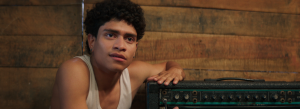
The Shadow of the Sun is convincing despite the million reasons it could fail, mainly because it’s a mid-life crisis film except without the wallowing self-centeredness that art about that subject tends to imply. Leo really does want to do a good job. He’s just stymied by all sorts of circumstances beyond his control, whether it’s his motorcycle breaking down or his girlfriend just picking fights for no reason. The death of the brothers’ parents in the distant past casts a long shadow, although Alex gives a surprisingly strong argument for why this isn’t such a big deal. Alex is a genuine optimist, even as Leo derisively says the central music contest is unwinnable because some jerks from Miami will just fly in and win it because the game is rigged.
It’s easy to see why both the ruling party in Venezuela and its opposition can find a lot to like in this movie. The Venezuela of The Shadow of the Sun is quite poor, but the story neither displays poverty as misery porn nor does it depict our heroes pluckily bootstrapping. A priest desperately trying to collect runoff water to give himself a bath is played for comedy, and the money becomes an increasingly ancillary concern as we watch Leo rocking out with his old band and having a good time, despite working every odd job he can so that they will be able to afford the road trip to Caracas.
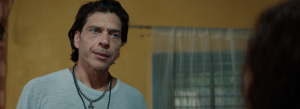
All of that being noted, the narrative is somewhat trite. Despite obviously building up to the road trip and the music competition in Caracas, both of these events arrive anticlimatically. A lot of emotional energy is dedicated to the gangster subplot, which isn’t bad per se, but feels like it comes from a completely different movie.
Also unhelpful is the movie’s lack of clarity on why the bakery was Alex’s responsibility, to the point that he in on receiving end of threats of violence. It just feels like careless editing.
The cliches and gaps are especially annoying when there are fascinating subplots staring us in the face waiting to be told. For example, how does Alex write songs at all when he’s deaf? There’s one really great scene where Alex successfully identifies something “wrong” with a practice session that the hearing members of the band have trouble picking up on. The scene is convincing in establishing Alex’s bonafides as a creative talent but doesn’t really explain how he can do it, or how he has honed his talent.
Although there is a band, The Shadow of the Sun really is just Leo and Alex’s story, and while it does work to a sentimental extent, it’s easy to see how this movie failed to hit the Academy’s shortlist. The Shadow of the Sun is the kind of vaguely encouraging crowd-pleaser that has you leaving the theater in a good mood, but doesn’t leave a lasting impression. Its most profound lesson: that Venezuelan men like Leo and Alex are just working stiffs like the rest of us, trapped in a greater political situation beyond their control and not thinking about it in especially greater geopolitical terms, is itself a lesson only obvious to this specific political moment. In the long term, this is just a movie you might catch on Tubi someday that will put a smile on your face. And to be fair, given the current political situation, that’s definitely something!
You May Also Like
-
 August 24, 2020
 -
 May 20, 2025
 -
 April 16, 2021

Very good piece, William. As a Venezuelan, I would have loved to write it, but as a consequence of having been living in Venezuela until a few weeks ago, after an emergency exit because my life was in danger, and now applying for asylum in Europe as a journalist, I can only thank you for your always sharp perspective as a critic, in this case of a film about my country.
Thank G-d you’re safe, Carlos.
Still rocking n’ rolling, Ken!