
A Voice Not Silenced
Revisiting The Gits 30 years after tragedy ended the band’s shot at fame
It was the summer of 1993, and The Gits were on the rise. The Seattle band was about to make the leap from the alt-rock indie realm to the major labels. Then on July 7, lead singer Mia Zapata was raped and murdered while walking home. As someone living in Seattle and covering the music scene, I can attest to the shock waves that rippled throughout the city. No suspects emerged, and the trail quickly went cold.
In 1999, Los Angeles-based filmmaker Kerri O’Kane was planning to make a film about ovarian cancer, which she was dealing with herself. Then a chance discovery of The Gits’ music set her on a new path. “That really changed my life quite a bit,” she says. “I mean, immensely. It gave me a purpose.” That purpose was to bring Zapata’s story to the screen. Then, in a twist that might be considered implausible if it were fiction, an arrest was made while O’Kane and her film producing partner, Jessy Bender, were in the midst of making their film. In 2004, Jesus Mezquia was found guilty of Zapata’s murder and sent to prison; he died in 2021, reportedly of COVID. As O’Kane puts it, “There was a conclusion, and it was an ending that I never could have predicted to this film.”
The Gits was first released in 2005, but has been unavailable for many years. Now, on its 20th anniversary, and coinciding with the reissue of The Gits’ second album, Enter: The Conquering Chicken on CD and vinyl (read about the album reissues here), The Gits is being made available on streaming platforms for the first time. In-person screenings have been held and will continue into the new year, and a physical release is also expected.
The film is a powerful story of music, tragedy, and justice, tracing the band’s journey from their beginnings at Antioch College in Yellow Springs, Ohio, to their relocation to Seattle just as the grunge wave was taking off, the devastating loss that hit the band as they were poised for greater things, and the long road to closure. Director O’Kane spoke with Book & Film Globe about the profound experience of making the film, how a short became a feature-length production, and revisiting just how one discovered new music before the internet.
Book & Film Globe: What was your background at the time you discovered The Gits’ music?
Kerri O’Kane: I went to film school at San Francisco State; I did very well there. I started my career as a camera assistant on movies. And I worked on [television series] Touched by an Angel. Remember that? It was very sweet, it was just such a wholesome show. Everybody lined up to hug [series star] Della Reese; she had that kind of love! That’s how I got into making a living at film. I was a camera assistant for many years. And I started doing music videos for local bands.
I was still very young. My life has had many ups and downs. And where do you go? What do you do? My love has always been for being creative, you know? That’s just where my passion lies. But oftentimes you can’t make a living at that. I worked in many camera houses and production houses and things like that.
How did you find out about The Gits’ music?
It was around November 1999. I lived a block and a half from Cedar Sinai Hospital here in Los Angeles. So I would walk back and forth to do my chemo treatments. And there was a bookstore. It was the strangest thing; I felt led there. And I found the book Manifesta: Young Women, Feminism, and The Future [by Jennifer Baumgardner and Amy Richards], and I was like, God, this is calling me. So I wound up buying the book, and that book changed everything. That book is what got me to Mia.
I flipped the book open and the first thing I saw was about Home Alive [a Seattle self-defense organization formed by Zapata’s friends after her death], and that Mia had been raped and murdered and the killer had not been found. At first I was really angry. Since I was very young, I’ve been so angry about how crimes against women are always normalized, like it’s just part of our lives. And I’ve always been very passionate about that, way before Mia, about women and just trying to bring justice to women for all these horrible things that continue to happen. And reading that the killer had not been found really upset me.
I became obsessed. I read every article about The Gits. There was a Tower Records on Sunset Boulevard and I drove over there and looked in the independent music section, and there it was, Seafish Louisville [a compilation released in 2000]. I didn’t know what to expect because I hadn’t heard the music; it wasn’t like today with the internet. I stuck it in my CD player, and the first song that came up was “Whirlwind,” and I was like, God, wow, wow! It was so powerful. Just so raw. And I was like, God, this is a woman that I would have loved to have gone to her shows. And I forgot the terrible thing that happened to her. I was like, wow, where has she been all my life, you know?
I go, “Jessy, I want to do a movie about this girl. We’ll just do a short movie.” And she goes, “Well, put it together.” Jessy worked in sound; she was working on Buffy the Vampire Slayer. She’s a professional sound engineer. I started going on eBay. I’m like, I want everything on this girl. And after buying a couple of albums from the same seller, somehow I find out that it was Steve Moriarty from The Gits, the band’s drummer. It was because of that connection between Steve and I that I was able to get in to do this movie.
How did things come together after that?
We told Steve, “We would like to do a short documentary about Mia and your band. Hopefully that will get the word out and more people will be aware that Mia’s killer has not been found.” And so Steve arranged a meeting in Seattle. Steve sat down and there was another guy there, and I whispered, “Oh, Jessy, Andy’s here!” [Andy Kessler, The Gits’ guitarist] And I could barely breathe because I was like, oh my God, this is like an interview. And Andy was somebody that I wanted to meet so badly, but was also scared of, because he looks intense. And I knew that he was Mia’s best friend.
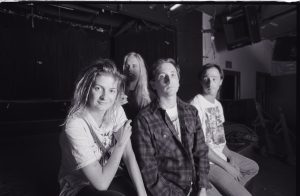
Steve was very interested in what I had to say. Steve was on board, but Andy was like, “You guys can do whatever you want, but I don’t want any part of it.” But then he did agree to do audio interviews. He said “All I ask of you is, I don’t want to talk about the investigation. I don’t want to talk about what happened.” And I understood. And so I started talking to him about his guitar riffs. And how did he and Mia work together. And we started to get to know each other a little more. And he really connected with Jessy because he loved Buffy the Vampire Slayer. Jessy got him a t-shirt and other things, and we all became buddies.
How did you find out about the killer’s arrest?
We were in Los Angeles, going over the footage. We get a phone call and I go, Jessy, will you get it? And she’s talking and it was Steve and she didn’t say anything to me. She just goes to the TV and turns it on; I don’t know if it was MTV or what it was. Jessy was kind of blanched; she looks at me and she goes, “Mia’s killer was caught.” That was where everything changed, leading to the film becoming a feature. Once he was caught and that whole story unfolded, the gates just fully opened up. Andy was like, “I’ll do whatever you guys want. I’ll be in your film.” And Matt [Dresdner, The Gits’ bassist] was fully on board.
So that was a real turning point.
That was the turning point. Absolutely. Because there was momentum with the community. That was like, the catalyst. And it was like I could see the light in all the people that I started to interview. There was a lightness about them, there was such a huge shift. Things just started to become more like there was a closure.
It was at that point that this became bigger than both Jessy and I. And it became something that I’m like, “I don’t know if I can handle this. I’ve never done a feature before. I do music videos. I do short films.” But we couldn’t stop at that point because it became a story that really needed to be told, you know? It really needed to be told.
Did you go to the trial?
I couldn’t go; I didn’t want to hear the details. But I did go for the sentencing.
I was there too.
The prosecutors asked us “Could you put a short video together that we can show in court, that will show who Mia is?” Because we had collected all this footage of jovial times and telling stories about Mia, fun things, like who she was as a person. So Jessy and I hired an editor here in LA to help us put that together. And we only had a little bit of time to do that, and we barely make it on the airplane to go to Seattle. And then we go straight to the courtroom.
So the video was like a preview of your movie, in a sense.
Exactly. And Kristen, Mia’s sister, held my hand the whole time the video played. As they turned the lights down, I saw a silhouette of [the killer’s] head, with headphones on, watching the video, seeing him see her, seeing the life that he took. That’s an indelible print in my mind; visually, I’ll never forget it.
The judge gave him a 36 year sentence. And I’m mad. I’m fucking angry. And I cursed at that guy. I couldn’t help myself. I just was like, why does he get peace? I don’t want him to have peace. Because I interviewed all these people and saw how broken they were because of what he did, their lives had changed forever.
There was an initial cut, but then the film got re-edited.
The 2005 cut, it got mixed reviews. It showed at South by Southwest. It showed in Seattle at the Northwest Film Forum. We felt like we hadn’t quite gotten to where we needed to be. We were still in contact with Steve and were like, “How do we get this more out there?” Because we weren’t savvy on this kind of stuff. And my work was done, as far as I was concerned. But I didn’t realize there was a whole new layer, like, you got to get a distributor, you got to get it out there. And we had several people approach us, in the film community, who said “You need to get a little bit more famous people who are in that.”
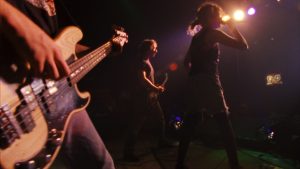
And Steve goes, “Hey, this woman in Los Angeles, Tamra Spivey, she wants to help you guys. She’s very well connected, and she can get you a couple bigger names.” And so we met this woman and her husband in this fancy house in Hollywood Hills. And she goes, “Hey, I can connect you to get you Joan Jett and [manager] Danny Goldberg.” It was Danny Goldberg who funded the last bit of our movie. So we flew to New York and we interviewed Joan Jett, and we got Kathleen Hanna [of Bikini Kill], which was lovely. And we were able to get a different editor and put it together a little more cohesively. It was really a struggle. I gotta be honest with you, that was the hardest part of making this film, was the editing and putting it together in that way. That was the most difficult.
Now that it’s getting picked up again, it really warms my heart. And that’s due to Matt and Rachel [Flotard, formerly of the band Visqueen and now a manager]. Jessy and Rachel and Matt have been working together feverishly to get this going again. I wasn’t involved. And I’ll tell you something else that’s very important. If not for Jessy Bender [the film’s executive producer], this film would never have been made. Jessy is the one who made this happen, and Jessy is the one that spent her money, her blood, her soul. She supported me with my crazy unhingedness and always believed in me.
Are you going to go to any of the film’s public screenings? I know there’s more planned.
Yes, I definitely will. I need to be there for myself at this point. You know, you have this passion, this big project, and then all of a sudden, it ends. And now what do you do? That put me into a very deep and dark depression. And my life changed. I became very reclusive for a couple of years, and that was very, very hard. So it’s very hard to relive that.
But you know, it was also one of the greatest joys and the most memorable times of my life. I was like 33, 35, and now I’m 57. And we’re talking about it years later and it still has a powerful impact on me, you know. And I’m really grateful that what I started out doing came to fruition. That guy, he was caught. So I felt my mission was complete. And he’s dead now, which I’m glad about.
I’m most proud of seeing Mia in that jester suit [at the end of the film], seeing her all whimsical, with the Silly String and everything. And the caption we put there: “Mia rests in Louisville, Kentucky. She welcomes visitors.” And then the film ends with “Precious Blood” and then goes into “Daily Bread,” which are two of my favorite songs. “Precious Blood” really always resonated with me because I felt like that was Mia’s cry. It just was symbolic of all the pain and the hurt for everybody. It was “Precious Blood” that kind of, for me, buttons it up for everybody’s pain, including my own, including Jessy’s. We were outsiders that were welcomed into a community that was very tight, and we had to work our way into that. We had to work our way into that and we were honest and true to our word.
I’m so happy that the movie is getting some traction. That’s warming my heart quite a bit.
For more on The Gits story, check out Steve Moriarty’s 2024 memoir, Mia Zapata and The Gits: A Story of Art, Rock, and Revolution.
You May Also Like
-
 November 15, 2023
 -
 November 10, 2022
 -
 August 28, 2020
