
America at 250 Is a Clash of ‘Taxi Driver’ vs ‘All the President’s Men’
Travis Bickle is wiping the floor with Woodward and Bernstein
In 1976, with the country’s bicentennial fireworks still smoking, Hollywood produced two competing visions of the people’s America. All the President’s Men argued that institutions ultimately work — that if good people do their jobs, the system, no matter how broken, corrects itself. Two reporters named Woodward and Bernstein, grinding it out in the trenches of a still-homespun Washington Post, bring down Nixon with nothing but shoe leather and a typewriter. It’s almost quaint.
Taxi Driver, meanwhile, stabbed at the soul of the nation. It told the everyman that beneath those institutions lived an isolated, alienated, furious population that no longer believed in any of it — embodied by Travis Bickle, cruising the streets of New York in search of an American Dream that had mutated into something violent. One ends with typewriters exposing presidential corruption via American letters. The other ends with a bloodbath and a vigilante being celebrated as a hero. Both are great movies; only one is still a poster that hangs in young men’s bedrooms around the world.
For fifty years, Americans treated the first film as reality and the second as pathology.
History suggests we got that backward.
At the time, one looked like a warning shot and the other like reassurance. Today, both feel cursed by their innocence — but only one of them still looks like a documentary. Funny how that happens. The numbers don’t exactly argue back. In the early 1970s, roughly seven in ten Americans said they trusted the mass media. Today, that figure hovers around three in ten. The institution that All the President’s Men treated as democracy’s watchdog has become, for millions of Americans, just another bullet-wounded combatant.
All the President’s Men (1976), directed by Alan J. Pakula, stars Robert Redford and Dustin Hoffman as Washington Post reporters Bob Woodward and Carl Bernstein, whose Watergate investigation helped bring down President Nixon. The most fantastical thing about the movie is that the story is true. An editor, Ben Bradlee, did go to bat for those journos, the institutions did hold firm, and lives were forever changed in the wake of the Watergate scandal. The villain goes off in a presidential helicopter toward infamy and disgrace. The people had a say in how a bad actor was dealt with. Accountability won. The movie became a national myth, showing the power of the newsroom — that journalists with gumption could end the reign of bullshit.
I love journalism. This stuff is deep in my bones. But while I adore what the movie did for the profession, man, reality doesn’t match the myth of what Hollywood can do for literally anything. As a working journalist, it’s a real nightmare out here. I know some folks who were good with a keyboard and a notepad who are now selling used Kias. We preserved the mythology long after we stopped preserving the conditions that made it possible. Since 2005, America has lost more than a third of its newspapers. More than 200 counties now have no local newspaper at all, and over half the country has only one—or none.
Newspaper newsroom employment has fallen by roughly half since 2008. In the post-Carter, pre-Ronald Reagan era, the proverbial shit hit the fan. We saw the beginning of media consolidation, the collapse of local journalism, and the rise of partisan silos. Today, a handful of corporations control the overwhelming majority of what Americans watch, hear, and read on media and social media. Whatever scandal came after Watergate, there was a PR suit waiting to spin it. All the President’s Men seemed quaint by the end of the twentieth century, and it certainly does in the Fox News toilet we live in today.
Taxi Driver dropped in 1976, directed by Martin Scorsese from a screenplay by Paul Schrader. It’s got a young Robert De Niro as Bickle, alongside Jodie Foster, Cybill Shepherd, Harvey Keitel, and Albert Brooks. The film won the Palme d’Or at the 1976 Cannes Film Festival and is widely regarded as one of the greatest American films ever made. It’s celebrated for its exploration of alienation, urban decay, and psychological isolation, and someone is always Travis Bickle for Halloween because fifty years later, the concept of a weirdo with an army jacket and a mohawk still works.
Maybe that’s because it no longer feels like a period piece. In 2023, the U.S. Surgeon General declared loneliness a public health epidemic, warning that chronic isolation carries health risks comparable to smoking fifteen cigarettes a day. One in three adults reports feeling lonely. Travis Bickle stopped being an outlier somewhere along the way.
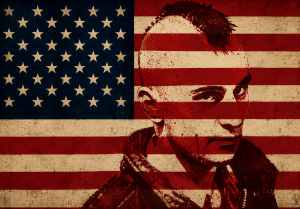 The thing about Bickle is that his story isn’t rooted in crime. Instead, he’s just a lonely dude who’s disconnected and unable to form a meaningful relationship. He can’t understand society. Sounds familiar, doesn’t it? Americans now spend more than seven hours a day consuming digital media, while friendships, civic organizations, and face-to-face socializing continue to drop. His alienation leaves him swimming in resentment for ordinary life — the folks with a steady paycheck, a conversation at the dinner table, people who seem to belong somewhere.
Scorsese presents Bickle as deeply sick. But also that media coverage is not subtle enough to understand that. The ending shows the sickness of the world Bickle hates: the newspapers celebrate him, and the public sees him as an honorable martyr. The audience leaves with a sense of ambiguity — maybe the papers and the public had a point. Over time, even viewers of the movie slip from imagining Bickle as a fiend into an idol.
How many dudes today are all, “This is literally me,” about Bickle and then wind up making a podcast about it? The antihero replaces the hero, while internet culture, full of weebs and sigma-male mythology, drives the conversation among men who worship Fight Club. We didn’t misunderstand Travis Bickle. We industrialized him.
Algorithms figured out there was money in loneliness. The angry young man became a lucrative business model. Influencers hawk dimestore grievances by getting these same fellas to join premium WhatsApp groups for a monthly fee. Podcasters monetize resentment. Social media rewards outrage with engagement and engagement with ad dollars. Bickle isn’t wandering Manhattan anymore, he’s using the system to monetize his rage.
When I told people I was writing this, a lot of people didn’t know All The President’s Men. Most of them at least culturally knew of Taxi Driver. The world Scorsese dreamed up lives in the dystopia thanks to the way the country has fallen under the wheels of a system that farms agony for clicks.
The films were never opposites. They were diagnosing the same country. One looked upward at the institutions. One looked downward at the people. Dudes in the Manosphere and the Nixon enablers looked down on the people and said, how can we make it worse for them so that we are the only answer. They now farm those people for money and as a bloc of voters. Scorsese could’ve never imagined the playing field of 2026 and how a version of Bickle is omnipresent.
We spent 50 years believing the first diagnosis and ignoring the second. The tragedy isn’t that Taxi Driver predicted America. The tragedy is that America decided Bickle looked like a role model. Meanwhile, the institutions from All the President’s Men became something we referenced nostalgically rather than maintained. Journalists are out of jobs, but there are plenty of off-the-street broskis with a webcam giving a hot take on abortion, race, and everything else because people subscribe to their channel and “smashed that Like button.” One film asked whether democracy could save itself. The other asked what happens when people stop believing it can. Fifty years later, only one question still feels resolved.
You May Also Like
-
 April 15, 1997
 -
 January 20, 2021
 -
 March 28, 2021
