
Run, Don’t Walk To See a One-Man, Three-Hour Biopic of French Poet Arthur Rimbaud, Really
If you’re into risk-taking, boundary-pushing cinema, find and see Patrick Wang’s latest film.
As the halfway point of 2026 nears, many publications are posting lists of the best films of the year so far. Among the titles cited on many of these lists are Hollywood spectacles like Project Hail Mary and 28 Years Later: The Bone Temple, and indie darlings like Nirvanna the Band the Show the Movie and Blue Heron. One title that has not popped up in any list I’ve seen so far is a film that is my pick for the best of the year to date: A. Rimbaud, an experimental three-hour biopic of 19th-century French poet Arthur Rimbaud.
It’s understandable if you haven’t heard about it. The film made its world premiere on May 12 at Roxy Cinema, located in the basement of the Roxy Hotel in New York City’s Tribeca neighborhood. It’s been screening once a week at that theater since then, with two screenings scheduled for Independence Day weekend. It also received a one-off screening at the Community Theater in Catskill, NY, earlier this month. And there have only been a handful of reviews so far, with Variety the most prestigious outlet covering it. If you live in New York, though, and have a taste for risk-taking, boundary-pushing cinema, then I’d urge you to take a chance on it while it’s still running.
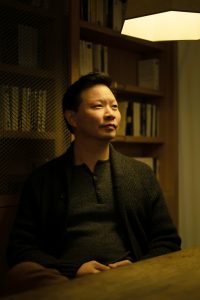
Patrick Wang, the writer and director of this micro-budget marvel, is hardly a newcomer. A. Rimbaud is his fourth feature — or fifth, if you count his two-part epic A Bread Factory as separate movies (they’re listed as such on IMDb). His debut feature, the 2011 domestic drama In the Family, is probably his best known, chiefly because of Roger Ebert’s advocacy. Though his follow-up, The Grief of Others, bowed at the South by Southwest festival, for the most part, Wang has bypassed the traditional film festival route, choosing to self-distribute his films and build word of mouth from the ground up (Wang expounds on his release approach here).
Given the aesthetic nature of A. Rimbaud, this independent approach to distribution makes sense. Whereas A Bread Factory featured an ensemble of characters to chronicle the shifting dynamics of a community in upstate New York, there is only one performer onscreen throughout the entirety of A. Rimbaud: Blake Draper, an Australian newcomer, who plays Rimbaud. And instead of ornate period settings, Wang uses spare, deliberately artificial sets (designed by Amy Williams) against a black background. In essence, Wang approaches Rimbaud’s brief yet meteoric life (he died at age 37) to some degree like a filmed solo theatrical performance in a black-box theater.
That may sound extremely boring, especially given its 175-minute length. That’s not at all how it plays, though. Draper is one of the main reasons for that, giving a beautifully detailed and emotionally wide-ranging performance. He convincingly portrays both Rimbaud’s youthful arrogance during the height of his literary fame in his early adulthood, and the more settled state of his nomadic professional later years after he had walked away from literature and became a soldier and merchant. And while Rimbaud does interact with others off-screen — including, most famously, his lover of two years, fellow poet Paul Verlaine — Wang uses musical phrases composed by Dan Schlosberg to represent these characters, with all of the musicians listed as the supporting cast in the opening credits. The sheer stylistic and expressive variety of Schlosberg’s motives for these people is itself dizzying.
Certainly, these formal gambits go against the grain of traditional period pieces, with their lavish sets, ornate costumes, and large casts. But Wang has much more on his mind than subverting genre conventions. The film includes recitations of Rimbaud’s poetry, including one lengthy sequence in which Draper moves across an extremely long table, reading laid-out pages featuring bits of what would become his masterpiece, A Season in Hell. Wang, working with cinematographer Frank Barrera, switches lighting schemes throughout this sequence to indicate changes in emotional temperature according to the passages he reads.
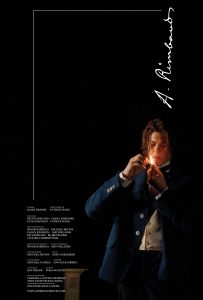 That purely visual evocation of Rimbaud’s art extends to the film as a whole. Even as Rimbaud’s life story unfolds in a straightforward chronological manner, Wang uses visual and aural elements to evoke the hallucinatory quality of his writing. Furthermore, the combination of seeing only Draper onscreen and using Schlosberg’s musical phrases as “dialogue” makes us truly feel the loneliness underpinning Rimbaud’s existence, the sense of not quite connecting with his fellow human beings even while interacting with them. A. Rimbaud is a biopic made in the manner of a psychological dreamscape, with Wang’s juxtaposition of linear narrative and surreal style doing more to suggest its subject’s inner life than most biopics’ literal-minded attempts at reductive cause-and-effect connections between biography and art.
Beyond Draper’s virtuosic performance and its evocations of Rimbaud’s life and work, though, Wang’s consistent visual invention keeps us stimulated throughout. Every frame of A. Rimbaud pulses with the electricity of a filmmaker working within his chosen aesthetic toolbox to come up with fresh ways to visualize everything from a mundane train or horse ride to a recitation of his poem “The Drunken Boat,” complete with artificial sea backgrounds and exaggerated close-ups.
Even Wang’s experimentation has a deeper purpose. Theater, of course, preceded cinema, and the films of the late 19th and early 20th centuries often come off like little more than filmed theater to modern eyes. With A. Rimbaud, Wang dares to revert to a pre-cinematic approach to reinvigorate his, and by extension our, sense of the expressive possibilities of the medium. In a time when mainstream cinema has long been coarsened by maximalist yet soulless special-effects spectacle, A. Rimbaud feels genuinely, exhilaratingly radical in its belief that less can indeed be more.
You May Also Like
-
 November 5, 2019
 -

-
 June 9, 2023
