
E. Jean Carroll Tells Her Story
‘Ask E. Jean’ prompts questions it doesn’t answer
If you’ve heard the name E. Jean Carroll, it’s most likely in the context of her 2019 case against Donald Trump related to his sexual assault on her in 1996. Ivy Meeropol’s new documentary Ask E. Jean tries to provide more context about the person who is now unavoidably infamous as President Trump’s only legally acknowledged sexual victim.
Meeropol’s nonchronological narrative is surprisingly coherent. Jeannie Carroll makes her first television appearance as, of all things, a champion cheerleader for Indiana University. From there, Carroll gets married, gets published, gets divorced, moves to New York City to further her growing writing career, and eventually lands a job hosting the early cable TV show Ask E. Jean (also the title of the documentary itself) from 1994-1996.
Back when she first legally leveled the accusation of sexual assault against President Trump, her professional name E. Jean Carroll was usually completed with her position as advice columnist for Elle. While Ask E. Jean opens with exposition of the case, and the case is the obvious reason why this documentary was even made to begin with, Meeropol makes effort to discuss Carroll’s life as a person and a professional. She explores “advice columnist” in terms of Carroll’s broader career, featuring many fascinating story titles and images in montage. The compilation provides an intriguing time capsule of the 80s and 90s era when Carroll was at the height of her career, albeit one that offers frustratingly little detail about the media environment that gave her such prominence that in one interview, a friend of Carroll states in all sincerity that she was an even bigger public figure of the nineties than Trump himself.
Ask E. Jean ★★★
(3/5 stars)
Directed by: Ivy Meeropol
Running time: 91 minutes
Perhaps the most obvious example of Carroll’s self-involvement is a brief sequence discussing her work as a gonzo journalist. Carroll defines “gonzo journalist” as how you “arrive at an event and you swirl the events around yourself and you write about how you reacted to the story.” It’s a technically correct but generally vacuous framing that serves little purpose save to act as an excuse to add Hunter S. Thompson clips to the montage. It’s not flattering to Carroll’s historical perspective that in a sequence describing topics as obviously potentially fascinating as militant lesbian pornographers, she still talks like she’s just selling a clip to Playboy rather than acting as a living document regarding these fascinating, forgotten subcultures.
Even a single clear anecdote explaining how she approached one of her stories might help. What is “the love train” that’s mentioned, for example? Why did Carroll go to it? If these stories were good enough to publish in Esquire, it certainly seem that at least at the time they were of a greater public interest than Carroll’s own career goals. Carroll herself implies as much when she describes herself as not a very good writer, an awkward bit of false humility in a film that is otherwise, often quite literally, greatly concerned with establishing — as her lawyers did in the Trump case — that E. Jean Carroll is very “fuckable.”
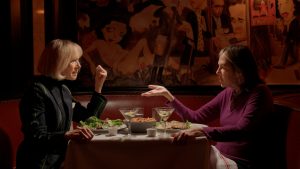 Trying to make Carroll look like the perfect victim is an odd turn to take for a documentary, which puts a lot of effort into showing her as a more fully fleshed out person. At one point literally, there’s a whole sequence where Carroll hires her old stylist from the Ask E. Jean TV show days to make her look “fuckable” because apparently a lot of Trump’s legal argument rests on the premise that he would not have wanted to have sex with her back then.
Meeropol’s Ask E. Jean does not generally concern itself with exact legal nuances. We actually hear far more from the attorney working for Trump interviewing Carroll in her deposition than we do from any of Carroll’s own lawyers about the legal or social relevance of the two trials. For what it’s worth, Meeropol’s strong editing does a good job of emphasizing that the two trials were about distinct legal topics. While the first one was about defamation and sexual assault, the second one did not deal with those merits, only whether Trump invited further damages onto Carroll by defying the first trial’s ruling and inspiring vicious attacks and threats from online trolls, among other sources. For the first trial, Carroll had to look “fuckable” because a crucial part of her argument was that Trump lied about her not being his type. For the second, Carroll looks exhausted and defeated by the abuse. Meeropol and Carroll alike seem to be hoping we don’t notice that if the first appearance was aided by stage makeup, it stands to reason that the second one was too.
All of the individual elements of Ask E. Jean sound interesting, with all involved parties having demonstrated media savvy. Yet Ask E. Jean downplays this for Carroll. She was, after all, a gonzo talk show host who was sexually assaulted by the “grab them by the pussy” president but, supposedly caught completely unawares by the unfair sexual dynamics she’d been writing about in her advice column for decades. Ask E. Jean wants to make Carroll look “fuckable” via the attractiveness of her empowering feminist brand, while paradoxically making her seem every bit as much of a helpless victim as the normie women asking her for advice because mainstream culture has failed them.
There are just too many contradictions here that hint at a more interesting story which get buried in the details. What are we supposed to make of the fact that Carroll credits Roger Ailes, of all people, with getting the Ask E. Jean TV show greenlit? Roger Ailes —the mogul behind Fox TV’s “bullshit mountain” — was one of the first sex pests to be publicly exposed and punished when #MeToo had its opening moments in 2016. It’s more than a little odd to see Carroll referring to Ailes in retrospect as if he could have been some sort of ambiguously defined ally against Trump, if not for the oppressive misogynistic culture of the nineties that made it impossible to call out toxic men.
The Ask E. Jean TV show itself, at least from the clips included in the documentary, is also awkward. As far as we can tell, Carroll’s schtick was encouraging women to show minimal tolerance to the toxic men in their lives. At one point she smilingly, charmingly exhorts a woman to leave her controlling husband to the cheers of the studio audience. Then in another moment on a panel Carroll suggests that women can fight back against rape by being more physically assertive. It’s hard to tell what we’re supposed to take away from the scenes because Carroll never discusses her advice career in terms of what advice she was giving and why. She mainly notes that you can learn more from the questions being asked than you can from the answers. Which I broadly agree with, but the Ask E. Jean documentary doesn’t really discuss the questions or the answers. We just know that some people were asking questions and Carroll was answering them.
In one sense, Carroll’s turnaround could be seen as a cruel twist of fate. Now she’s the one who needs advice. But since this isn’t an angle that makes Carroll look “fuckable,” Meeropol just ignores it. And this is just too big a gap to be satisfactorily explained by #MeToo ushering in a new era for sexual assault victims. Even if we accept that Carroll had good reasons for not making an accusation between 1996 and 2016, what about between 2016 and 2019? And why would the gonzo journalist choose to make the story less about herself?
And, among the other questions neglected, is how, despite being humiliated by Carroll in the court of law, Trump returned. Unfortunately, the documentary is quite muddled unless you try to interpret it exclusively through the very narrow lens of Carroll being empowering and heroic with the exact details only existing as flavor to that thesis.
You May Also Like
-
 September 13, 2022
 -
 January 25, 2019
 -
 February 7, 2024
