
He Managed The Beatles and They Couldn’t Manage Without Him
Q&A with Philip Norman, biographer of Beatles manager Brian Epstein
“I thought for a long time there was no room for me in writing about the Beatles,” says British journalist and author Philip Norman. “So many millions of words have being written about the Beatles. How could there possibly be room for me?”
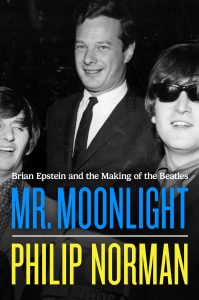
Yet the fates conspired to have Norman write not just one, but four Beatles-related tomes: Shout! The Beatles in Their Generation (1981), and biographies of John Lennon (2008), Paul McCartney (2016), and George Harrison (2023). Now, he’s onto his fifth book about the Fab Four, but has skipped over Ringo Starr (“Ringo would not be a book, really; a ‘booklet,’ I think, in Ringo’s case”). Instead, he tackles the life of the group’s ill-fated manager, Brian Epstein, in Mr. Moonlight: Brian Epstein and the Making of the Beatles.
Mr. Moonlight: Brian Epstein and the Making of the Beatles
By Philip Norman
Da Capo, 368 pages
Epstein’s story is as remarkable as those of the Beatles’ own band members. He was from a prosperous family, albeit in provincial Liverpool, running what was billed as “The finest record store in the North [of England]” when he fell under the Beatles’ spell. Then, through sheer determination and a sizeable dose of luck, he managed to get them a record contract, sending them on their way to worldwide fame.
Polite, soft-spoken, and immaculately groomed, Epstein stood in stark contrast to the stereotypical view of a brash, cigar-chewing rock band manager. But he was also a highly conflicted person; Jewish at a time when casual antisemitism was normalized, gay when it was illegal and brought risks of assault, blackmail, and a prison sentence. Epstein, Norman shows, coped with these mounting anxieties through an increasing, and ultimately fatal, use of alcohol and drugs.
 Norman would take a brief step back from that characterization and call it “perhaps fatal.” The most controversial element of Shout! is his suggestion that Epstein’s death in 1967 at the age of 32, officially attributed to an overdose of barbiturates, was actually murder. Mr. Moonlight delves more deeply into what Norman calls “the question marks over Brian’s death,” while presenting a sympathetic portrait of a man who changed the face of pop culture but could never find peace in his own life.
Norman first encountered the Beatles in December 1965, as a young reporter for the Newcastle paper The Northern Echo. He later covered the chaotic life at the Beatles’ London HQ, Apple Corps., at the time the group was falling apart. “I never did meet Brian,” he says. “I knew his mother, Queenie, and his younger brother, Clive. But no, I never met Brian. When I think of all the people I could have met in 1965, like Noel Coward, Graham Greene — it gives me the horrors to think of those opportunities that I missed. And so with Mr. Moonlight, I had to try to think myself into his mentality and his mind. As I was once a novelist, that’s something that comes naturally. I do try to make these books very much novelistic.”
Book & Film Globe: What was it like to experience that first big burst of Beatlemania in Britain in 1963?
Philip Norman: In 1963, they were still just a rather novel, eccentric group of blokes who weren’t like any pop musicians had ever been before. Because they were witty. They weren’t mumbling Neanderthals; they were interesting. And they came from a part of the country that the rest of the country hardly knew about. It took quite a while for them to become bigger than any earthly instrument could measure.
At the time, I worked for a local paper. I did get to interview them on what was their very last UK tour in 1965. I got into their dressing room and they were just so interesting and funny. I was a complete nobody and they were so nice. John was wearing the first t shirt I ever saw with something written on the front; that was very unusual at the time. And he was just so nice. When I think about what he was going through at the time and writing a song called “Help!” — which he actually meant — I’m even more amazed.
I asked, “Do you mind if I stick around?” “Oh no, you stick around, that’s fine,” they said. And then the roadie, Neil Aspinall, came in and said, “Out.” And I said, “Well, they said I could stay.” And he said, “No, you’ve got to go.” Because he was the one who said “No.” They couldn’t say no themselves, you know.
Later, I had a friend who edited a magazine in New York called Show, and he said, “Why don’t you try and find out what’s going on at their Apple organization?” And I approached this wonderful man called Derek Taylor — trust the Beatles to have a witty PR person!
I never got to interview Derek. Was he as charming as people said?
He was indeed. He was one of those people who, the flavor of his personality never really translated into print. In the Apple press office, he sat at a big desk with a scallop-shaped wicker chair behind him; he looked like an oyster on the half-shell. He was a talker. His bon mots and observations were often very indiscreet. Allen Klein had just arrived [as the Beatles’ new manager], and what he said about Allen was extraordinarily tactless. And he didn’t seem to mind it being in print.
Derek didn’t mind that I hadn’t written anything except this 1965 article on the Beatles in Newcastle upon Tyne. But [at the time Show magazine asked me to write about the Beatles] I had just written a piece about Charles Atlas, the strong man, and on that basis I was allowed to stick around the Apple house for about four weeks while they were making Abbey Road. I was also allowed to sit in John and Yoko’s [Ono, Lennon’s wife] office for a whole morning and watched them when they were doing a kind of walk-in clinic for the dispossessed and the needy. So I was being slowly inducted into writing about the Beatles.
After you did Shout, did you think okay, I’m done with the Beatles now?
Yes. I thought, “Now I’ve done this. And now I’ve done a biography.” I hadn’t done a biography before. Now who else should I do? But it was no good. The Beatles had got hold of me by that point. Everyone said, “You’ve got to do the Rolling Stones, because the Beatles and the Stones were close friends.” And then, “You’ve got to do Elton John because Elton was discovered by the Beatles’ music publisher, Dick James.” And after that it was “You’ve got to do Buddy Holly, because Buddy Holly taught them all to play the guitar.”
It was like a chain reaction. It actually was chaining me to this one big story, which was British popular music in the 1960s, which has all these different threads. It’s one of the greatest stories. And it’s a story that should have been told by Chekhov or Tolstoy or Charles Dickens. It’s very much the story of David Copperfield, or Pip, in Great Expectations, a very ordinary young man is propelled into the most extraordinary circumstances. And eventually it all falls apart as most of these stories did.
I’ve always felt that Brian Epstein is something of an unsung hero in the Beatles story.
Absolutely, absolutely. And of course, one can see it now so much, because antisemitism is sickeningly on the rise again, and also homophobia. What he suffered from both of those horrible human manifestations, without complaining about it at all, was just extraordinary. Even at the height of his success with the Beatles, he still had to contend with both of those things.
A common criticism is that he wasn’t the best businessman. But what would you say were Brian’s strengths as a manager?
Well, there was nobody like him ever before or since in management at all. Because he treated the Beatles like his children. And he protected them and pampered them, just like you would your precious offspring. Managers were a seedy bunch before, and they haven’t been much better since Brian.
Brian was just unique. He really changed the course of popular music. He changed the conception of pop musicians. Because he didn’t alter the Beatles’ music or try and change their personalities. Brian really just devoted himself to producing this impermeable shield around them. Because their fame was terrifying. And it would have torn them to pieces without Brian.
Were there new things you uncovered?
I had obviously had written about Brian in lots of contexts because of doing the other individual Beatles books and Shout! But on actually concentrating on him alone, there was lot more there. Firstly, realizing the magnitude of what he was up against, and what he suffered from those levels of homophobia. And also that he was very, very funny. And having such class and giving the Beatles such class. And of course it was very hard to fight the Beatles wanting to get into the picture. But I had to focus on Brian, and keep John at bay somehow and keep Paul at bay somehow. So it was quite difficult; every one of these books is bloody difficult.
But also, again, to treat him really as my hero. And he was heroic. Absolutely heroic and wonderful. And the Beatles would never have parted from Brian, however much the relationship changed. And he was changing too, and he wanted to do other things himself. He presented a US pop TV show from London. He tried running a theater. He basically always most wanted to be a man of the theater. And even in the theater, which traditionally gave a refuge to homosexuals, that didn’t happen for Brian. He was having lunch with Geoffrey Ellis [who worked for Epstein’s company NEMS Enterprises] at the Mirabelle restaurant in London. And Laurence Harvey, the actor, was heard to say, “I didn’t know they let queers in here now.” Even the theater wouldn’t accept him.
He was also struggled with substance abuse. Throughout the book, you see his decisions and his life getting repeatedly undercut the more his addiction gets its grip on him.
Yes, yes. And I mean, he did in some ways live in a sort of self-delusion. He thought people didn’t realize when he was slipping a pill into his mouth, because he would cover his mouth with his hand in a very well-mannered way. He had a special pocket in his jacket just to carry his pills.
One of the most more controversial areas in Shout! was your presenting the idea that Brian’s death was murder. But here you go into more specifics and bring the Kray brothers in, which I certainly hadn’t expected. What persuades you that this is what happened?
Well, first of all, a very good Liverpool journalist was called to interview Reggie Kray who was marginally the more sane one of these two psychopathic gangsters, the Kray brothers. And he quite unexpectedly brought up the subject of Brian’s death and how they had decided they would like to take over the Beatles in the 1960s, because in the ’60s the Krays were celebrities. The collapsing class barriers allowed them to be. And they had interests in nightclubs and everything. They wanted to be stars. And the fact that Reggie Kray had enigmatically said it wasn’t us, it wasn’t the Kray organization that killed Brian, was saying quite implicitly that somebody else had.
But also there was a very strange detail that was left out of most newspaper reports of Brian’s death: That a police inspector, who tried to move the body as it was still in situ at Brian’s house, had seen blood come out of his mouth and his nose. That’s not any sort of expected symptom for an overdose of barbiturates. And then also the fact that all this was traceable back to the one real terrible misstep that Brian made, which was he’d made a very bad deal with the company that was handling the Beatles’ merchandising in America. And he’d handed the job of apportioning these licenses to his lawyer, David Jacobs. And a year after Brian’s death, Jacobs was found hanging from a satin cord in a garage in his home in Hove, in Sussex. Jacobs was absolutely as involved with this terrible screw up with the merchandising. And a manufacturer in America had a fatal heart attack [before Epstein died] due to the stress, and this man’s son had sworn to take out a contract on Brian.
So this is something not to be ignored. Absolutely not to be ignored. Plus the fact that the inquest into Brian was an absolute travesty. Very few of the right people were allowed to give evidence. The coroner later conducted the inquest on Jimi Hendrix, which again was a disgrace. That’s why Jimi Hendrix’s death to this day is full of ambiguities and unanswered questions.
Have you had any pushback from people; “No, I just don’t buy your theory”?
Well, no. And in fact, nobody can discount it any more than nobody can absolutely prove it. But there are these unanswered questions which have not been raised before.
One quote of John’s that always resonated with me was that after hearing about Brian’s death [in 1967], John said his first thought was, “We’ve fucking had it.”
Yes. They were absolutely were, no question. Two years of drift and then Allen Klein. I mean, how much worse could it have been?
But for all the mistakes he made, it also seems that Brian was perhaps the best manager for them, the right man at the right time.
Well, yes. I interviewed Allen Klein when I was doing the Apple story, and he said “How could he be bothered with his other artists? Why wouldn’t he just concentrate on the Beatles?” That’s what Klein’s take on it was. But in fact, Brian, in the end, thought he was [a visionary producer and tastemaker like Russian entrepreneur] Diaghilev, you know. He couldn’t stop signing people up. Some of them didn’t have much talent. A few did. And he got tired of them, which was a shame. He wasn’t totally constant as a manager. But the Beatles were always on another level.
Derek Taylor had a great line about the Beatles, calling them “The 20th Century’s greatest romance.” Why is it a romance that’s continued, do you think?
Well, what is extraordinary is that they went through their careers on precedent, on what other pop stars had done. And every other big pop star had run their course, the fans had got tired of them, and moved on to something else. And the Beatles always thought that would happen to them. That was why John and Paul used to give their songs to other people to cover, because they thought one day they’d have to earn their living as songwriters. And you look at them now and they are like a world religion. They really are literally like that. A secular religion that just absolutely covers every single culture, every single country. So every single country in the world is fascinated by them and the fascination never seems to go away.
You May Also Like
-
 December 4, 2025
 -
 December 15, 2021
 -
 November 28, 2022
