The Cruelty of Nice Minnesota Folks
Justin Ellis explains why Minneapolis was America’s raw racial nerve
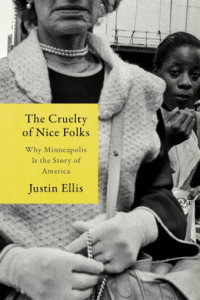
Justin Ellis premises The Cruelty of Nice Folks on the painful irony that George Floyd — the man whose murder at the hands of the police set off the Black Lives Matter movement — was killed in Minneapolis, the capital of the most notoriously liberal state in the country.
As a Minnesota native, and an African-American himself, Ellis sees no great mystery in the irony but has plenty to explain about it, and The Cruelty of Nice Folks is a longer form version of articles he’s written before, most prominently this 2020 piece from The Atlantic.
Ellis mildly resents having to repeatedly explain how these greater systems of power work in the wake of each tragedy. Especially since the unsettling subtext that runs throughout Ellis’ story is that well-meaning liberal platitudes aren’t a new idea. Indeed, Ellis argues that American liberalism seems wholly incapable of dealing with the country’s legacy of systemic racism.
The Cruelty of Nice Folks
Justin Ellis
Harper; 432 pages
Ellis alternates the long historical arc of Minnesota’s local history with his own family research. Why did they come to Minnesota? Why did anyone? The short answer is that the South, at the beginning of the 20th century with the rise of the Klu Klux Klan, was a very violent, dangerous place. This much is largely uncontested. Where Ellis diverges from the liberal narrative is that instead of seeing progress in Minnesota, he just sees more passive forms of discrimination. Redlining is the most obvious example: the city is zoned in such a way that you can almost immediately see where the ghetto transforms into a more genteel neighborhood. Health care is another such throughline, where decent access to care always seems to find a way to cut across racial lines despite public figures like Hubert Humphrey always denying, seemingly credibly, that they themselves are racist when all the processes they support clearly are.
 This is the Minnesota nice stereotype applied on a political level. In Ellis’ formulation, Minnesota liberals like Humphrey have been able to get away with bad policy time and again mostly by credibly presenting themselves as nice guys. Whether a nice guy is even who we might want for fights of this level of severity is another unspoken context. Tim Walz was just as unhelpful fighting racial injustice and police brutality as he was fighting Trump or Somali fraud. But he and others like him get away with this by being just so gosh-darned nice no one can ascribe a malicious motive to their actions, regardless of their effectiveness.
The Cruelty of Nice Folks is not a pleasant story. It was never going to be, as what Ellis is fundamentally doing here is explaining the long historical Minnesota context of the George Floyd incident that largely got lost once that story went national. The postscript of George Floyd disturbingly falls into the same pattern as so many other civil rights struggles. Immediate protests die out, energy dissipates and becomes a whimper in committee. When Ellis’ final chapter starts discussing present-day Minnesota controversies like the Somalian fraud and the ICE raids, similarly, it’s hard to shake the feelings that in the long-term these will just become more anecdotes of resistance with no apparent long-term path to meaningful change.
This narrative is backed up by the story Ellis tells about his own family who came to Minneapolis as part of The Great Migration fleeing the racism of the deep South to seek better opportunities in the North. While his family was not destroyed as it might have been in the South, it saw few of the hoped-for opportunities. It’s little surprise that Ellis doesn’t live in Minnesota today, because despite it being his home, it was only ever really such in the sense that his mother was still there. Just like Floyd left Texas, so too did Ellis leave Minnesota. Migration is less as an aspiration than a coping mechanism.

Unfortunately his auto-ethnography tends to be more vibes-based than clearly connected. Part of the issue is that, in many cases, Ellis does not know what really happened with his family due to a lack of generational stories explaining their motivations. The decision to move to a certain neighborhood might have been influenced by redlining several decades back, for example, but this isn’t something now-dead parents would have felt the need to explain to children. Consequently the human interest elements don’t add very much. Sixty pages of this 432 page book are dedicated to notes from verifiable sources, and this level of scholarship just makes the family anecdotes less impressive in comparison. Irritatingly, for all these notes, The Cruelty of Nice Folks lacks an index, making it that much more difficult to guess which vaguely worded chapters like “Rules of the House” are about actual historical events and which are about Ellis’ personal family drama. Or both, as is often the case.
It’s a shame the book is so difficult to use as a reference, because it makes perfect sense as a broader narrative in memory. George Floyd was just another migrant, according to this story, one who knew he faced discrimination but whose tormenters were so passive-aggressive it wasn’t always easy to see how. Then it got caught on film. Despite the “Minnesota nice” reputation, Ellis shows an Upper Midwest that was never really any less racist or patronizing than the South, just one whose patronizing racism was expressed in a different way. In his telling, there was never any genuine desire for racial justice, just a need to reassure White communities that they were nice folks.
You May Also Like
-

-

-
 May 21, 2019