
‘Dead Man’s Wire’ Takes Poetic License
Gus Van Sant’s true crime drama is a carefully crafted time capsule that feels eerily contemporary
If To Die For made me fall in love with Gus Van Sant, Dead Man’s Wire made me want to renew my vows. This film had me from the jump, every period detail rippling with intensity, taut with the suspended animation of the frozen landscape of Indianapolis in February 1977. Danny Elfman’s vibrant score and choice needle-drops work in concert with Saar Klein’s crisp, efficient editing, to create a film that feels like it was made in the ‘70’s but with a 2026 zing.
Dead Man’s Wire ★★★★★ (5/5 stars)
Directed by: Gus Van Sant
Written by: Austin Kolodney
Starring: Bill Skarsgård, Dacre Montgomery, Cary Elwes, Colman Domingo, Al Pacino
Running time: 105 mins
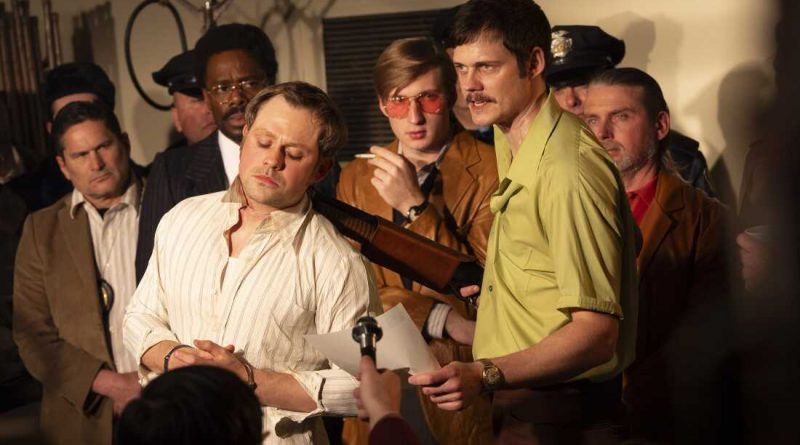
Dead Man’s Wire is based on actual events: a 63-hour stand off that played out in front of a national audience. A would-be developer named Tony Kiritsis (Bill Skarsgård, stellar) kidnapped Dick Hall (Dacre Montgomery, excellent), a mortgage broker at the bank that seized his property. Kiritsis’ intended target, J.M. Hall, the bank’s chairman and Dick’s father, was vacationing in Florida at the time of the abduction.
Kiritsis took out the loan to purchase land with a plan to build a shopping center and was convinced that the bank confiscated the land to develop it themselves. He knew the Hall family personally and couldn’t imagine another reason for the foreclosure.
Van Sant’s title highlights the unique feature of this abduction: Kiritsis placed Hall in a dead man’s wire, a device that connects the trigger of a sawed off shotgun to a wire that loops around the captive’s neck, ensuring death should he try to escape… or trip, or fall asleep. The contraption allowed Kiritsis to march his prisoner through the icy streets unimpeded – no one dared interfere, not even the officers who recognized Kiritsis as a regular at a local cop bar. Among these was Detective Michael Grable (a transformed Cary Elwes). One of the only morally unimpeachable figures in the story, Grable had completed a two hour FBI hostage negotiation training only weeks before the kidnapping. He attempted to calm Kiritsis in the street and went on to be the force’s chief negotiator for this case and beyond.
In the film, a plucky local news reporter captures the events on camera. In a move that foreshadows today’s social media, Linda Page (Industry’s Myha’la) leads a flood of radio and television outlets to Kiritsis’ apartment building where he has rigged his apartment with explosives and holds Hall for 63 hours.
In an effort to control the message he sees playing out on television, Kiritsis reaches out to Fred Temple (Colman Domingo), a popular radio DJ. He has three demands – he wants his land back, an apology from the bank’s chairman, and to go free. But, hearing himself on the radio, he becomes enamored of his own voice and philosophies, and grows increasingly dependent on Temple for that platform.
Well before Kiritsis demands that all major outlets live broadcast his statement (they did), we recognize that there’s another character in the film: Media.
Though based on actual events, the film is a mix of replication and imagination. Screenwriter Austin Kolodney — who wrote the script on spec after happening upon news footage and being struck by the humor and pathos of this madman underdog story — invents a number of events that played out behind closed doors. Kolodney’s background in comedy shows in the way he mines the absurd for humor and also in the film’s pacing. 63 hours is a long time to be in an apartment, and the writer has to come up with devices to keep things moving. Though care is taken in recreating events that appeared in contemporary footage, the film takes some artistic license, going so far as to add a dream sequence.
One key liberty the film takes to great effect is to swap out the head of news, who Kiritsis actually called in 1977, for the fictionalized Temple. The opening scene cuts between music on car radios and the DJ in his booth. It feels like an artful plot device, reminiscent of Spike Lee’s Do The Right Thing: a DJ philosopher with his finger on the pulse who spins great tunes — useful for an engaging soundtrack.
But Temple’s role becomes more than narrator – he becomes directly ensnared in the plot. When Kiritsis reaches out to him directly, he emerges as a sort of everyman in the story, and its moral center. He is not unfeeling, but would like to go home at the end of a long day. Temple dutifully hands a recording of his conversation with Kiritsis over to law enforcement, but, maybe because he understands the power of the media, is as dubious about giving Kiritsis a platform as he is about aiding the police, and later the FBI.
Temple is disturbed by the violence and would prefer to keep the increasingly unhinged Kiritsis at arm’s length. Kiritsis, for his part, is smitten with Temple, falling hard for this parasocial relationship. In a fairly wonderful and chaotic scene, Kiritsis devotes a soul dance to Temple, albeit in his apartment, far from Temple’s view. Domingo delivers a charismatic, nuanced performance, revealing Temple’s careful management of expectations and the strain of his public persona. Dead Man’s Wire is not a referendum on the media – Van Sant doesn’t preach – but holds up a 1970s mirror that reflects the present.
Kolodney cites Dog Day Afternoon as an influence, and Dead Man’s Wire succeeds in generating a similar tension to that iconic 1975 movie. Van Sant follows through on the homage, casting Al Pacino as the hostage’s father and chairman of the bank, M.J. Hall. Though Pacino’s character sounds like someone from the bayou (confusing for a film set in Indiana), he manages to bring gravitas to a particularly tense scene, when Kiritsis phones him where he’s vacationing in Florida with his wife. Nearly without lines, and clearly without power, Mabel Hall is perfectly cast – Van Sant fans will recognize her as long time collaborator, Kelly Lynch.
Kiritsis demands an apology, ostensibly in exchange for his son’s life. When he refuses, a cocky Kiritsis passes the phone to Hall junior, confident that the chairman will acquiesce when he hears his son’s voice. It’s clear that Hall Jr. doubts his dad will risk his business or reputation, but he makes the ask. Hall Sr. refuses. (The heartbreaking scene is especially well played by Montgomery). Hall Sr.’s callous refusal sobers Kiritsis, creating a tender bond between the two men. It also helps frame Kiritsis as a folkhero: we almost forget he’s a brutal kidnapper of an innocent man, he’s a little man standing up to big business.
Thank goodness Van Sant did not feel he had to copy what had happened. His lead actors bear little resemblance to the men they portray. Unlike the towering Bill Skarsgård, Kiritsis was quite short, noticeably smaller than his prisoner. Not only is Montgomery shorter than Hall was, he is also about two decades younger than Hall was in 1977. No matter. Van Sant has killer casting instincts – each actor is superb and together they form a kind of odd couple with gallows humor that galvanizes the horror and pathos of the situation. It’s complicated. It’s ever so complicated and, thanks to an insanity plea for one and an addiction for the other, the “wrong” person escapes unscathed, even if everyone survives.
You May Also Like
-
 December 10, 2025
 -
 October 8, 2018
 -
 April 5, 2019

Great review