
Cannes Has Some Serious (and Some Comic) Daddy Issues
Family ties are being stretched for drama and laughs in festival film after film
An otherwise sleepy Cannes Film Festival (low on Hollywood glitz, high on arthouse austerity) jolted to life over the weekend when gay writer/comedian and Instagram celebrity Jordan Firstman premiered his adorably bawdy directing debut Club Kid in the sidebar section Un Certain Regard. The winning millennial dramedy, about a hedonistic party promoter who suddenly learns he’s the father of a 10-year-old son, became the talk of the Croisette — a breakout crowd-pleasing hit that sparked a bidding war among U.S. distributors. The winner: A24, in an eye-watering $17 million deal for worldwide rights.
That formidable lump sum might turn out to be a bargain, considering Firstman’s ability to generate awareness and tubthump ticket sales across his huge following on social media. Club Kid won’t be a hard sell to general audiences, either. The film delivers a hilarious take on a drug-fueled raver ground down by his party-hard queer subculture who meets a moon-eyed tweener to inspire his shambolic attempts to pull his life together and finally become an adult. The basic premise is as old as Charlie Chaplin’s The Kid, but this K-fueled LGBTQ twist on the manchild and the child that makes him a man has a sober Kramer vs. Kramer undercurrent sure to tug heartstrings even while tickling funny bones.
Daddy issues are running rampant through Cannes this year, with one competition film after the next reflecting the tensions that test the familial ties that bind. In Rodrigo Sorogoyen’s The Beloved, a Spanish riff on last year’s Sentimental Value, Javier Bardem gives a galvanizing performance as a celebrated film director whose next film stars his estranged actress daughter (Victoria Luengo). Bardem’s palpable churn of emotions — regret, tenderness, anger, frustration, and affection, especially in a tour-de-force 20-minute restaurant scene that opens the film — has made the Oscar-winning thespian a formidable frontrunner for the festival’s Best Actor prize.
Sebastian Stan is nearly unrecognizable as Mihai Gheorghiu, a bald-headed, bespectacled and devout Romanian father of five newly immigrated to Norway in Cristian Mungiu’s lacerating drama Fjord. When child protection services suspects Mihai of physically abusing his kids, they take them away from him and his quiet wife Lisbet (Renata Reinsve). What emerges is a surprisingly sympathetic portrait of a Catholic conservative whose vocal faith and cultural traditions make him a victim of nanny-state antireligious governmental overreach. But, in true Mungiu style, Fjord is also brilliantly shaded and layered with complexities and contradictions, showing how dogmatic affiliations always strain under the very human need to live and love freely.
Two other competition films show how some flawed fathers leave psychic wounds on their children. Marie Kreutzer’s deeply unsettling Gentle Monster features a brutally conflicted Léa Seydoux as a loving wife and mother whose husband gets arrested for suspicion of trafficking in child pornography. And James Gray’s finely textured New York autofiction Paper Tiger shows the fallout when a middle-class beta dad (Miles Teller) in 1986 Queens, eager to impress his two sons and enrich his life with his no-nonsense wife (Scarlett Johansson) gets hoodwinked by his flashy rich businessman brother (Adam Driver) into shady dealings with the Russian mob.
Bad dads abound! In the midnight section, French provocateur Quentin Dupieux debuted his star-studded English-language lark Full Phil, with Woody Harrelson as an emotionally constipated dad trying to reconnect with his snarky 32-year-old daughter Kristen Stewart in a luxury Parisian hotel (Tim Heidecker and Eric Wareheim co-star as ’50s-era b-movie scientists in a ridiculously unrelated black-and-white Creature of the Black Lagoon subplot). While a very slender Stewart relentlessly shoves her mouth with room-service food — quiches, chickens, steaks, desserts — Harrelson painfully realizes his belly is swelling to the size of a beach ball.
Meanwhile, in Nicolas Winding Refn’s hyper-stylized genre thriller Her Private Hell, Sophie Thatcher stars as a fashion-plate actress whose emotionally manipulative father married her former best friend (Havana Rose Liu); while outside, in a mist-shrouded city, a spooky serial killer named The Leather Man is looking for his own daughter. And every time he rips open another random nubile victim, the women literally (and inexplicably) scream “Daddy!”
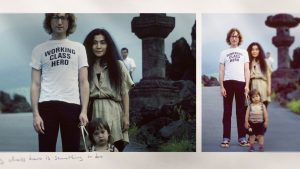
But not all fathers were skewered this week. One unabashedly great rocker dad — call him a pop pop — gets a valedictory tribute in Steven Soderbergh’s John Lennon: the Last Interview. The loving, thoughtful film is crafted from a two-hour radio interview recorded just hours before Mark David Chapman gunned down the former Beatle coming home to the Dakota, and features talking-head commentary from the interviewees, plus archival photos mixed with expressionistic, A.I. generated stock footage (including abstract psychedelic imagery as well as goofy photorealistic shots of everyone from average people to midcentury British miners to hunky cavemen).
At its core, the touchingly optimistic Lennon pontificates about the five-year break he took from recording and touring so he could help raise his young son Sean. “Artists have to reflect what we are,” he says at one point. “Artists are a reflection of society.” Surprisingly future-focused, he elaborates on a duty he feels to “create children, create societies,” explains how “I’m a fan of people,” and how “where there’s life, there’s hope.” He even refers to watching a recent Barbara Walters interview with Burt Reynolds, in which the then-major box office idol — arguably one of the biggest movie stars in the world at the time — said that his great ambition in life is to be a father. Lennon wholeheartedly agreed, and added what he liked most about kids. “They’re not hypocrites,” he said. “And they’re not phonies.”
