Hello Dolly!
Concepts and practical effects can take a horror flick so far
The horror genre is often an unsubtle jab at our parents, whether it’s the monster abandoned by Dr. Frankenstein, Freddie Krueger-esque demons revenging themselves on the children as proxies, or adult figures failing to listen as their children warn them about a killer doll. The new indie horror flick Dolly has a novel take on these themes: the monster thinks it is literally a parent.
The horror comes when it tries to parent an adult it has abducted. Think Misery meets Barbarian. The apprehension only intensifies when the masked monstrosity capable of tearing your jaw off is trying to make baby take the bottle and won’t take no for an answer.
Somewhat disappointingly, the element of the title monster in Dolly appearing to see itself as a perpetually grieving parent isn’t quite as present in Dolly as the marketing had led me to believe or as the film demands. Dolly starts out by introducing us to the monster’s victims: Chase (Seann William Scott) is a single dad preparing to propose to Macy (Fabianne Therese) over a long hike. As a couple, they’re surprisingly unconvincing: the proposal seems like it’s a bad idea and, insofar at their relationship is developed, Dolly feels like an allegory for listening to your romantic partner’s discomfort, lest you be disemboweled by a horrific monster in the Tennessee backwoods.
Dolly ★★★ (3/5 stars)
Directed by: Rod Blackhurst
Written by: Rod Blackhurst, Braondon Weavil
Starring: Seann William Scott, Fabianne Therese, Max the Impaler
Running time: 82 minutes
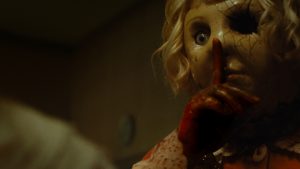
Dolly doesn’t lend itself well to any greater thematic reading, frankly, when so much of the runtime is dedicated to the usual horror tropes. But let’s be honest here, its independent distribution notwithstanding, Dolly is not aimed at the art house crowd. This is a movie for people who want to watch professional wrestler Max the Impaler dress up in a creepy doll costume, throw people around like rag dolls, and occasionally impale people with whatever blunt tools are immediately available to them. And do they ever deliver on that front! Despite not uttering a single word of coherent dialog, Max the Impaler sells the character of pitiable monster who really wants to be a good mom. It’s not her fault she’s so insanely bad at it.
The practical effects are another big star of the show. Dolly is shot in 16mm, and it shows, with the often grainy footage subtly accentuating moments of grim bloody horror. Although what’s really impressive is less the prosthetics themselves and how well the actors are able to move around while using them. It’s genuinely tough to watch Dolly a lot of the time, because of how disgusting the imagery can get. I have to give the cast points just for being able to maintain a straight face during a lot of these wincing scenes. Dolly mostly avoids dipping into self-parody and is a better movie for that, as it makes the threats and the violence feel that much more real.
 A pity the same can’t be said for the characters, who aren’t awful, just a little boring — making the monster’s anxieties seem more convincing. I’m not sure sketching them out more would have necessarily helped, though, given that Dolly is at its strongest during its extended, wordless sequences. Or at least, no more words than a helpless stammer that the monster might or might not even understand.
Writer/director/producer Rod Blackhurst seems optimistic about the future of Dolly as a franchise, and it’s hard to blame him when the final product looks this good. A week ago he did a pretty decent Ask Me Anything on Reddit that doesn’t give an exact budget, but does make it clear that this presentation follows the classic horror ethos of limitations into virtues. As an expanded concept off of the 2022 short Babygirl, which was a huge hit with exactly the target audience that’s likely to want to watch Dolly, I can’t imagine any of these viewers will be disappointed. Without question, Dolly is just Babygirl but a lot more of it.
Can this concept work in a larger scope? It’s not clear, since it barely works at this scope. It’s definitely cheeky to name a film set near Chattanooga after the patron saint of East Tennessee but Blackhurst clearly has ideas of what’s going on in these Tennessee backwoods, with a post-credit scene teasing that the cops have some ideas while addressing an unseen, unknown figure for aid. But we don’t see that in the movie and, frankly, Dollywood seems more appealing than the Blackhurst Dollyverse. If Blackhurst does get his sequel, hopefully whatever he’s driving at will involve more pro wrestling energy and stagemanship. His ideas for staging, practical effects, and unpleasant imagery are much more dynamic than his plotting. Unfortunately, these ideas not quite dynamic enough or present enough to compensate for Dolly‘s flaws and make it a strong recommendation beyond horror genre fans.