
No Place for Anything, Least of all, Soccer
A new documentary about football in Greenland provokes thoughts about sport and politics
For thousands of years Inuit fisherman have lived and hunted from the edges of Greenland. It’s an island larger than Europe, stuck between Canada and Europe on the way up to the Arctic. A slab of inhospitable rock covered with an ice sheet for most of the year, it can barely support life — as various Norse settlements have found to their cost over the millennia.
No Place for Football: The Story of the Shortest Season on Earth ★★★★ (4/5 stars)
Directed by: Brandon Scott Smith and Derek Sullivan
Running time: 91 mins
As an autonomous territory of Denmark, Greenland is not entitled to a spot in the international soccer firmament — though it is fighting for recognition. Its inhabitants are all Danish citizens which means they are also EU citizens (although Greenland itself is not part of the EU). These affiliations mean that they are eligible for financial support and, indeed, the island receives a good deal of aid. The other thing that this European affiliation suggests is a love of soccer.
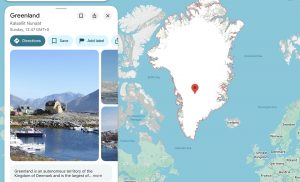
Though the temperatures are below freezing for all but a couple of months in the summer, new all-weather artificial soccer fields have breathed new life into what was already a soccer mad country. Previously the Greenlandic Golden Tuukkaq, and all organized soccer in the country, was contested on sand pitches, but the week-long tournament — the entire football championship of Greenland — is now played on handsome, true-running fake-turf fields with a breathtaking backdrop of glaciers, glacial hills and icebergs.
No Place for Football: The Story of the Shortest Season on Earth follows B-67, the team from the capital city Nuuk as they head to Ilulissat (where the glaciers meet the sea) for the maximum of five games that will decide who will become champions. Two groups of four play each other, then the top two from each group play the top two from the other group in semi-finals and the winners play off for the gold.
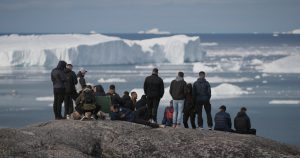
Presumably it was not the impending tournament this year that had President Trump looking over the events of the island last week, but the excitement of the soccer is no less compelling for the tiny size of the populations competing. The entire population of Greenland is about 57,000 — about half the size of Peoria, Illinois. Over a third of them live in Nuuk, which makes B-67 the hot favorites for the title, playing against villages of under 7,000 people.
Once they had the idea, the structure of the film writes itself pretty much — what is Greenland? who is the team? how does the tournament go? Directors Brandon Scott Smith and Derek Sullivan use the new Danish coach for B-67 Nicolai Nielsen as a path into the story and don’t get in the way of a story of small town pride, extreme living conditions, and the quest for soccer glory. It’s neither Nanook of the North (though it does draw on that image.ry) nor Hoop Dreams, but it is a charming little portrait
Ninety percent of the Greenland population is Inuit and, as the directors interview players, owners, and — notably — the delightfully lugubrious-sounding sports commentator Noah Mølgaard — we hear Danish, Greenlandic, and English being spoken — all, thankfully, with subtitles. Apart from providing an aural primer on why there are so many Qs and Ks in Greenlandic, it’s a reminder that language and identity are closely related. It did make me wonder about Danish Inuit relations and identity both within teams and between teams, but the movie does not even touch on that.
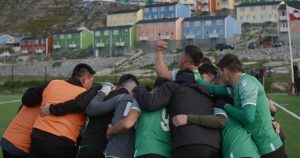
Ironically for a country where settlements on the map are often lengthy roman character transliterations of Greenlandic Inuit names, all the soccer teams are referred to exclusively, and tersely, as letter: number. For example, B-67 stands for Boldklubben af 1967, literally Ball-Club from 1967 in Danish; their hometown rivals IT-79 are Inuit Timersoqatigiiffiat-79 (literally “their sports club” in Greenlandic) which was founded in 1979.
The views are breathtaking, the quality of the soccer is mediocre but the excitement is authentic and the weather adds tension. The actual playing conditions in Ilulissat are fair, but getting whole teams to this small glacial village of 5,000 in the unreliable storms and ice of a Greenland spring is fraught. Ironically, the teams coming by boat have fewer problems. The film was made just before Air Greenland changed its transatlantic and domestic hub to Nuuk and, spoiler, several of the players from Nuuk get stuck in transit at the old Kangerlussuaq hub on the way to the tournament.
At a time when geopolitics is rearing its head over the proud hardscrabble residents of Greenland, Patrick “Pato” Frederiksen, the captain of B-67 and of Greenland, provides an exemplar of the actual humans who live, work, and play there. Released on Apple TV on the weekend when Arsenal played Paris St. Germain for the European Champions League, with both squads valued over $1.3 billion, No Place for Football is a timely reminder that the money is entirely beside the point of why we play and care about sport.
You May Also Like
-
 July 17, 2025
 -
 August 22, 2023
 -
 November 16, 2022
