
‘The Testament of Ann Lee’ Turns Shaker Worship Into Cinematic Ecstasy
Mona Fastvold’s hypnotic musical about the Shakers’ charismatic founder abandons narrative convention in favor of trance, devotion, and embodied faith
Seeing The Testament of Ann Lee is like going to a rave. You can’t really remember any of the songs, sometimes it feels like it’s taking too long, and you emerge feeling like you’ve lived through something.
The Testament of Ann Lee★★★★ (4/5 stars)
Directed by: Mona Fastvold
Written by: Mona Fastvold, Brady Corbet
Starring: Amanda Seyfried, William Pullman, Thomasin McKenzie, Christopher Abbott
Running time: 2 hours, 10 mins
Before seeing The Testament of Ann Lee, I only knew of The Shakers through their brooms and furniture. Their aesthetic values function and simplicity; design is utilitarian, lines elegant, items unadorned. Careful and durable construction reflects the Shaker tenets of utility, simplicity and cooperation. Socially, too, groups live light: eschewing many earthly pleasures, requiring sobriety and celibacy. The celibacy requirement, even for married couples, may be why there are currently only three practicing Shakers in the United States.
But Shakers worship through extended ecstatic dance – one depicted in the film lasts three days without rest. These orgiastic dances stand in contrast to the rest of the sect’s utopian simplicity, or perhaps they enable one another. The shared worship experience — the rawness, the loss of self, the hours of shared rhythm and sweat — marks them out. It’s also the defining feature of The Testament of Ann Lee, the epic story of the charismatic leader who brought the Shaker religion to America.
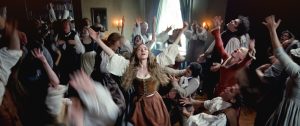
The film introduces us to Ann as a small child in 1774 Manchester, England. One of many children born to a blacksmith and his wife in a tiny home, the close quarters force her to witness her parents’ intimate acts – where her father’s appetites nearly kill her mother. The children never attend school, but toil in factories where Ann works alongside her younger brother, William. As a young woman, Ann (a luminous, grounded Amanda Seyfried) finds employment as a cook in the town’s infirmary, which also houses the insane asylum. It is hard work, but a clear improvement over the factories. We follow Ann, accompanied by William (Lewis Pullman), to a Shaker meeting held in secret in a dark living room. Tentative, perhaps nervous even, at the teachings of gender equality, she transforms when they begin to worship through dance and song, giving herself over completely. She leaves flush with the experience, a convert.
She and William become regulars at Shaker meetings, where she meets her future husband, Abraham Standerin (Christopher Abbott). In a cruel twist of fate, and perhaps biology, all four of their children die before the age of one. Director Mona Fastvold (The Brutalist) depicts Ann’s life-threatening deliveries graphically and unflinchingly, a choice that feels downright feminist.
After the death of her fourth child, she suffers a nervous breakdown and is committed to the asylum where she once worked as a cook. Upon her release, she returns to the Shakers as a leader, only to be arrested for noise-making after she and her flock shake for three days straight, incessantly dancing, singing and stomping. She fasts in prison, having visions and, in the film, levitating, emerging as “Mother Ann,” the prophet who will lead the Shakers to America.
Initially on arrival in the Colonies, the promise of the freedom to practice their religion does not match reality, forcing Ann and her followers to leave New York City for the Hudson Valley. The film depicts the quest for their first church’s location with a traditional musical “number,” showing Seyfried singing “I am detaching, I am lead” as she moves through the pristine countryside, arms outstretched. The song put me in mind of “Mamma Mia,” a more traditional musical, also starring Seyfried. The thought did not pull me out of the film entirely, but it does speak to a challenge for the audience: the film is a musical, but most of the music is hymns sung in worship, with a few songs sung by Seyfried that communicate her pain, or faith, the passage of time, or the quest for a new home. The genre can be a bit confusing, but her pitch perfect performance helps it slide, plus the film never interrogates Lee’s visions or levitation, so why shouldn’t she sing with an invisible orchestra?
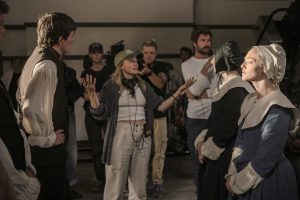
Fastvold, a new U.S. citizen who stumbled upon Ann Lee while researching Shaker hymns for another project, was surprised to learn that few Americans were familiar with their first female (European) religious leader. She gets a bit bogged down in the details and the second act becomes less of a character study and more a historical drama about the ins and outs of the Shaker settlements and expansion in the New World. We see them endure winters, build beautiful buildings and furnishings, rebuild after being run off for their practices, and gain followers. As it turns out, the Shakers’ commitment to pacifism was a bigger liability than their explicit celibacy. When they refused to take a side in the Revolutionary War, their community was attacked by Patriot mobs and soldiers. Her brother William died shortly after his brutal beating, and Ann also succumbed a few months later, presumably as a result of that attack and the years of physical trauma she endured in childbirth, incarceration and travel.
The story of Ann Lee and the Shakers is intriguing, but the plot is not the star of the film. Where the film succeeds is not in its laudable historical accuracy, nor the course of its often harrowing events, but in its transference of the experience of the Shakers’ dance to the audience. Their dance is not performance, but worship. And it is treated as such. Celia Rowlson-Hall’s choreography is repetitive, the gestures rhythmic, organic, sometimes desperate. The dancers intertwine, entering and emerging from a maze of bodies, the camera (exquisite work by cinematographer William Rexer) sometimes captures an eye, a limb, sometimes swoops in like a choreographed element. There is no gaze. The dance is for those seeking absolution. We are all sinners and the dizzying camera work invites us in.
I confess that, more than once, I wondered how long the dance scenes would last. The first Shaker meeting in a living room in England is claustrophobic, crammed with worshippers bumping into each other, in the thrall of the holy spirit. I enjoyed it, but wondered what I was in for. (Spoiler: lots more dancing!) Later, on the transatlantic journey to the Colonies, their ship battered by a storm, Mother Ann sees an Angel and encourages the Shakers to defy orders to stay below deck. They emerge to help the sailors and save the day. The sailors begrudgingly allow them to worship: cue a lot of dancing.
The sailors stand in for the audience, like them, we can appreciate that dance-worship is important to the Shakers but then we see its beauty, we find that we are breathing with them. We are still spectators, but the lines are blurred. The scene is shot beautifully with the wide sky above, the promise of salvation on the horizon, and a freedom to the movement that points to the freedom that awaits them in the colonies. It’s also long. But, somehow, the repetitive movements, the artistry of the camera work, the passion of the performers, took me on a journey without my conscious knowledge or consent.
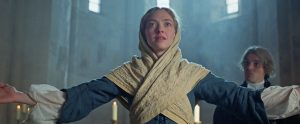
The film ends with maybe the most arresting funeral I’ve ever seen on film. A clean meeting house, furnished with only Shaker chairs serves as the backdrop for aerial shots of dancers weaving in and out of one another, breathing together, celebrating the life of their prophet. Awash in light and love, Mother Ann is far from the dark living rooms where she first discovered the rapturous dance that would lead her to the fresh air of the New World and beyond.
Leaving the theatre, I felt a little unsteady. I had to take stock. I was drifting through the lobby, disembodied. I had been through something. I thought about the performances, which are uniformly good — Seyfried’s in particular — as are the design elements. But the director’s choice to make the audience invest its time, to stay in wordless scenes of swirling white fabric, to defy, in many ways, the agreed upon formula for success on streaming platforms, takes The Testament of Ann Lee from movie to experience. See it in the theater. Get comfortable, and prepare to let go.
You May Also Like
-
 May 7, 2024
 -
 November 14, 2024
 -
 June 7, 2020
