
Louis CK Gets ‘Ridiculous’ and Grumpy
First Netflix special for 9 years is entertaining but limited
Louis C.K. opens his new Netflix special Ridiculous by explaining that he went for an AIDS test — not because he’d had sex at all recently, but because he needed some good news. It’s a classic C.K. opener: bleak, unexpected, perfectly constructed.
The first thing you notice, though, is how much he’s aged.
That’s partly because it’s been nine years since his last Netflix special, Louis C.K. 2017. Back then, he was still one of America’s defining comedians. Then came the revelations about his sexual misconduct, his public apology, and the effective exile that followed. There is no formal mechanism for rehabilitation in the #MeToo era, but after years of touring and releasing material independently, C.K. now appears, if not forgiven, then at least commercially uncanceled.
The last thing you notice about Ridiculous is that he’s still talking about aging.
Almost the entire hour circles mortality: putting his father in a nursing home, dating at 58, having to pee halfway through every movie, being judged by younger generations. As a fellow New Yorker not far behind him, I found the grumpy-old-man shtick relatable enough. There are flashes of vintage absurdity — his delight in the absorbent pad beneath supermarket chicken breasts, a strange application of tampon technology devoted to soaking up raw poultry juice — but the comic engine feels different now.
“You’ve got to look for new joy in life,” he says, “because life is too long… You can have a great life, but you’re still alive after that.”
That’s true, but it’s not particularly daring.
At his peak, Louis C.K.’s shows weren’t just provocative. His comedy expertly probed the fault lines holding American society together, exposing hypocrisies about race, sex, parenting, politics, religion and power. Even when he crossed lines, it felt as though there was something meaningful on the other side.
There’s very little of that tension in Ridiculous. Most joke lands with the effortless precision of a consummate craftsman — save for one oddly flat take that probably should have been left on the cutting-room floor — but remarkably little feels at stake. There’s an excellent riff on how the “Barely Legal” porno genre openly flirts with pedophilia, yet even that observation lands less as social critique than as another example of humanity’s general grossness.
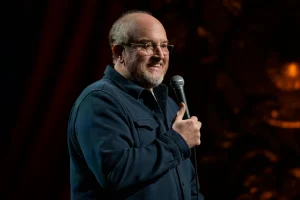
One of the nuggets of wisdom he drops comes via a joke about a Buddhist monk overwhelmed by tragedy, leading C.K. to conclude, “Buddhism is limited.” The line inadvertently describes his own comic philosophy. His worldview remains clear-eyed, resigned and deeply funny, but increasingly detached from the world around him.
He still sails close to taboo before retreating at exactly the right moment. A decade ago that dance felt thrilling. Today it’s harder to separate the performance from his history.
Most striking is what he avoids in this mainstream special. He never addresses the hopes and dreams for the future, but that was never his way. Perhaps his adult daughters have told him to leave them out of his act. More pertinently, he never really addresses the broader cultural disappointments that haunt men of his generation or the political and social shifts that have reshaped the America he once dissected so brilliantly. Perhaps that’s deliberate, in his live shows he’s been more outspoken, but also sometimes appearing more unhinged without a comic payoff.
Late in the special, C.K. observes that by the time you finally understand how the world works, the world has already changed. He recalls growing up believing that one of life’s essential skills was learning not to appear gay. It lands less as a joke than as an explanation of his own professional situation. Louis C.K. is still a funny guy, but the world has moved on.
You May Also Like
-
 May 28, 2019
 -
 June 10, 2024
 -
 November 7, 2022
