‘Pantheon’ creator Ken Liu: The BFG Interview
An animated series on uploaded intelligence gets a second life on Netflix. We talked to the creator.
In a world that contains more content than anyone knows what to do with, Pantheon on fell into a gray area on AMC+ when the ambitious, multifaceted adaptation of Ken Liu’s short stories about Uploaded Intelligence was pulled from legal sources despite a second season being completed and even released in New Zealand. But the animated series is getting a second wind. Netflix has the rights to the first season and will restore its legal availability on November 22nd.
The idea of Uploaded Intelligence is a fascinating one, somewhere between the fads of simulation theory and artificial intelligence, with remarkable philosophical implications about what it means to be human or machine. Today I’ll be talking to Ken Liu, about Pantheon and related stories in The Hidden Girl and Other Stories, that deal with the subject of uploaded intelligence. A winner of the Nebula, Hugo, and World Fantasy Awards, he discourses to great length on subjects as broad as machine augmented creativity to technological history- all the way back to books and origami.
I’d like you to explain to us what uploaded intelligence is, and why you find the topic so interesting that you’ve written multiple stories on the topic.
I’m fascinated by a particular genre of futurism, which focuses on the materiality of consciousness (in pop culture, this idea is best explored in Croteam’s video game, THE TALOS PRINCIPLE). If all consciousness is a physical phenomenon and can be entirely explained via physical laws and mechanisms, then it follows that we can artificially replicate those mechanisms and reproduce consciousness in a medium other than human flesh.
Given that computing hardware is now so powerful, some futurists believe that it’s inevitable that we’ll replicate or simulate the mechanisms of consciousness using computation and thus reproduce our selves (however you define that term) in the digital realm. That is what an uploaded consciousness (UI) is: a hardware upgrade for human consciousness.
I find the philosophical implications of this view joyful, terrifying, exciting, troubling, hopeful — sometimes all at once.
The production process of Pantheon fascinates me, because this is quite an unusual way to make a show. The Maddie stories have the main characters actually seen in the show, but we can also see full plots from unrelated stories lifted wholesale, with the Maddie stories being significantly changed. How involved were you in this process, of what stories to adapt and how?
Craig Silverstein, the creator of the show, had me in the writers room for a few weeks at the beginning to help flesh out the world of PANTHEON and to break down seasons, plots, episodes. Later, there were a few additional consultation sessions where I gave input on specific aspects of the show. This was the limited extent of my creative involvement. I didn’t work as a writer on the show.
The final episode being a straight adaptation of Seven Birthdays is especially intriguing, since it calls attention to how the premise could be applied to nearly any individual nostalgic memory. I found the highly compressed nature of the last couple episodes interesting in general, since it’s actually quite similar to how you tend to compress unusually long periods of time in your stories. How deliberate was this as a creative choice, compared to just having to finish the series quickly when you all realized there wasn’t going to be a third season?
“Seven Birthdays” was not originally part of the PANTHEON package of stories. However, when we were working on the show, Craig wanted to work out the cosmic implications of UI over a long period of time. “Altogether Elsewhere, Vast Herds of Reindeer” had a huge time jump going from the world of Maddie to CloudWorld, and Craig wanted to do something similar (but even grander) for the big cosmic jump at the end of season two. He settled on “Seven Birthdays” as a nice way to circle back to the beginning, to connect what will be with what was, and so that story was added to the set of stories late in the development process.
I found Real Artists to be a sort of ironic counterpart to the uploaded intelligence content since it very literally discusses AI art, although I don’t think the idea was quite as well known when you first wrote the story. Real Artists also has the distinction of becoming a short film, currently free to watch on Kanopy, a film that they made with your support. Do you think you could have improved Pantheon by such a process?
I seriously doubt that the process described in Real Artists would be useful for something like PANTHEON, which really expresses a singular vision shared by Craig, the writers, and myself. Real Artists is a thought experiment, positing the possibility that art can be replaced by an optimization process without authorial intent. But as a practicing artist, I don’t believe that can ever be true. Authorial intent is the beating heart of all art, and optimization, unguided by an author who wants to say something, leads nowhere.
This is why I don’t believe AI-authored art will ever mean anything — so long as we’re talking about current iterations of AI, for which it’s nonsense to speak of intent or will or consciousness. But I can imagine two categories of AI art that would be interesting: 1) AI is a tool wielded by the artist to realize a vision (much as the camera is a tool wielded by the photographer to realize a vision); 2) AI develops to the point where it’s another instance of the materiality of consciousness, and in that case, AI, as a separate consciousness in the universe, will certainly be capable of creating art that I’ll find fascinating.
I think a lot of how we process art is in retrospect, might be part of why I find Real Artists and its ideas such a departure from the uploaded intelligence stories. This is also a big theme with the storyline involving Steve Holstrum and Caspian in Pantheon- this was so in keeping with your stories I was a little surprised to learn they created these characters for the show and not from your stories. Can you describe any of your input into that in regard to Pantheon?
As I mentioned, I was there at the beginning, when Craig and the team were fleshing out the world and working out the new characters and plot lines. Craig came up with the new characters, and I really enjoyed the process of working out with the team a grand story involving all these characters that would span many hours of TV and then breaking that down into individual episodes that maintained dramatic tension. I had a lot of fun participating in a collective intelligence—a writers room—and seeing how the creative process is so different and yet so similar to working solo as a novelist and short story writer.
A lot of your work is quite philosophically political, which I rather enjoy as a contrast to the more literally political stories coming out of sci-fi these days. Much of the uploaded intelligence content you write about is too alien to really map coherently onto current politics. And with your unrelated short stories, even explicitly political content like Thoughts and Prayers dealing with gun violence closes surprisingly brutally with the implication that people who pick fights with monsters on the Internet shouldn’t act surprised when they fight back. Do you personally identify with many of these antihuman sentiments, or are you just trying to look at them from an alternate vantage point?
I hold the fairly unfashionable view that art that tells you exactly what the artist’s own politics is isn’t good art.
(Note that this is not the same as a claim that art should be “apolitical.” That’s nonsense. Art is inevitably political, as it must reflect the artist’s understanding of the world. However, art also isn’t mere advocacy, or a piece of propaganda.)
There is always a temptation to join the conversation of the moment, to voice your opinion on every current topic—and this is a good thing, for the most part; a vibrant democracy requires citizens to do exactly that.
However, I don’t believe art should be primarily about the conversation of the moment. If I can, I prefer to write things that will still be interesting to read in fifty years, and even better, in 500 or 5000 years. That means art that comprehends the vicissitudes of the human condition, of a multiplicity of perspectives, of empathy as wide as humanly possible, and most importantly, that stands outside the artist in that moment, in that place. In practice, this means that readers who try to guess my politics from my art will be as likely to get it wrong as to get it right. I consider it a good sign when readers who hold divergent political views all cite my work as “supporting” their particular political stance—it means I’ve successfully created an aesthetic object that is sufficiently complex and nuanced that it transcends advocacy, that can be contemplated on its own, to be integrated into the narratives of diverse audience members.
We are all limited by our individual human experience (there’s the materiality of consciousness again), and good art has to be rooted in that experience. But I also believe art requires us to transcend those limits—both as artist and as audience—so that we can delve deep into the collective unconscious, that place of deep dreaming, where, as Le Guin notes, all true art, poetry, religion, and spirituality reside.
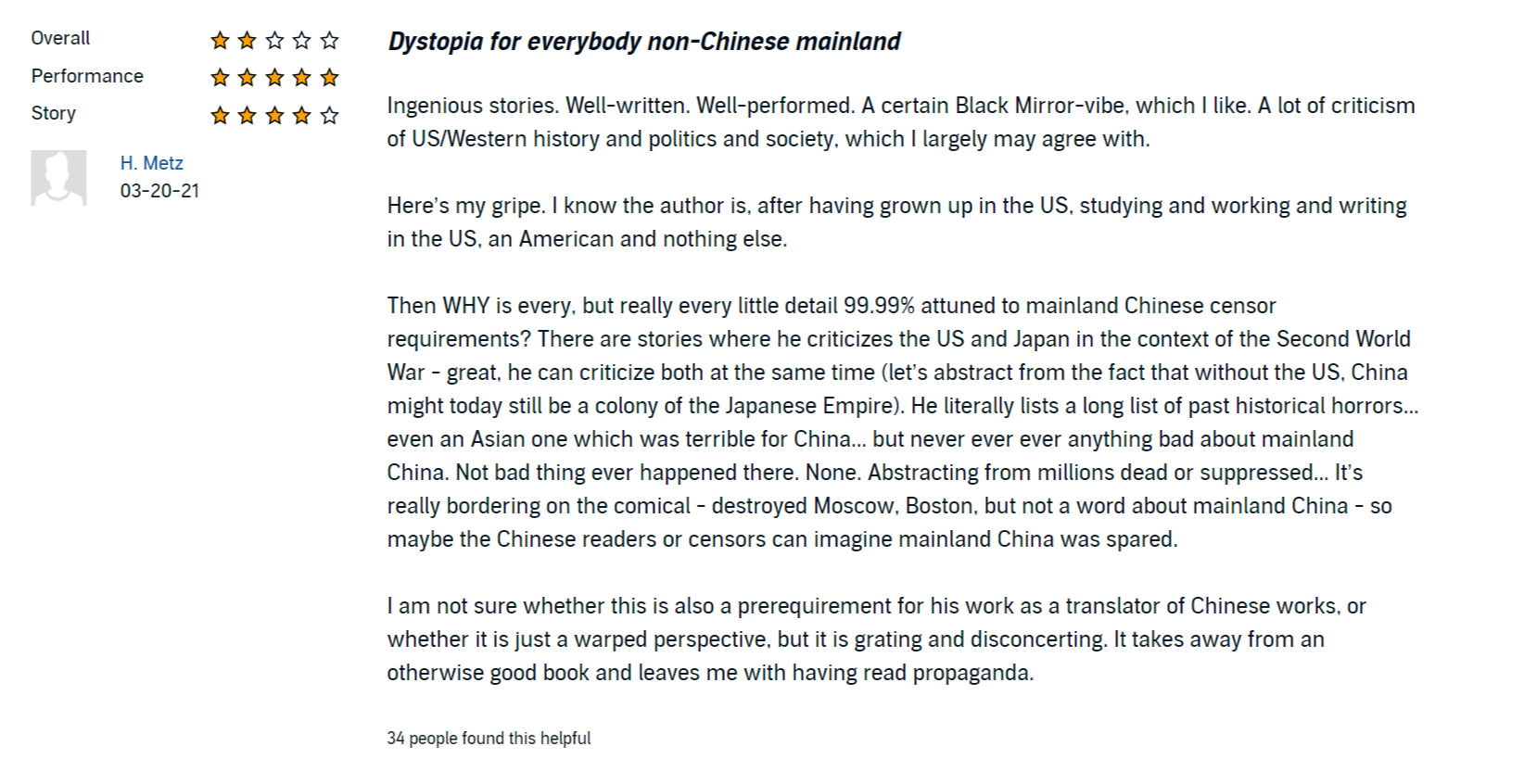
I consider alternate perspectives important even if I don’t necessarily agree with them, although I can’t help but feel like a lot of our cultural discussion is uselessly pigeonholed. For an example of what I mean by this, here’s a review of Hidden Girl. What this person even means by this, I honestly have no idea. The only story in your collection to even mention modern China, Byzantine Empathy, is quite critical of their Myanmar policy. What do you say to people who see that you’re Chinese and just assume that someway, somehow, you’re expressing secret pro China sympathies?
This is a good reminder of why I don’t read reviews. LOL.
As to the specifics of this reader’s complaint, I’m as baffled as you. The story they seem to be complaining about contains the very thing they claim I don’t include. But I’m not going to argue about it, as arguing against the absurd only legitimates it.
As an American, I’m naturally more interested in the future of America. I believe in our story and care about it viscerally—even though we seem to be fighting amongst ourselves a lot over what that story is right now—and so when I write fiction, I focus on the future of that story. This needs no explanation or apology.
But some people will always try to exclude me from the American story on the basis of my race — that’s the stance of the people in your hypothetical example. They believe that I’m sneaky and part of some conspiracy solely because of my racial identity, and of course we do have a name for that: racism. Now trying to explain yourself to placate racists is a waste of time. It’s like wrestling pigs: the pigs love it but you get all muddy.
I prefer to focus on readers who are worth focusing on. Life is much too short.
The Chinese uploads in Pantheon were interesting–we learn at one point that despite one of them being presumed to be an imprisoned democracy activist he’s actually an old school Communist. The English-language reporting on China is just so terrible no one from that sphere understands or cares about the distinction in political dissent. I don’t know how much influence you had on that, but do you have any comment on the notion of AI using identities to limit our interpretation of people and ideas instead of calling attention to the vastness of human experience?
I definitely agree that we should be on guard for allowing an identity label to flatten or displace the uniqueness of individual stories.
I don’t think any of us enjoy having others make assumptions about us solely because we can be described as belonging to “X” group. It’s even worse when your ideas are either dismissed or misinterpreted as a result of identity labels being attached to you.
We tend to see the diversity within our own group and are blind to such diversity within other groups. But this is something that can be corrected by conscious attention. Treating individuals as individuals is hard, and there’s always temptation to resort to shorthands and labels, but we have to push back against this laziness as much as possible. Otherwise we will miss out on so many useful, necessary, and beautiful ideas.
Finally, there’s also a practical craft tip based on this point: in art, easy labels make bad (because boring) characters.
Chanda going from a relatively generic cultish figure in The Gods Will Not Be Slain to a more well-rounded character in Pantheon is another figure warranting mention on the same lines. Do you think his changed motivation from story to show really makes that much of a difference?
I do. Chanda was not a fully fleshed out character in the stories (because the story I told was not about him). When Craig wanted to turn him into a real character for the show, we had to do all the work needed to make that happen. That you can understand his story, see him the way he wanted to be seen—that makes all the difference. Art is about the why, not merely the what.
Like I’ve said in other contexts: there are no monsters; the monster is us.
Of course that’s just another running theme in your work even far away from the uploaded intelligence premise. I’m thinking of how in The Message James decides that no one told about the pregnancy because he wasn’t ready to be a father, when he clearly had access to information demonstrating that the real problem was a fundamental disagreement over the importance of his work. Do reasons matter if the outcome is still the same?
That’s a debate that will not be resolved today or anytime in the near future.
We spend our lives crafting, editing, telling the story of who we are: to our friends, foes, lovers; to strangers; to ourselves. Everything we do makes sense to our own story.
But in that process, we weave others into our story, as supporting characters, as antagonists, as caricatures. To misunderstand others is sometimes inevitable, as we struggle to make sense of our own character arc and plot, fashioned out of this mess of one random thing happening after another that we can life.
It’s human to assume that we’re the hero of our own epics, but it bears remembering that so is everyone else. Let us have the grace to forgive others for not playing the role we want them to play in our stories, as we hope we’ll be forgiven in turn.
Well, those are all the questions I have for you. Are there any final words you’d like to add or discuss that I didn’t get into here?
I’m so glad that I got to be part of PANTHEON. Everyone, from Craig and the writers to the animation artists and voice actors and … all put their heart and soul into it, and I really think the result is something we can all be proud of. I wish it had gotten a bigger audience, but the audience we did and do have are the best, smartest thinkers I could wish for. Few artists get to have that, and I’m glad that I got so lucky.
Ken Liu is currently working on his next novel. He most recently published “The Passing of the Dragon” at Reactor Magazine, readable here. Those who enjoyed Liu’s answer to the sixth question of this interview will find that story a most expansive discussion of the subject of the meaning of art.
You May Also Like
-

-
 May 26, 2020
 -
 November 7, 2022