Making Princesses Great Again
Korean romantasy ‘The Remarried Empress’ gets the Disney treatment
The numbers are in, and The Remarried Empress is now Disney’s best ever local original premiere. That’s Disney marketing speak for most viewed — hence “best” — for a Disney+ (and Hulu) exclusive — hence “original” — that was produced outside of the United States, hence “local.” The casual viewer could be forgiven for not noticing that this is a homegrown South Korean production, though, given that The Remarried Empress is a tale of dashing occidental monarchs engaging in romantic banter near and around Czech castles.
Even Disney knows, however, that the very idea of glamorous princes and princess is passé at this point. While shoving remakes of its unwanted intellectual property into every theater, the Big Mouse has remained weirdly insistent about how princess culture is bad, actually. The Disney cult of personality remains a compelling subject, though, whether as a true crime documentary or a horrifying speculative fiction.
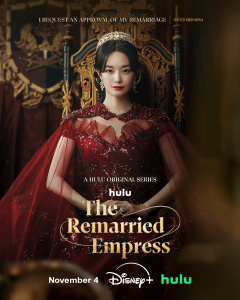 The unironic approach of the source material for The Remarried Empress is, for these reasons, difficult to fathom for audiences in the United States. The original webnovel and webtoon versions (this series is based on the latter) jumpstarted the whole genre of shojo royalist intrigue in South Korea, with its lead character Empress Navier (played by Shin Min-a in live-action) looking gorgeously storybook while also having a continuous, complex internal monologue combining the tactical wit of Jane Austen with the existential dread of the Bronte sisters. Despite its archaic influences, this Korean occidental romantic fantasy blends the best of multiple, wildly different genre traditions into something surprisingly distinct.
I mention the original romantasy novel and webtoon to emphasize that the live action version of The Remarried Empress is thoroughly modern — and that is not a compliment. The new series opens on Navier in bed with her husband emperor Sovieshu (played by Ju Ji-hoon), as he creepily purrs about wanting to get her pregnant while they prepare for their main work of the day: a hunting expedition. A big, magical forcefield encompasses a deer forest where an underground CGI abomination is also hiding. Bounty hunters chasing and brutalizing Rashta (played by Lee Se-young) are coincidentally caught in this magical dragnet, allowing Sovieshu to rescue the beautiful slave while some weird CGI bird rescues Navier from the monster.
If none of this sounds like royal intrigue, that’s where most of the trouble starts. This is a long and as-yet unfinished story, which takes six chunky tankobon sized volumes to even get to the point where the empress is remarried. Dithering on special effects extravaganzas, when this is a genre chiefly defined by beautiful wardrobes, is a questionable creative choice to say the least. If the new content was at least entertaining or expanded the world in a compelling way that would be fine but unfortunately, when The Remarried Empress isn’t doing gratuitous action and CGI, it’s mostly focused on adding moralizing material to remind the viewer that slavery is bad.
One of the better romantic costume dramas of recent years in the West, Bridgerton, contends with the awkward subtext of how the wealth of the very era it’s fetishizing was built on the exploitation of colonized labor, meaning that even though this alternate history has more privileged colorful faces, the exploitation still exists. The Remarried Empress has a similar elephant in its room, namely that slavery is intrinsic to its premise of empire, and the fact that Rashta is a runaway slave is a pretty big deal. The source material does a Bridgerton style sidestep, discussing slavery mostly in terms of its relation to the influence of noble families within the Eastern Empire, with Rashta’s obvious social ambitions and general lack of class consciousness making it fairly easy to avoid Marxist readings of her situation.
But rather than hiding this elephant in the corner, The Remarried Empress insists on making the viewer look at it with extended scenes of slaves and prisoners being brutalized and tortured. The intended purpose of this artistic choice is, frankly, difficult to fathom. The Remarried Empress is quite coy about what purpose slavery plays in the economic system of the Eastern Empire, which just makes the various whippings of slaves and prisoners feel that much more gratuitous since this doesn’t appear to be a problem anyone is all that interested in trying to solve.
The dialog states that slavery is actually illegal there, presumably to make Navier’s stewardship of this empire somewhat defensible. But Sovieshu’s treatment of prisoners suggests that the monarchs of this world are no strangers to brutality — even if being violent to bad guys has a certain filmic justice. In any event the moralizing doesn’t add anything to the central conflict, especially since the way the violence has a bad habit of abruptly jumping from gritty realism to cartoonish bravado.
Enter Prince Heinrey (played by Lee Jong-suk), who makes a good first impression by easily subduing a few dozen bandits who are harassing commoners at a local bar before going on to order a glass of milk. While in his original webtoon form Prince Heinrey could charitably be described as duplicitous, even by his confidantes and eventual wife, The Remarried Empress defangs him to the point of his being little more than a scamp, whose swashbuckling is bloodless and nonthreatening. Nothing is serious in The Remarried Empress despite events sometimes taking an abrupt turn for the tense, resulting in a warped sense of dramatic stakes.
This hits the hardest with the title character as Navier heads inexorably toward the defining event in her life. But unlike the other three principal characters, Navier doesn’t even have a confusing, counterintuitive relationship with the abstract concept of state-sponsored violence to explain her current life circumstances. She’s perturbed enough over Sovieshu obviously obsessing over Rashta to be annoyed about it, but lacks any apparent long-term goals or motivations to exposit the reasons behind her subdued reactions. Navier listens to gossip about Heinrey but has nothing to say about the political implications of why he’s coming to the Eastern Empire’s New Year’s celebration or what the normally aloof Western Kingdom’s reasons are for sending such a high-ranking representative to such an event.
The source material of The Remarried Empress was popular precisely because Navier’s internal monologues go a long way to explaining her often cold but always logical thought process, giving greater weight to her enigmatic smiles. But in live-action, Shin Min-a just has regular smiles, and they’re not even the smiles of an older woman finding moments of levity in an increasingly fraught political crisis. Navier in live action treats the unfolding drama with all the seriousness of a high school girl listening to the latest gossip about the prom.
That’s the counterintuitive Disneyfication that has been wrought on this franchise. Instead of becoming more family-friendly by scrapping the intellectual motivations and complex political machinations, the sex and the violence are amped up to such a high point that the show’s no longer kid-appropriate. Not that The Remarried Empress was ever really kid-appropriate but it wasn’t kid-exclusionary either. It aspired to tell an intelligent story about fundamentally rational, intelligent people mulling over who to knife, how to knife them, and what to do in order to avoid being seen as the bad guy for starting the knifing. The pretty dresses are a deceptively sweet introduction to a world of brutal political power plays lurking just beneath that surface.
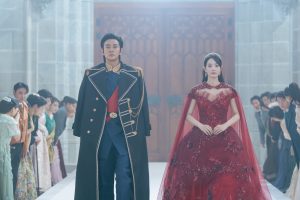
In its new Disney form, The Remarried Empress lacks any kind of broader target audience to whom its more “adult” changes would appeal, replacing nuance and subtext with overly literal knifing against characters too broadly caricatured as either good or evil with no real interest in their character motivations. New magical scenes accomplish little aside from further slowing down the glacial pacing and draining the special effects budget. New characters are introduced for little reason except to present more cheap moralizing when the whole point of a palace intrigue is that you’re never sure whether characters are actually malicious or just pretending. The ambiguity is what makes the story fun, adding faint hits of detective style drama for the viewer to guess along with the protagonist who’s really trustworthy, especially when we know information that they don’t.
The real shame of The Remarried Empress is that it does have moments where it hits those peaks that made the webtoon so iconic. Like the cliffhanger of the second episode, where Rashta first meets Navier. The empress coldly, politely tries to tell the runaway slave that they will never be friends, only for the situation to escalate and Sovieshu to assert rank. Moments like this have majesty worthy not just of the original story but also of the talented actors who K-Drama fans will recognize as big names commanding big paychecks.
The Remarried Empress has a lousy script and uninspired direction that seems incapable of doing anything impressive unless it’s directly imitating the visual composition of the webtoon. That paucity of original thought in an otherwise poorly adapted series means the expensively assembled actors have little to play with most of the time and the “best” audiences who have seen the Disney version only have seen the worst of the three versions. And, for such an iconic series, that’s a shame.
You May Also Like
-
 January 16, 1997
-
 November 28, 2022
-
 March 30, 2022