
Peter Sellers: One of the Best Bonds Ever!
Sixty years after his time on the 007 set, we reconsider an overlooked version of the iconic role
It’s that time again. Her Majesty’s Secret Service and Amazon MGM are in need of a new Bond, James Bond. As the franchise’s well-oiled promotion machine goes through its ritual, attention-getting “Who Will Be the Next Bond?” dance of the seven veils — and Polymarket favors Slow Horses star Jack Lowden — what better time for a salutary reexamination of multiple Oscar nominee and British comedian Peter Sellers’ notorious renegade turn as the world’s most famous secret agent?
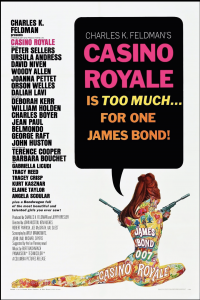 Quite simply, the psychologically tormented, chronically insecure, blank-slate Sellers — who always said the fact that he had no personality made him a brilliant impressionist — was one of the best Bonds ever.
Sadly, only Bond fanatics and lovers of late-Sixties psychedelia (we see you, Mike Myers) remember Sellers’ singular, intense, nuanced performance as 007. It’s easy to see why. That delicate, understated, prematurely interrupted tour de force was buried under the pyroclastic flow of excess and indulgence that was the 1967 film version of Casino Royale.
We are here to right that wrong.
Sellers’ James Bond-in-waiting Evelyn (“Isn’t that a girl’s name?”) Tremble — deserves a full scale excavation.
Casino Royale deserves much of the withering criticism it has received over the years, but Sellers’ performance amidst that mess needs to be recognised — and what a mess it was!
Producer Charles K. Feldman, armed with the film rights to the only Bond book not controlled by Cubby Broccoli’s Eon Productions, opted to forgo making a traditional spy film. Instead, the veteran producer — fresh off What’s New Pussycat? (1965) — dove deeper into the psychedelic, anti-establishment zeitgeist swirling around him.
Narrative structure was thrown out the window. Five maverick directors were hired to shoot unrelated segments in total isolation. Strong-willed, idiosyncratic stars like Sellers, Orson Welles, and Woody Allen were given carte blanche to write their own dialogue while a rotating array of writers drifted in and out of the project.
Five Bond segments emerged, wildly divergent in tone, look and quality. They were loosely held together by a flimsy premise in which an aged David Niven playing the original “Sir James Bond” takes over MI6 and renames every agent “James Bond” to sow confusion among their adversaries.
It was a madhouse.
For the first segment legendary director John Huston (The Maltese Falcon, The Dead) mailed in a glacially paced Benny Hill/Carry On-style bore in which Niven’s original morally upright Bond is besieged by platoons of beautiful women, bad accents, and even more dreadful double entendres. This bumps up against a visually delightful Ken Hughes-directed, Cabinet of Dr. Caligari-inspired 20-minute spasm of pop-art inflected German Expressionism set in East Berlin’s Mata Hari School of Dance. Woody Allen follows in full nebbish mode as Bond’s neurotic nephew “Jimmy Bond,” an arch-villain armed with ingestible micro-atomic bombs and a bacillus designed to destroy all men over 4’6. (This was the segment Myers’ Austin Powers franchise borrowed from most liberally.)
In the midst of all this — and intertwined — the understated, almost delicate Sellers mid-movie segments directed by Joseph McGrath The Magic Christian (1969) are left fighting for air.
To make matters worse, almost an hour of the film elapses before Sellers’ Tremble is properly introduced. The plot requires the mild-mannered, slightly neurotic baccarat expert to be recruited, transformed into James Bond, and sent to bankrupt and compromise the villain Le Chiffre. Played by Orson Welles, Le Chiffre is a gambling-addicted master spy specializing in kompromat and selling it to the highest bidder.
The initial sequences of this segment unfold in stellar fashion. Sellers and McGrath agreed Sellers would play Tremble straight. The comedy would arise from a normal, sophisticated man trapped inside an absurd environment — a template Sellers would perfect the following year as the repressed, straight-laced Harold Fine in the wonderful I Love You, Alice B. Toklas (1968).
Sellers was adamant he would not serve up another crowd-pleasing clown à la Inspector Clouseau. He was desperate to be acknowledged as a legitimate leading man, not a buffoon.
To this end, Sellers even secretly hired the brilliant satirist, counterculture darling, and script doctor extraordinaire Terry Southern (Dr. Strangelove (1964), The Magic Christian (1969)) to rewrite all his dialogue.
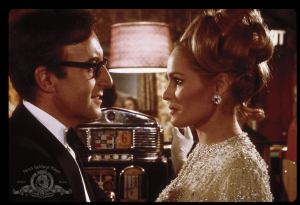
What emerged when Sellers was paired with “Ur-Bond Girl” Ursula Andress as super-spy Vesper Lynd were some of the finest non-action Bond sequences ever filmed. Andress’s Lynd — forced out of a wealthy retirement by MI6 via the threat of a tax audit to recruit Tremble — is herself a revelation. The Swiss stunner took full advantage of the production chaos and her irreplaceable status as a direct link to the official Eon Bond franchise to seize control of her dialogue and portrayal. She was never better.
The pair’s pivotal first meeting takes place in the dreary, decidedly downmarket — and very un-Bond-like — basement-dwelling Buckingham Club. It is there our Bond-to-be, the bespectacled Tremble, plies his professional gambler’s trade. The locale serves as a subtle British class cue largely lost on non-UK audiences, yet essential to understanding Tremble’s psyche. In a matter of minutes and a handful of micro-expressions, Tremble communicates a lifetime of quiet yearning for more alongside a surprising, destabilizing inner strength. Watch for the subtle flutter in Andress’s left eye at the close of their innuendo-laden sizing-up conversation, when this initially predatory professional realizes the seemingly meek baccarat expert now staring intently at her may be far more than she or MI6 bargained for.
From the humble Buckingham Club, Vesper lures Tremble across the class divide into her luxurious Mayfair apartment — and symbolically through John le Carré’s looking-glass into the world of espionage. All this is superbly shot in slow motion through the distorting lens of an enormous, room-sized aquarium, scored to Burt Bacharach and Hal David’s iconic, Oscar-nominated “The Look of Love” (sung by Dusty Springfield). It’s arguably the best Bond song ever.
In that dreamily evocative eye- and ear-worm scene, Sellers, Andress, McGrath, Southern, and Bacharach reach peak Bond. It is easy to see why, decades later, Myers lifted the visual aesthetic (but not the poignant mood) wholesale for Austin Powers.
Sellers and McGrath do concede to Feldman’s demands for just a little Sixties wackiness via a a sight-gag-stuffed Q-Branch gadget briefing, as well as a surreal identity test in which Lynd has Tremble try on costumes of famous historical figures. However, Tremble never drops his mask of earnest dignity. The buffoons are decidedly elsewhere.
Tremble’s transformation culminates as he pulls up at the opulent Casino Royale. After a telling, amusing moment of hesitation at the casino cashier’s cage — where the newly christened Bond gets a bit wobbly with his new surname — he and Lynd take in the grand lobby, and the slightest of smiles crosses our new Bond’s lips. He is ready to meet his moment.
Cruelly, for both audience and actor, this is the exact point where the production of this segment implodes.
Once the colossal yet fragile egos of Sellers and Orson Welles collided on set, things rapidly unraveled. Welles — like Huston, there purely for the paycheque — arrived with a sneer, quickly dominating the chaotic set by performing elaborate close-up magic tricks and treating the whole exercise as an extended party. Sellers the introvert, intimidated by the domineering Welles’ acknowledged artistic genius and disoriented by the mounting chaos, fled to his trailer.
Seeking to establish himself in Welles’ eyes, Sellers invited his friend Princess Margaret, the Queen’s sister, to an on-set luncheon. Catastrophe ensued. After Sellers greeted the Princess with an elaborate, cringe-inducing display of self-debasement and British class deference, she walked right past him to spend the entire lunch gushing over a gloating Welles.
Crushed, Sellers refused to be in the same room as Welles. When McGrath told him he was acting like a child, Sellers slugged McGrath, then fired him. Ironically, it was Sellers who had campaigned for Welles to play Le Chiffre.
McGrath’s departure solved nothing. Sellers continued refusing to share a set with Welles, forcing their shots “together” to be filmed on separate days using stand-ins and mannequins — including the climactic baccarat game and aftermath, which turned out surprisingly well.
Then before anything could truly be finished, Sellers walked off the set for good. This triggered a panicked rush of rewrites and frantic efforts to stitch together a coherent end to his storyline using every scrap of Sellers footage available, including outtakes and previously rejected material — explaining the wild incoherence of the film’s final stretch.
Given that chaos, The Manchurian Candidate-style psychedelic psychological torture sequence and the genuinely funny cameo by Sellers’ friend Peter O’Toole — assembled by directors Robert Parrish and Val Guest just prior to that finale — are, in retrospect, pretty impressive.
The same cannot be said for how the now scrambling production kills off its star mid-shoot. Reluctant cleanup director Guest reconfigures an already-shot scene in which Lynd rescues her protégé from a murderous mob of bagpipers. Recalling Andress to the set, he reshoots the ending so that, after seemingly saving him, Lynd inexplicably turns her bagpipe machine gun on her beloved Bond, slaughtering him. Her clunker of an accompanying line — “Never trust a rich spy” — does nothing to sell this jarring betrayal of their earlier on-screen romance.
So there it is. What remains of Sellers’ performance is a haunting cinematic “what if.” Yet the roughly half-hour that remains is more than enough to prove the point. Sellers was a hell of a Bond. Happily, modern viewing habits — heavily focused on clips and shorter attention spans — may well resurrect Sellers’ rogue 007 and bring the story of Evelyn Tremble’s fragmentary apotheosis into Bond to the wider audience it so richly deserves.
You May Also Like
-
 November 6, 2020
-
 October 7, 2021
-
 October 5, 2026
