
From Village to Myth: Moscow’s Thousand-Year Story
Simon Morrison’s sweeping history traces the rise of one of the world’s great cities
Towards the end of his eminently readable new book A Kingdom and a Village: A One-Thousand Year History of Moscow, Simon Morrison references another book on Russia by scholar Alexei Yurchak, Everything Was Forever, Until It Was No More. This latter title perfectly encapsulated why I wanted to read Morrison’s book. So much of my comfortable-enough American life from 30 years ago felt like forever at the time, but now it felt as if it was on the precipice of “no more.”
Russia seemed long ago to have passed the point where their people no longer believed in their country and instead were stuck with a broken political system that seemed to have very little to do with them. How does that happen? How might we prevent it? While my reasons for wanting to read the book centered on these questions, Morrison has plans of his own. His title instead chronicles several centuries during which Moscow goes from being a small village on the Moskva River comprised of a hodge-podge of races and ethnicities to becoming the capital of a fully realized country with kings and enemies and an individual identity we all might recognize as Russian. This well-researched chronicling turns out to be the most valuable part of Morrison’s book.
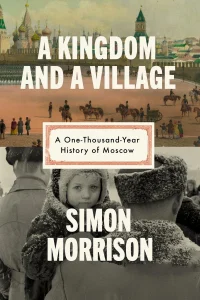
A Kingdom and a Village:A One-Thousand-Year History of Moscow
By Simon Morrison
Knopf; 399 pages
To give some sense of Morrison’s subject matter, he offers a detailed look into what we can know about the original Muscovites — a combination of Byzantine-influenced Slavics and Scandinavians, among others, each bringing their own culture to the region over a period of centuries.
The common enemies of these disparate groups were mostly a combination of the Mongols and Tatars from the east, whose Golden Horde (descendants of Genghis Khan) made a habit of sacking Moscow in the early 13th century. However, the people to the west were not exactly hospitable either. Germans and Swedes made practices of raiding and attempting to colonize the village that would become Moscow. I was struck by Morrison’s effective scene-setting both through stories and impressive research, showing how these Rus villages were wedged between East and West.
The country that would one day occupy eleven times zones and would call itself a sixth of the world, began as just a small group of colonies besieged on all sides by the larger forces of the world. Together, they did their best to get on, avoid fires and plagues, and keep the barbarians at bay.
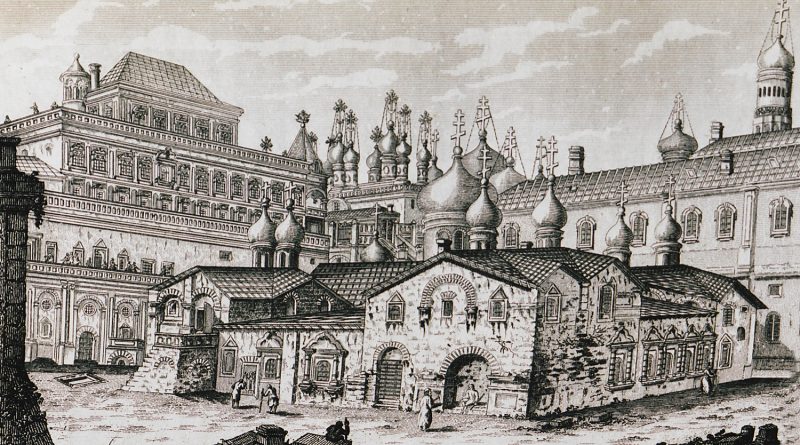
 The village grew into a city, the seat of government of a whole kingdom. And then the unthinkable: in 1712, Peter the Great moved the capital of Russia from the barbarian, easterly Moscow to the civilized western St. Petersburg. The Tsar disliked Moscow and favored the Europeanization of Russia. He even “brought public theater to [Moscow], after which came public opera, ballet, and homegrown literature.” There were still barbarians at the eastern gate, but the West was welcome in, at least for some, though Morrison reminds us that the more insular Orthodox church wanted nothing to do with it.
The church’s attitude would prove prescient. Napoleon came galloping into Moscow from the West in 1812, giving the city and country an enemy against which to unify. With Napoleon’s defeat, Moscow, which had “clung to Slavophile traditions” while St. Petersburg kowtowed to Europe, regained its central place in the minds of its people. As Morrison, a lover of Moscow if there ever was one, would have it, the Russian Empire would stand, but only because the city Peter had eschewed for more cosmopolitan climes remained true to itself. Moscow was again the bedrock of Russian ethos.
It isn’t until the latter part of the book that Morrison offers the first hint of the denials and obfuscations that become part and parcel of Moscow in the 20th century. He describes the contents of a 1927 book called Vanished Moscow that chronicles the author Ivan Alexandrovich Belousev’s Moscow neighborhood of Zaryadye around the turn of the 20th century. The neighborhood featured Jewish merchants who were forced to leave the city in 1891-92 by Tsar Alexander III. Morrison describes going to the Jewish Museum and Tolerance Center in 2019 and how the institution glosses over the pogroms of the Russian Empire and offers no information at all on Zaryadye. By the time of Morrison’s museum visit, controlling the narrative had become a hallmark of Russian life for decades. The kingdom and the village were both gone. What was left?
Morrison’s chronicling of the turn of the 20th century in the country reveals what happened between Zaryadye and his 2019 museum visit. A series of workers’ strikes in Moscow and St. Petersburg led to the fall of the monarchy in 1917 and the surprising rise of the Bolshevik Vladimir Ilyich Lenin. Lenin “found himself presiding over a catastrophe of his own making,” a catastrophe that went into overdrive when Joseph Stalin took over in 1924. “Stalin falsified reality and then falsified falsehoods.” In 1937-38, Stalin’s regime arrested more than 1.5 million and executed more than 650,000. People starved, but the positive spin from government’s censors and cultural representatives never ceased. You can imagine the populace ignoring the nonsense from their political leaders whenever possible, or at least I can.
Morrison writes, “Totalitarian regimes repress people for what they are: obstacles on the path to paradise.” Those 650,000 executed seemingly were such obstacles. I can sometimes feel like a similar obstacle, though I continue to hope the majority of our country eventually sees the current administration as the obstacle. To trust Morrison’s account, powerful nations can go from a place where well-meaning people and their government work together to achieve shared goals, such as when Russia banded together against Napoleon, to a place that can make the lives of those well-meaning people very hard, even to the point of erasing them. Understanding that much strikes me as a clue to saving our own.
You May Also Like
-
 December 28, 2023
 -
 December 28, 2018
 -
 October 23, 2020
