
In ‘The Boundless Deep’ We See a Poet’s Struggle With Belief
A young Alfred Lord Tennyson spent decades trying to resolve science and God
Science and technology have never been able to satisfy our deepest needs, though they have often tried. All the talk of AI bots that chat with you like a special friend strikes me as nightmarish. Who is so desperate to make people replaceable? I’m not sure I trust the motivations of these machine makers. The same goes for language tools that write books and song lyrics for you. I don’t want AI-generated Bob Dylans or Toni Morrisons. When in doubt, keep humans in the equation, or how about leave equations out of it entirely?
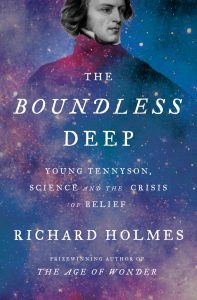
The Boundless Deep: Young Tennyson, Science, and the Crisis of Belief
By Richard Holmes
Pantheon; 448 pages
While perhaps new to me, uncomfortable feelings about science and technology, such as our current qualms about AI, are not unique to our time. Those with deep attachments to things such as traditional religion have been wrestling with the new science of the day for centuries. The latest effort by biographer Richard Holmes, The Boundless Deep, touches on the concerns of the newest scientific advancements on the development of Alfred Lord Tennyson, who loved science but needed more than just the measurable to satisfy his soul.

In The Boundless Deep, Holmes chronicles the struggles of a young Tennyson as the discoveries of his time impacted “biological evolution, a godless universe, and planetary extinction.” Holmes uses sources to draw out how Tennyson’s scientific intellectual development, which came into direct conflict with his spiritual being. It took 16 years, but Tennyson eventually resolved this conflict as revealed through his masterwork poem In Memoriam and the newly hatched agnosticism therein.
Tennyson grew up as the son of an Anglican rector but quickly found himself fascinated by books like the Conversations on Physical Science, one of a popular series at the time. “The book was simple enough,” he writes in a letter, “but somehow, I don’t know why, I felt different after reading it. The oxygen and carbon and all the rest of it unsettled me a little, and made me less able to believe, made my faith heavier, duller.” I can’t help but think of my own feelings when confronted with the entirely computer-generated band the Velvet Sundown and their millions of Spotify followers. I understand Tennyson’s unsettled feelings. Is nothing sacred?
A central scientific event that rattled young Tennyson was the discovery, in 1824, of the bones of the Megalosaurus. “This was a grotesque type of giant lizard,” Holmes writes, “which had roamed the earth in unspecified antiquity, and which is now recognised as the first genus of non-avian dinosaur.” It’s quaint to think there was time when folks like Tennyson were made aware of dinosaurs, blowing out of the water the supposed 6,000 years of humanity outlined in the Bible. The news seems to have caused very real trauma in the rector’s son, a kind of spiritual terror. These and other new discoveries were coming for Tennyson, for everyone. Fundamental intellectual and empirical changes were afoot that needed to be responded to, or else.
Central to Tennyson’s development as a poet was the tragic death of his friend Arthur Hallam of a stroke. Tennyson was 24 at the time, and his feelings surrounding this event would become the genesis of his most celebrated poem In Memoriam. Tennyson worked on it for years before its publication in 1850, when the poet was 40. At 131 cantos and 723 stanzas, the poem is monumental, with sections on Hallam and others on faith, science, and mortality.
 While most aspects of Tennyson’s life are treated chronologically in the biography, Holmes refers to In Memoriam throughout. This choice both reflects the fact that Tennyson was working on it during the span of his life covered in the book, as well as gives the poem pride of place. It was, if not the most popular, the most respected piece of writing he ever did, the one poem by him every English major like me had to read.
The poem attempts to offer something of a crystallization of Tennyson’s spiritual development during his first four decades. It starts with the poet’s intensely personal feelings for his dead friend, but over the years Tennyson manages to address the spiritual concerns surrounding the ascendant sciences of astronomy and geology and what they mean for the centrality of Christian thought to himself and others. “The collection continuously evolved,” Holmes writes, “and only towards the very end did Tennyson try to impose on it a traditionally religious, even specifically Christian theme: Death, Mourning and Rebirth.” If the Earth has been around for far longer than the Bible suggests, and the stars just keep going, how can Tennyson continue to believe in God? In Memoriam offers a kind of answer.
It would take the better part of two decades of wrestling with religious doubt for Tennyson to get back to something resembling faith. Holmes chronicles this inner wrestling in detail. It included several years of flopping at friends’ houses, traveling from London to his childhood home of Lincolnshire and back, and questioning the value of his poetic gift. “He realized [his poetry] might be just a form of indulgent therapy, or even a kind of drug-taking, a ‘narcotic’ like his brother Charles’s opium-taking, or even Coleridge’s at Highgate.” Was a well-wrought poem from his heart just another beautiful delusion, another thing that didn’t deserve his devotion?
In his thirties, Tennyson’s finally tackled through his poetry the lack of evidence of a creative God in the face of evolution. His craft seemed to be the one possible avenue that might have the capacity to mitigate his doubt. Holmes writes, “Long before [Tennyson] — or anyone else — could have read Darwin, he responded to the metaphysical crisis that Darwinism and the actual theory of evolution would subsequently produce throughout society.” In In Memoriam Nos. 50-60, Tennyson deals with this “intellectual and … imaginative crisis” that Holmes compares to “the discovery of life — intelligent life, not mere bacterial life, but an entire civilization — on another planet. Our whole view of Creation would have to change.”
In In Memoriam No. 54, Tennyson writes:
That nothing walks with aimless feet;
That not one life shall be destroy’d,
Or cast as rubbish to the void,
When God hath made the pile complete;
Tennyson was rocked to his core by the idea that humans could be just another animal that might go extinct, thrown on the rubbish pile with the dinosaurs. Scientific discovery rendered real existential pain for him.
It would take years, but as chronicled by Holmes, Tennyson’s poetry would eventually offer a path that allowed the latest scientific discoveries to coexist with his deeper beliefs. In In Memoriam Nos. 118-123, Tennyson learns to see the development of man’s spiritual tendency as part of the universe’s evolution. Tennyson writes in No. 118 of man:
Who trove and branch’d from clime to clime,
The herald of a higher race,
And of himself in higher place,
If so he type this work of time
In other words, according to Holmes, Tennyson resolves that the “cosmic evolution among the stars might produce a moral or spiritual evolution among mankind. We might evolve into a ‘nobler’ race, or ‘higher’ type of humanity.” The very fact that we can “type,” or represent, the works of man shows we have evolved into something of a higher form. Why would that evolutionary process not also impact our moral and spiritual development? Thus, evolution and spirituality existed without conflict in him for the first time.
Tennyson’s next forty years would be spent as the Poet Laureate of England, embracing all life had to offer him from his various areas of interest. Despite his well-known success in his later years, his lofty position was borne from soil of real chaos, and like the chaos that brought us life in the first place, the results can be beautiful.
You May Also Like
-
 March 19, 2022
 -
 January 27, 2023
 -
 June 9, 2022
