
Jack Kerouac on the Run
A new Grolier Club exhibition reveals unexpected sides of the Beat writer — an athlete and artist whose literary destiny was born from a freak accident.
One day in the fall of 1940, just two weeks into his first semester at Columbia University, Jack Kerouac suffered a broken leg. According to an account from his friend and dorm-mate Jimmy Crump, the accident in only his second football game of the season left the young man physically and mentally shattered for weeks. Career seemingly shattered like his leg, Kerouac lay on his back in his dorm room, looking at the ceiling, unable to attend classes.
“Running Through Heaven: Visions of Jack Kerouac,” an exhibition at Manhattan’s Grolier Club through May 16, offers viewers a pointed reminder of the role of chance and luck in human affairs and the ability of random events to alter the course of history — in this case, literary history.
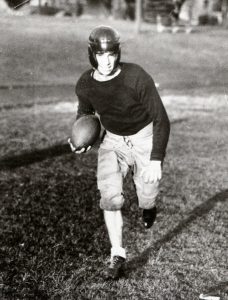
In the new show, we get a glimpse of Kerouac before his matriculation to Columbia. An eager boy in athletic gear, clutching a football in his right hand, charges toward the camera, grinning, full of confidence. His passion for the sport is palpable. A caption informs the viewer that the photo dates to the late 1930s, when Kerouac was a “standout running back” and “star athlete” in Lowell, Massachusetts, before the accident that “ended his football days and redirected him toward a career in literature.”
After that broken leg rendered him unable to run, dive, or tackle, Kerouac resolved to express himself through feats of lyricism, in sentences that run on for pages, driven by an inexhaustible passion. In this connection, one might think of a line from the new play Giant, in which Tom Maschler, an editor who is about to enter a tennis match with the writer Ian McEwan, quips, “If he plays as well as he writes, I’m f***ed.” If Kerouac had played football with the brio he brought to his writing, he would have left heaps of wrecked bodies across the playing fields.
 Though the mishap at Columbia must have been harrowing, the rest of the exhibit depends on it. Without it, Kerouac would have been too busy with pro sports to have adventures in far-flung places such as Morocco, Mexico, and California, let alone have the time to sit down and write works such as On the Road, The Subterraneans, The Dharma Bums, Dr. Sax, Big Sur, Visions of Gerard, and Desolation Angels.
“Running Through Heaven” features little-known samples of the creative spirit that manifested itself over the course of a relatively brief, but quite busy, career — not just in prose but, interestingly, in art. One of the items is a self-portrait Kerouac sketched in pencil in 1956 while living in Mexico and presented to his then-girlfriend, Helen Weaver. In it, Kerouac’s torso and shoulders appear as just the faintest of outlines, while his head and face are rendered in detail, as if reflecting how chance and luck made him a writer and thinker rather than a footballer relying heavily on upper-body strength.
Then there’s “Angel Midnight,” an ink-and-pastel rendering of an angel under the kind of impressionistic sky that Van Gogh might have painted, which, according to the caption, Kerouac originally conceived as cover art for an experimental poem.
Though evidence of Kerouac’s talent as a visual artist is abundant at the Grolier Club, some viewers will be more curious about rare first editions of books that had an influence on them or even changed their lives. The exhibition also includes Kerouac’s personal copy of the seminal novel On the Road — a 1957 Viking Press edition with a subdued cover design featuring abstract art in a small box above the title against a black background.
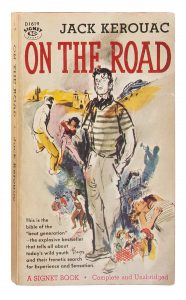 By 1958, Signet’s first edition cover features a guy who looks much like the young Kerouac himself. The caption states the edition’s impact: “Its sensational cover and wide distribution helped fix his image as the voice of a rebellious generation.”
The caption continues, though, that Kerouac “grew uneasy with the Beat label.” Perhaps the exhibition could have explored in more detail why later Kerouac might not have liked people associating him so directly with youthful rebellion and the Beat generation. His later identification with tradition and sectarian order grew partly out of his interest in Brittany and his French Catholic lineage — a subject of Satori in Paris, Kerouac’s 1966 account of a trip he took to Paris and Brittany.
In the course of that trip, Kerouac did genealogical research at the Bibliothèque nationale, hoping to unearth information about the people of northwestern France from whom he was descended, and took a train ride out to the Breton coast to get to know the people of that region and their ways. Unfashionable as it might be, then and now, a theme of Satori in Paris is Kerouac’s growing sympathy for the conservative instincts that drove some people of the region to oppose the French Revolution.
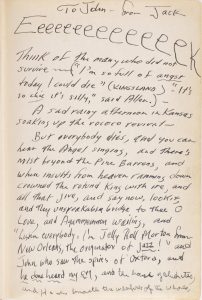
The Grolier Club show also features a 1950 Harcourt, Brace first edition of one of Kerouac’s least-known works, The Town and the City, which contains a joint inscription from the author and his friend and fellow Beat, Allen Ginsberg, along with a handwritten note beginning, “Think of the many who did not survive.” The note goes on to refer to “a sad rainy afternoon in Kansas” and is full of imagery about death, end times, and divine retribution. Whole PhDs could be — and maybe have been — written about this complicated, rambling diatribe.
 Besides the published works, we see letters from Kerouac to friends such as Ed White, a friend from Columbia, and Neal Cassady, a member of his inner circle. But one wonders whether any of those acquaintances had quite the same impact on his mind and creative self as his relationship with William S. Burroughs.
Indeed, one of the most striking items in the show is Ginsberg’s 1957 photo of Kerouac holding Burroughs’s cat in a garden in Tangiers, where, the caption states, Kerouac had gone to help type up the manuscript of Naked Lunch. One hopes that his presence there, and the affection he showed the cat, might have provided one of the more peaceful passages in the troubled life of Burroughs.
Still other items in “Running Through Heaven,” whose title alludes to Kerouac’s staying power as a writer and visionary after an accident took away his ability to be a literal running back, are of a more intrusive nature. All writers have juvenilia, and one wonders whether “Ken Harris,” a detective story dating to Kerouac’s early years in Lowell, is a work he would have wanted audiences to see.
The caption calls it a “somewhat sophomoric exploration of detective genre fiction” that nonetheless demonstrates a “talent for setting the scene in words.”
When Kerouac died in 1969 at age 47, the victim of chronic alcohol abuse, his juvenilia was far in the rear-view mirror — to adopt the idiom of his most famous novel. Prevented by a freak accident from launching a pro sports career, Kerouac rushes you with a typewriter, rather than a football, and he knocks the wind right out of you.
You May Also Like
-
 August 15, 2019
 -
 February 24, 2020
 -
 January 9, 2019

Kerouac experianced first hand life’s twists. No longer an athlete, he picked up the pen and was quite successful despite passing so young. He is an inspiration showing us that even when dealt with difficult or life changing decisions, you still can standout. Excellent article.