
Art Blossoms Where No One Is Watching
Wong Kar Wai’s ‘Blossoms Shanghai’ rewards time and patience
Towards the end of 2019, the French film magazine Cahiers du Cinéma released their picks for the best films of the 2010s. At the top of the list was a choice many might consider provocative: the third season of the late David Lynch’s television series Twin Peaks, which premiered on Showtime in 2017. Could a TV series be considered a film, even if conceived by an artist known for his contributions to cinema? Blossoms Shanghai has the potential to reignite such a debate, since this first work in more than a decade from acclaimed Hong Kong filmmaker Wong Kar Wai is a 30-episode TV series that began unfurling here in the United States, three episodes a week, on the Criterion Channel in late November of last year.
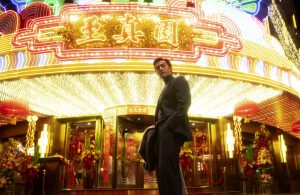
But though it became a huge hit in China when it premiered in late 2023, its reception so far here in the U.S. has been more muted. Granted, Wong is more an art-house cinema darling than either Lynch or a highly regarded TV auteur like Vince Gilligan and Ryan Murphy, so Blossoms Shanghai was always going to be a relatively niche interest here. But even cinephiles seem not to be paying it much attention, or are at best damning it with faint praise. The initial reviews that greeted Blossoms Shanghai here in late November — ranging from disappointed to respectful, most of them written by TV, not film, critics — didn’t help.
But is it really fair to judge an entire series if you are technically only getting a portion of the whole story? Most of those TV critics were judging a 30-episode narrative based either six or 12 episodes. That’s like declaring a book a masterpiece or a failure based on reading only the first third. One Brother Karamazov anyone?
Having now seen all 30 episodes, I’m ready to pass judgment on Blossoms Shanghai.
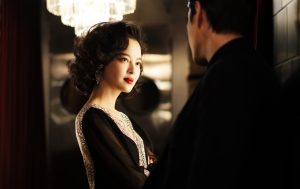
It’s worth taking seriously as a work of art. If not necessarily a masterpiece on par with, say, Wong’s In the Mood for Love, it still shows this great filmmaker both solidifying his strengths and pushing his art in fresh directions.
One of those fresh directions is narrative. With films like In the Mood for Love, Chungking Express, and Happy Together, specific scenes, images, and feelings stick in the mind rather than narrative arcs. This isn’t surprising given the way Wong has historically made films: without a script beforehand, reliant on improvisation, feeling out his stories and characters as he goes. Such an intuitive approach was probably impossible, though, for a project as large as Blossoms Shanghai.
Based on Jin Yucheng’s novel Blossoms, Wong for once had to work with a screenwriter, Qin Wen, to keep track of its multiple characters and storylines. (For the record, controversy has erupted around a screenwriter’s claim that Wong and Qin stole his work for the show without proper credit, in addition to exploitative working conditions generally.)
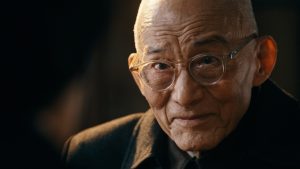
The first few episodes don’t entirely allay fears of Wong subsuming his distinct aesthetic under more mundane storytelling needs. Because so much about the setting — Shanghai during its economic boom in the early 1990s — and the characters need to be set up, there’s inevitably lots of dialogue to contend with. So, even though Wong’s visual signatures are omnipresent — shots of characters caught in mirror reflections and through windows and doorways, the blurry step-printed motion — initially there’s a sense of an artist merely delving into a familiar bag of tricks to liven up breathlessly-delivered exposition. Nor does his reuse of music cues that featured in many of his earlier films inspire confidence (though that’s a fault perhaps only diehard Wong fans like myself would notice).
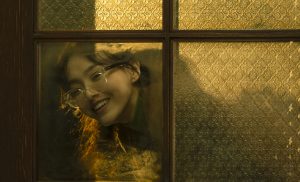
Gradually, however, many of Wong’s thematic tentpoles swim into view. Broadly speaking, the series chronicles the rise and fall of Ah Bao (Hu Ge), who, in Jay Gatsby fashion, earned enough from the stock market and other deals to transform himself into Mr. Bao, a wealthy man about town: the subject of everyone’s gossip. Mr. Bao could be seen as a variation of Chow Mo-wan (Tony Leung) in Wong’s part-historical, part-science fiction folly 2046: an enigmatic heartbreaker around whom a trio of lovelorn women revolve. In Blossoms Shanghai, that trio includes: Ling Zi (Ma Yili), the co-owner of Tokyo Nights, a restaurant that functions as Mr. Bao’s oasis from the Vegas-like hoopla of his current home base of Huanghe Road; Miss Wang (Tang Yan), a close business associate of Mr. Bao’s at the Foreign Trade Office; and Li Li (Xin Zhilei), the owner of the new Grand Lisbon restaurant on Huanghe Road, and someone who, like Mr. Bao, is an outsider with a mysterious past. (There are plenty more significant characters, many of them mentioned in this handy introductory piece.)
What distinguishes these relationships from those in Wong’s previous films is the sense that these and many other characters are expressing their innermost feelings through their actions. In the world of Blossoms Shanghai, even the riskiest stock trade is fraught with romantic subtext, with Shanghai’s booming market providing the arena in which characters express loyalty or rejection. Even when the series threatens to bog down in financial jargon as Ah Bao and others cut backroom deals and buy and sell stocks, Wong keeps the underlying emotional stakes clear. His use of color, motion, and sound gains in resonance once you realize he’s amplifying what these characters otherwise choose to keep close to the vest. In such a context, moments of actual physical contact, however small, tremble with cosmic significance.
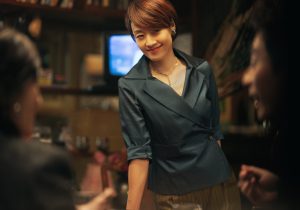
“All memories are traces of tears,” according to an oft-quoted intertitle from 2046. Blossoms Shanghai similarly traces the ways that people enshrine even the most painful memories and emotions in their psyches the way Marcel Proust’s narrator in In Search of Lost Time fixated on the way a mere madeleine inspired a host of personal and historical associations. Because of the epic length of the series, even more than in his films, we not only notice the way objects and actions acquire significance over time, but truly feel it. When, for instance, a Cadillac in an early episode pops up towards the last third of the series in a different form, there’s a genuine sense of tragedy in the way one character misunderstands the intentions of another based on their changed relationship.
That kind of attention to novelistic detail is new in Wong’s filmography, as is the rigorous world-building on display. (Adding to that rigor: Wong’s decision to have most of the cast speak in the local Chinese dialect of Shanghainese instead of the more widely spoken Mandarin.) Screenwriter Qin Wen deserves much of the credit for the way the hustling, bustling Huanghe Road becomes a whole universe in itself, one with a pecking order, territorial disputes, and even a roadside vendor serving as a local historian and Greek chorus. But it wouldn’t have come to life without Wong’s far-seeing vision; Peter Pau’s colorful cinematography; Nan Tu’s dazzling art direction; Yuan Du’s propulsive editing; and the magnetic, vividly theatrical performances in its large ensemble cast.
At its best, watching Blossoms Shanghai is like diving into a lively and immersive serial, one that keeps you gripped moment by moment, episode by episode, while offering enough on a broader level to make the entire meal feel truly filling. By the culmination of this 30-episode series, you feel like you’ve witnessed an entire epoch passing, a whole society ushered into a new era. That’s certainly more than can be said of any of Wong’s much shorter films.
The final three episodes of Blossoms Shanghai drop on the Criterion Channel on Monday, January 26, 2026.
You May Also Like
-
 April 25, 2022
 -
 February 3, 2019
 -
 April 26, 2022
