Back in the U.S.S.R.
Rock and rolling back the years with Boris Grebenshchikov
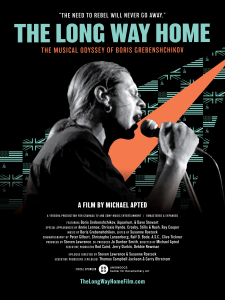
Some 37 years ago, Michael Apted, the late English documentary director probably best known for the Up documentary series Coal Miner’s Daughter, Gorillas in the Mist and the James Bond movie, The World Is Not Enough, made the speculative rockumentary The Long Way Home. Over the course of 1988, he followed legendary Soviet rock star Boris Grebenschikov as the Russian tried to parlay his musical ability and Soviet underground cred into international rock stardom. If this is the first time you’ve ever heard of Boris Grebenshchikov, well, that just shows how the plan worked.
It wasn’t for lack of trying. Grebenshchikov hung out with Dave Stewart from The Eurythmics and got media spots across Western media, including on Letterman. Even then he spoke, sang, and wrote in very good English. Originally released on British public television in 1989, the Sundance Film Festival in 1990, with a VHS release in 1991, The Long Way Home has since fallen into a similar obscurity to its subject, with no official distributor. A remastered version of The Long Way Home will play at the Museum of Modern Art in New York City on Wednesday, January 28, in hopes of a sale for wider distribution.
The Long Way Home ★★★ (3/5 stars)
Directed by: Michael Apted
Written by: Zack Hilditch
Starring: Boris Grebenshchikov
Running time: 97 minutes
Originally only 82 minutes, the extra fifteen minutes of the remaster consist mainly of a short, vague afterword which highlights Grebenshchikov’s opposition to the war in Ukraine which resulted in his exile from Russia. This explains why a remaster of the project became viable. The Long Way Home is for the most part an unintentional depiction of the style and culture clash between American music producers and Grebenshchikov. The argumentative nature of these sections would take on a very different meaning if Grebenshchikov was a Putin supporter.
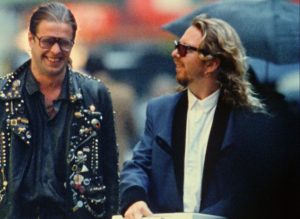
Whatever his specific issues in regard to the act of making music, though, Grebenshchikov is a remarkably sunny, optimistic guy when it comes to idea of music as a politics-transcending means of achieving peace. The Long Way Home sets this tone early with Grebenshchikov’s own words. His interest in music began way back in the early ’60s, where every 25 seconds on Voice of America, there would be a three second chord, which Grebenshchikov later identified as The Beatles.
However, Grebenshchikov came to rock music from Leningrad, literally, a very different place than the typical Beatles fan. You can hear it in the ennui of his often elegiac music that comes from the restricted world he lived in. To use Grebenshchikov’s own words, The Long Way Home tells the story of a yearning for freedom, to go beyond the limitations of Leningrad.
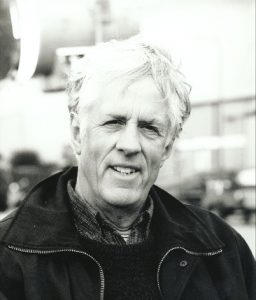
That’s certainly how the documentary read in its original 1989 context. In retrospect, Grebenshchikov’s optimism seems outrageously misplaced. It’s quite clear that his approach to making music is almost fundamentally incompatible with the American producers. Grebenshchikov isn’t making a product. He’s making art, and relishes spending as much time as he can perfecting it. Emphasis on “he can.”
Perhaps as a consequence of dealing with the Soviet system Grebenshchikov is bad at taking advice. He has been brought up to know better than to show weakness to the demands of the producers. As he sees it, he has a deadline, and so long as he meets that deadline, they have no valid cause to complain. Despite his soft-spoken demeanor, he seems utterly impervious to any pressure or from American producers or any sense that they have anything to contribute. In one especially brutal read, he bluntly tells the producers they won’t be able to intimidate him.
Grebenshchikov’s other worst enemy is his own self-doubt which, along with the despair caused by the sadness of Leningrad, delays the completion of songs and releases. In the most singularly ironic part of the film. Leningrad circa 1988 actually looks pretty nice — very clean, and quiet. Grebenshchikov’s daily life there looks rather pleasant. There’s even a scene where he takes his son to the hot baths, complete with all the implied nudity . When Grebenshchikov talks about how he’s sad because he doesn’t see his wife as often as he’d like (apparently there’s 30 people in the room every time he does see her), he looks and acts like every worker who misses their spouse because of the workaday grind. In this way, Apted’s depiction of him is about as far away from the stereotypical idea of a rock star as you can get.
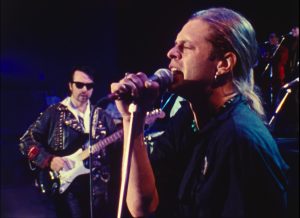
The Long Way Home also depicts a rather one-sided version of Glasnost which, again, makes some sense in its original late ’80s context. People in the West already knew how they felt about Glasnost, getting the opinion of a Soviet celebrity was the novelty. Forty years on, though, it’s hard to shake the feeling that Grebenshchikov’s interpretation of the thawing relationship was a tad rosy. We don’t see as much of Los Angeles as we do of Leningrad, but what little we do see is a dump by comparison. In one blink-and-you’ll-miss-it shot, there’s a billboard for Rambo III, a movie which somewhat infamously glamorized freedom fighters like Osama bin Laden.
All of which is to say, Americans in 1988 clearly had a very different interpretation of Grebenshchikov’s world than he had of theirs. Grebenshchikov never thought Americans were the enemy, even if he ultimately, after continued exposure, decided he didn’t like them all that much and thought American rock music had become stagnant. But even when he’s being negative, Grebenshchikov is a likeable, affable guy with a demeanor that exudes the same chill folk vibe as his music.
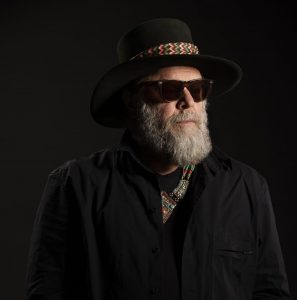
This hurts The Long Way Home as a film, though. It’s very weak when it comes to objective information or contextualization. All that stuff about Glasnost? That’s me explaining it, not the film, which assumes, fairly reasonably, that its 1989-1990 audience already knows about Glasnost. This isn’t a flaw, mind you, Apted set out to make a film documenting Grebenshchikov’s attempt to break borders, and he succeeded. We’re just so far removed from all that now that the on-the-street and in-the-recording-studio depictions of the time are of greater interest than Grebenshchikov’s own celebrity.
Grebenshchikov’s classic music is available on YouTube, albeit with no English subtitles.
You May Also Like
-
 June 7, 2021
 -
 November 16, 2022
 -
 March 1, 2019