
Was Gregg Allman One of the Most Misunderstood Rockers of the 70s?
‘The Music of My Soul’ documentary shares new views of a rock legend
Even though Gregg Allman was one of the most influential American rockers of the 70s, The Music of My Soul, which premieres on June 9, is here to show you that there’s a lot you didn’t know about him.
Gregg Allman: The Music of My Soul ★★★★ (4/5 stars)
Directed by: James Keach
Running time: 96 mins
As the soul-soaked voice of The Allman Brothers Band, he was an originator of the Southern rock sound that permeated America throughout the ‘70s. And though other documentaries have been devoted to the band, this is the first time Gregg himself has been the subject of a feature film.
There was almost a biopic about Gregg in 2014, but it came to a notorious halt when a camera operator was accidentally killed at the start of filming. Made with the participation of those closest to Allman and co-produced his manager Michael Lehman, The Music of My Soul can’t help but contain a hefty portion of Allman Brothers Band content. But unlike 2013’s ABB doc Song of the South, it focuses not on doomed guitar hero Duane Allman but on the little brother without whom the band could never have gotten off the ground.
Director Keach has produced or directed powerful films about Linda Ronstadt, David Crosby, and Glen Campbell, so it’s safe to say he knows a thing or two about capturing the essence of American musical giants. Plenty of luminaries have been friends and admirers, from Jimmy Carter (whose friendship with the Allmans is covered here) to Eric Clapton and Melissa Etheridge. But the interviews focus on occupants of Gregg’s innermost circle, like best friend and right-hand man of 50 years, Chank Middleton.
The core of the film is constructed around a comprehensive, previously unseen interview conducted in Gregg’s final years, where he holds nothing back in recalling the peaks and valleys of his tumultuous times in and out of the Allman Brothers Band. We learn a lot about Gregg and Duane’s musical development during their formative years — the debt they owed to inspirational but little-known artists like blues singer/guitarist Floyd Miles and Hank Ballard’s bandleader, saxophonist Hank Moore; and the concert featuring Jackie Wilson and Otis Redding that changed the impressionable, young Allmans’ lives and put them on the path that led to their artistic destiny.
We find out that — counter to what one might presume — it was Gregg, not big brother Duane, who learned guitar first, though it was quickly sorted out which one of the brothers would hang his whole life on the mastery of the instrument. Curiously, the one bothersome hole in the narrative is that while Gregg’s early guitar experiences are detailed, there’s not a word about his introduction to the keyboards that were his main axe even in his and Duane’s multiple pre-ABB bands, apart from how he fell in love with the Hammond organ just as the Allman Brothers Band began.
Juicy historical nuggets abound. Ever wonder what the first song Gregg ever sang with the ABB was? (Spoiler: “Trouble No More” by Muddy Waters). And, amid all the details, you get a real feel for what Gregg’s world was like at each phase of his life.
We’re reminded that in the late 60s and early 70s, the South was still Jim Crow territory, civil rights legislation notwithstanding. And, as a racially mixed band, Gregg and the guys were bumping up against those ugly realities day after day. We hear about Gregg’s early development as a songwriter, and how the tunes just seemed to fall out of him in those early ABB years, as the likes of “Midnight Rider” and “Whipping Post” enmeshed themselves in our cultural consciousness.
Watching the band’s brisk trajectory towards stardom from ’69 to ’71, it’s easy to imagine the rush the young musicians must have experienced. Especially Gregg, who was just 20 when the group’s self-titled 1969 debut was recorded. Duane’s superhuman slide guitar and Gregg’s smoldering vocals over his roiling Hammond headed the band’s proprietary blend of blues, country, jazz, and rock influences. With rock impresario Bill Graham’s imprimatur and an absolutely relentless touring schedule, the Allman Brothers Band went from countercultural darlings to straight-up rock stars in just a couple of years.
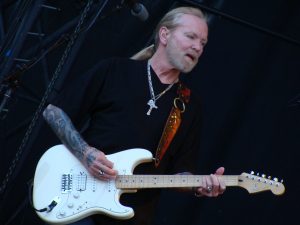
When Duane died in a 1971 motorcycle accident just months after the release of the band’s milestone At Fillmore East album, nothing was ever the same again for either Gregg or the band. The younger brother spent the rest of his life dealing with the loss. One surprising fact dropped into the mix at this point is that the world very nearly lost both brothers within 24 hours of each other, because Gregg OD’ed after learning of Duane’s death.
At this juncture, Gregg’s decades-long substance abuse issues becomes a major plot point, and we get his perspective on the problem as well as the POV of people close to him. But instead of trying to oversimplify things, Keach lets the messiness be, portraying the contradictions of Allman being dogged by addiction and loss while helping lead the band to even greater successes, including their appearance at the legendary 1973 Watkins Glen festival, an event larger in scale than Woodstock.
Covering the tempestuous marriage between Allman and Cher that made the couple’s lives supermarket tabloid fodder in the mid 70s, The Music of My Soul starts to get at one of the key contradictions in Gregg’s deceptively complex makeup: his chronically uneasy status as a painfully shy rock star. Despite his rep as a hard-living renegade, the film presents its subject as majorly misunderstood. Sure, the hard-living part was true enough, but like many people, Allman self-medicated to tamp down a lot of personal pain.
The film covers the ups and downs of Gregg’s solo career and his later years with the ABB, leading up to one of the biggest ironies of Allman’s life — that when he finally beat down the demons of drugs and alcohol, his body had already been terribly damaged. Serious health issues including a liver transplant complicated what should have been Allman’s victory lap.
It’s poignant seeing footage from the end of Gregg’s life, when he knew his days were numbered. But it’s also inspiring to watch excerpts from the all-star 2014 All My Friends concert, as he and some heavy-duty pals salute his spirit. If you can make it through Allman and Jackson Browne’s duo versions of the former’s “Melissa” and the latter’s “These Days” with dry eyes, you just might be a robot.
You May Also Like
-
 September 21, 2018
 -
 December 30, 2020
 -
 December 20, 2024
