
‘An American Tragedy’ at 100
A novel of Dostoyevskian scope examines a social dynamic baked into the present no less than the world of 1925
December 17 marks the hundredth anniversary of the publication of Theodore Dreiser’s sprawling 1925 novel An American Tragedy. The book has subject matter in common with a more celebrated novel published that year, F. Scott Fitzgerald’s The Great Gatsby. Yet the voice, the style, and the approach to satirizing extremes of vanity and greed are Dreiser’s alone. The work is grittier, grubbier, more infused with dread. It may be the most penetrating study we have of the mind of a man incapable of being only somewhat ambitious. Having gotten a taste of the richer life, he can’t stop thinking about it. Though not without decency, he feels entitled to wealth and that any ends justify his assumption of that lifestyle.
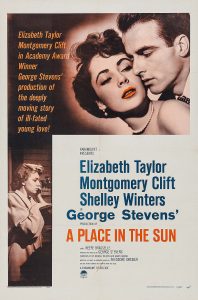
An American Tragedy, which became the basis for the classic 1951 film A Place in the Sun, starring Montgomery Clift and Elizabeth Taylor, is the story of Clyde Griffiths, a poor child of religious parents who tries to make his way in the world, makes a bit of progress, then realizes that far greater heights await him if he can just take care of a nagging problem. He chooses to solve it through murder.
 Clyde works in a drugstore before landing a job as a bellhop in a fancy Kansas City hotel, whose manager warns him about the dangers of letting the pay go to his head. Not that the wages are stellar. But, as the manager warns Clyde, they are enough to make some of the boys who work there cocky. They overbalance to the point of going out on the town all night and showing up late for work the next morning in no fit state to interact with the rich guests. Guys get hired and fired all the time. As Clyde bonds with some of the charismatic boys doing the same lowly jobs he does, they share all they know about making an impression, obeying the rules, and staying on the management’s good side.
But after a grisly accident involving a girl on a snowy road, Clyde flees the Midwest and ends up working in a factory in an upstate New York town. There he begins a relationship with a young woman of equally humble origins named Roberta Alden, who toils in the same factory. They begin to envision a future together until Clyde meets Sondra Finchley, a rich, beautiful woman who holds out the promise of the gilded life that guests in that hotel back in Missouri took for granted but that Clyde has been able only to regard with awe from the outside. Sondra professes her love for Clyde, but, by then, he has gotten Roberta pregnant and has made promises to her. For Clyde, poor Roberta symbolizes an impoverished life that any sane person with a choice would decline.
If you know that An American Tragedy is based on the case of Chester Gillette, who went to the electric chair in New York State on March 30, 1908, for the murder of Grace Brown, then it is no spoiler to describe what happens next. Clyde takes Roberta out on a lake in a boat with a plan in mind for her “accidental” drowning to free him from his agonizing double bind. He envisions her murder, plots it, makes all the arrangements for it. But then, at the climactic moment on the lake, Dreiser introduces subtle questions of agency and motive. Roberta falls out of the boat and drowns, but not quite as a result of any individual action on Clyde’s part. It’s a stochastic murder: Clyde brings about all the circumstances for her death without quite triggering it. He is guilty of something pretty serious, but, in Dreiser’s telling, whether he is technically a murderer becomes a maddening legal, moral, and philosophical question. The courtroom scenes, in which the D.A., Orville Mason, relentlessly hammers Clyde on the witness stand, are more powerful than anything in To Kill a Mockingbird or Inherit the Wind.

Try not to be too hard on Clyde — he cannot stop thinking about that ideal of opulence and of having “made it.” It’s a feature of the system itself — it is driven by aspiration. Clyde’s obsession with wealth emerges even more starkly in the 1951 movie, in a scene where he is dancing with Angela (the Sondra character). As they move around the floor, he confesses that he has loved her since the moment he first saw her and then, in a moment so brief many viewers will miss it, intimates that he felt such passion for her long before they ever met. Angela/Sondra embodies the short cut to love and success that Clyde has been dreaming of since he was a boy.
Assessing the book and its legacy, critics may ask why Dreiser needs 800 pages to tell the story when Fitzgerald said what he had to say in a novella-length work. H.L. Mencken’s judgment of An American Tragedy was that the novel was “a vast, sloppy, chaotic thing of 385,000 words — at least 250,000 of them unnecessary!”
But for the astute reader, there are reasons for the Dostoyevskian length. Dreiser’s social insight depends on contrasts between one milieu and another, and you need to reach the final scenes of the book for the payoff. In the first half of the book, Dreiser invests in describing the habits, mores, jokes, and tricks of the hotel boys who welcome Clyde into their ranks because he wants readers to identify closely with Clyde. The later sections, where Clyde sits on death row, read like a grotesque parody of those earlier passages, as we meet the other condemned inmates, who have habits, jokes, tricks of their own. Dreiser immersed us in the world of the hotel, and then pulled us back to look at a broader canvas, as if to say, And you thought the bellhops had a humble station in life?
The peculiarly American tragedy here is that awareness that the slope can slide down too, comes too late for Clyde. He had neither imagined that the society he lived in was hard-wired to keep the idiosyncrasies of its various castes exactly as they are nor to deny to all but the luckiest any hope of advancement from a lower caste to a higher.
You May Also Like
-
 August 4, 1996
 -
 December 12, 2018
 -
 June 7, 2020
