
How Far Was It From ‘Eyes Wide Shut’ to Epstein’s Island?
Stanley Kubrick’s monument to elite depravity is sadly fresh
Twenty-five after the release of Eyes Wide Shut, the revelation of elite depravity is news that stays news. The ongoing revelations and coverups about Jeffrey Epstein’s sex island escapades make the film’s exploration of desire and the dangerous implications of male insecurity deeply relevant. The problem is that the film’s ponderous digressions reek of overthinking and obscure whatever message it intends to convey.
Stanley Kubrick’s bitter swan song was making news even before it was finally released in 1999. The 400 days it took to shoot holds the world record for longest ever, it starred one of Hollywood’s most glamorous couples in Tom Cruise and Nicole Kidman, and rumors of psychosexual intrigue flew, including something about Harvey Keitel (who quit the production after doing over sixty takes of an actor walking through a door) getting weird with Nicole Kidman’s hair.
Then, to add fuel to the fire, Kubrick, the infamously perfectionist auteur, died suddenly of a heart attack aged 70, shortly after the film was finished. This prompted even more bizarre conspiracy theories that he might have been a man who knew too much about the secret perversions of the elite.
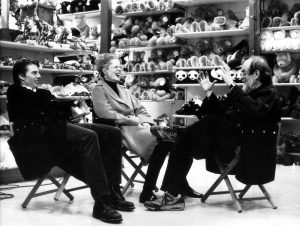
But, no matter how lucrative and enticing, rumors and conspiracies aren’t evidence. A notorious workaholic recluse like Kubrick was not likely to hear inside information about the secret sex lives of the rich and famous. Moreover, it would be pretty dumb for any elite cabal to let a major movie studio film versions of their secret debauchery in vivid detail for more than a year, then let it be painstakingly edited, and internationally released by a famous director starring two household name level movie stars.
In the movie, Dr. Bill Harford and his wife Alice attend a fancy party hosted by the wealthy and sleazy Victor Zeigler, each getting hit on by strangers. That night they get stoned and have an argument. Alice accuses Bill of being disingenuous when he says that he trusts Alice not to fool around on him and that, conversely, there is no hint of sexual tension with any of the patients he examines. Each of them seemed to enjoy their flirtations but neither acted on them. Yet they seem to feel guilty anyway — a very American reaction.
Alice makes the justifiable point that even if Bill thinks he’s sure of his and wife’s fidelity to each other, women do in fact have plenty of sexual desires too. She tells a story about how during a family vacation she was so turned on from a random glance from a handsome stranger that she would have been willing to leave everything for one hot night with him.
Kudos for blowing up the antiquated sexist notion that women aren’t sexual beings. Alice rightfully scoffs at the quaint notion that women are solely motivated by commitment and domesticity. Alice’s logic reminds us that there’s a big difference between having illicit desires and being able to express them in public. Men have felt free to let their hormones rip in a million different ways since the dawn of time but, during many periods of history, the public expression of women’s desires has been frowned upon. The movie takes a welcome progressive stance in putting an adult woman’s sexual agency front and center.
That said, there is quite a bit of blatant gazing at Kidman’s nude body, which is lovely and beautifully photographed. A cynic like Kubrick has to know perfectly well that he’s teasing the males in the audience by putting such a gorgeous woman on display so frankly. It might be a celebration of the female form, it might be an attempt at making heterosexual men squirm in their seats a little by rejecting the usual adolescent coyness toward nudity of most mainstream American movies. Then again, I can’t forget how definitively a female friend once dismissed the scenes of Alice getting dressed: “no woman puts her bra on like that.” Maybe Kubrick’s idea of feminism is more limited than he realized.
The main problem with the film is that it gets hard to care about the frustrations, erotic or otherwise, of these stuffy, shallow, and distant people. Kidman is a great actress, which makes Alice’s stilted and formal erotic confession so disappointing. Her brittle, disembodied, pretentious tone of voice undermines our interest in her character’s motivations, both in this scene and beyond. It does not sound like the spontaneous confession of a fiercely passionate woman who has finally revealed a dark secret to her hapless husband. It sounds more like a stoned, bored wife baiting her clueless spouse, which is exactly what Bill accuses her of, not that it changes anything. Unremarkable for an old married couple perhaps, but it doesn’t really make Alice’s revelations convincing or moving.
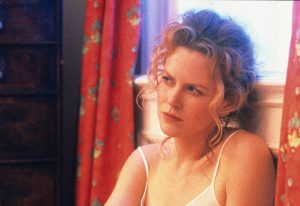 Being turned on by an attractive stranger seems like a fairly commonplace thing to experience for anyone, especially if you live, as the Harfords do, in a place like New York City where you’re passing interesting looking people all the time. Idealizing attractive strangers is nothing special. Nor does it really seem like a revelation to make a sophisticated adult throw away their entire privileged New York City lifestyle the Harfords enjoy, let alone trashing a marriage and traumatizing their young daughter.
One of the major differences between love and sex, both in the movies and in real life, is that most people will not blow up their lives for sex as they will do for love. Generally when people cheat they schedule it as an illicit extramural activity, rather than wanting to lose or change anything about the rest of their life. In contrast, falling in love changes everything.
We’re supposed to believe that Bill is so gobsmacked by the sudden revelation of his wife’s passing fancy that he must wander the dreamlike streets of New York City gnashing his teeth over a hypothetical betrayal while neurotically replaying it in increasingly vivid detail in his mind. You could read it as an example of toxic masculinity, where the rich entitled white man can’t abide his wife telling him that another guy was hotter than him once. Both women and men seem to swoon over Bill at various points (he is played by Tom Cruise after all) and evidently he’s too much of a lunkhead to notice. All the film shows us as he broods and mopes is that Bill is slightly less well-adjusted than he otherwise seems to be.
The plot would have been far more engaging if Alice’ s desires had been more provocative. She could have admitted to something more understandably devastating, such as actually cheating on Bill with, say, a friend or a coworker or a random stranger. Which would be worse? Or if the film had established them as a deeply committed loving couple on the brink of self-destruction. That’s when we could have really seen something compelling about the true cost of wounded male pride. Kubrick could have made a much stronger point about male fragility and entitlement if he’d had more interesting characters.
On top of this drawback, the story reels with useless digressions. Most egregiously there’s a tedious scene with a creepy costume salesman who’s apparently pimping out his quite young looking daughter which doesn’t seem to add anything to the story. Women’s bodies are shown as part of male dominated financial transactions more clearly elsewhere, if that was supposed to be the point, such as when Bill halfheartedly solicits a doomed prostitute. There’s also a strange scene full of unexpected pathos when the grieving daughter of a recently deceased elderly patient suddenly projects all her anguish as love for Dr. Bill, which may reflect something about the polymorphous nature of desire, but does not obviously enrich the story.
Eyes Wide Shut’s look at a strained marriage does continue some of the themes that interested Kubrick throughout his career, particularly how institutions try to rein in unruly subjects. Think of the failed attempts at rehabilitation of Alex and his droogs in A Clockwork Orange, or the mad apocalyptic slapstick of Dr. Strangelove, the psychotic cadets in Full Metal Jacket, or the cold mechanical precision of HAL in 2001. A notoriously meticulous and misanthropic filmmaker, Kubrick tended to have more interest in the workings of the systems that acted on people than he did about the actual people inside of them.
If we’re supposed to get emotionally caught up in Bill and Alice’s nightmarish world of jealousy and desire and guilt, it would help if there was more of a reason to do so. After the two of them start to awkwardly reconcile in the film’s last moments, Alice’s final line — which is simply the word “fuck” — could have been so much more redemptive, funny, and moving if she said it like she really meant it. After spending a long two hours plus with a torpid sexual psychodrama, it’s a shame to be so anticlimactic.
The infamous orgy scene evinces an interesting mix of dread and intrigue. Religious imagery, ominous music, and those haunting Venetian masks resemble the kind of thing that we might imagine from the decadent ultra rich. This elegant depravity, not out of place in the aristocratic balls of the 19th Century, is in stark contrast to Epstein’s tawdry sex island. Bill finds his way to a secret castle and — just as from the outside, the Epstein activities seem nauseating — the notoriously explicit sex in the orgy sequence is less sexy than one might expect.
Kubrick perceptively shows us how the orgy is all about spectacle not pleasure. Everything we see at the castle is very depersonalized, from the masks and the cloaks and the robotic way the women walk, to the pneumatic pounding away at supine bodies while everyone watches from the corners of elegant rooms. It’s all about showing off your power for the fellow big shots. Epstein certainly loved flaunting his elite wealth and connections though his island was more of a panopticon, with secret cameras in every room, used to eventually blackmail the clientele. The elite decadence in Eyes Wide Shut and Epstein’s island might have significant differences but one common denominator: power.
You May Also Like
-
 June 8, 2021
 -
 December 14, 2021
 -
 November 6, 2020

Useless digression? Mofo Kubrick was telling us the Russians were selling kids to New York elites. The whole thing tracks. He probably put that in their because the censors wouldn’t allow the orgy scene to allude to underage sex. He put in what he could. Also, the plot of the film was kept top secret until just before its release. Unless Epstein was in the editing booth with, no one outside the crew and actors would know what the movie was even about. S