Remember SNL’s Pat?
New documentary argues Julia Sweeney’s character was inspiring — and maybe bigoted
Early in We Are Pat director Rowan Haber remarks that 30 years ago, they never would have believed they would make a documentary about Pat, the Saturday Night Live character played by Julia Sweeney. The joke behind every sketch was that no one could tell whether Pat was a man or a woman. Pat, being generally weird and clueless, always gave ambiguous answers to questions which would seem to clearly identify them one way or another. Well before the pronoun fights of the 21st century, SNL poked fun at both gender non-conforming culture and how uneasy mainstream culture felt about people who didn’t nearly fit into their narrowly preconceived ideas.
I share Haber’s surprise that this documentary exists. Where’s the documentary about how Matt Foley was predictive and critical of Vanlife? Or that Toonces the Driving Cat was an early cautionary tale of self-driving cars? Comedy imitates life, to be sure, but analysis of it quickly devolves into self-parody without fairly solid examples.
We Are Pat ★★
(2/5 stars)
Directed by: Rowan Haber
Running time: 86 minutes
We Are Pat briefly provides an explanation for the conflict that breathed life into a long-forgotten character. The gist of a barrage of headlines at the midway point is that Sweeney and others began to worry that the way she portrayed Pat was offensive. Sweeney thought there might be parallels to blackface and wondered whether she should apologize to the relevant community for being “the Al Jolson of androgyny.”
Although We Are Pat frames Sweeney as a reluctant participant in Haber’s retrospective endeavor, it seems as though Sweeney herself was the driver behind the headlines and, as a result, behind the return to relevance of her most famous character. But Sweeney’s self-inflicted struggle session provides no compelling argument that any of the rest of us ever really need to think about Pat.

Haber does talk to other people, gender non-conforming and trans comedians, on the topic of Pat. But they barely engage the question of whether Sweeney should apologize: They can’t actually even seem to agree whether Pat is an empowering icon or a figure of anti-gender-conforming scorn. It doesn’t help that aside from being androgynous, Pat presents as a fat nerd. Which is to say, that if kids bullied other kids over their looking like Pat, there’s not really any good way to untangle the extent to which this was fat nerd bullying (also bad) or specifically gendered bullying.
Haber’s interviews with Sweeney make it fairly clear that she didn’t think about any of this when she was developing the character. Amusingly, her main frame of reference for the Pat character was a creepy guy at work hitting on her, with the androgynous gimmick only taking over the concept when an offhand crack about Pat’s gender ambiguity near the end of a workshopped sketch drew the biggest laughs. Sweeney’s discussion of the mildly sexist working environment at Saturday Night Live in the nineties is almost interesting, but the criticism is milquetoast and forgettable aside from the fact that before Pat, all of the best known recurring bits were developed by men.
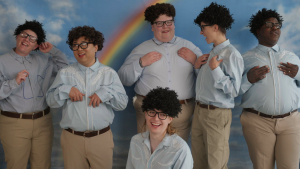
We Are Pat generates some momentum when Haber’s gang of comedians try to engage the character of Pat critically. The most profound observation is one comedian pointing out that in real life, when people aren’t sure what your gender is, and really want to know, they don’t tiptoe around it like the people in the Pat sketches do. They just straight out demand to know whether you’re a boy or a girl — often in a vicious manner. By the second and third decades of this century, discomfort is no longer tentative, but bold prejudice. The delicate probing of Pat’s colleagues has become a museum piece.
The Pat sketches themselves are presented with enough context that viewers can draw their own conclusions. For my part, I was surprised how well they held up. Yes, the Pat joke is extremely one note and stupid but that’s the point. However far any scene extends Pat wriggles out of definition. However long any series of situations is repeated (any of which by any reasonable standard should quickly identify Pat’s gender), Pat — seemingly unintentionally — remains nonbinary. The joke is usually on the other: one guy admits to having (great) sex with Pat eight times, but still somehow doesn’t know their gender; Christopher Walken stone-facedly chooses suicide because the existence of Pat so thoroughly disturbs his understanding of the universe. The feature film It’s Pat! climaxes with their neighbor going insane and chasing them down in the style of a psychotic serial killer.
These sketches are funny because they’re fundamentally manners-based comedies like Seinfeld or Curb Your Enthusiasm. For the tension to work, there has to be a set of shared and unspoken rules which all the characters are reluctant to defy. Here though, the Larry David method of spelling out these unspoken rules is inverted because, while Pat is the constant throughout all the sketches, none of the men and women who want to know Pat’s gender just ask Pat outright to tell them their gender because that’s such an obviously rude question.

The main framing device for We Are Pat follows comedians trying to reclaim Pat, making a politically correct version of the sketch. Their difficulty, and what makes We Are Pat so generally unhelpful in analyzing the concept of Pat, is that at no point do any of the comedians even seem consider that Pat comes from a particular genre, and that Pat jokes thus conform to a certain structure. They’re so deep in the woods of gender-identity they completely fail to notice that they’re surrounded by comedy trees.
It’s little surprise that they fail so miserably (the sketch they come up with is genuinely awful), because there’s no joke if Pat can’t make people uncomfortable. Gender identity isn’t inherently funny. Comedic timing works by defying expectations. Of course Pat has to demonstrate their gender identity by entering a locker room, so when something else happens instead, that’s funny. Accepting Pat as they may be can come off as a great social outcome — and may show that we have become more socially tolerant in the past 30 years — but it’s not funny.
Streaming on Peacock, We Are Pat telegraphs its lack of punch for the simple reason that NBC wouldn’t provide a platform to this documentary if they thought it represented a meaningful threat to the Saturday Night Live brand. Pat being just barely important enough to venerate as a pop culture icon while also being just problematic enough to criticize as an emblem of cis-supremacy isn’t an argument. It’s more a desperate attempt to keep the conversation going long after its thesis has been exposed as intrinsically flawed.
You May Also Like
-
 December 6, 2022
 -
 November 1, 2022
 -
 November 12, 2021