
‘The Man Will Burn’ Wonders Whether Burning Man Has Lost Its Roots
The iconic desert festival grows up, can it survive a decade of mainstream wealth?
Burning Man is not a monolith. Expectations for the festival vary depending on who you ask and what the experience means to them. For the outsider, it’s a place for the most annoying people on Earth to dance in their underwear to EDM music, and for the festivalgoer, it’s an otherworldly experience that defines their lives.
The distance between those two versions of Burning Man gets even stranger when you realize how much the thing has grown. The original 1986 burn on San Francisco’s Baker Beach drew just 35 people. Today, Black Rock City is built to accommodate roughly 80,000. Burning Man says nearly 480,000 different people have participated in the Nevada event since it moved to the desert in 1990.

Watching the new HBO documentary The Man Will Burn, the four-part docuseries highlights the challenges of running a festival that’s more of an art-orgy experience than a simple place out in the desert for everyone to get weird. At one moment, you see the idealism of the whole thing: this was an art collective that helped make something cool, something interesting and enduring. But now it’s increasingly populated by white dudes who can afford to go be weird rather than necessarily the people who should be going.
And “afford” is doing some heavy lifting. Tickets for Burning Man in 2026 range from $250 for subsidized admission all the way to $3,000, and that’s before you factor in transportation, food, water, camping gear, or the small fortune required to cosplay as a cyberpunk desert warlord for a week.
The Man Will Burn is a four-part HBO documentary series directed by Academy Award-nominated filmmaker Jehane Noujaim, who made The Square and HBO’s The Vow, and Vikram Gandhi, the filmmaker behind Kūmāré. Produced by HBO Documentary Films with Double Agent, Noujaim Films and The Othrs, the series premiered July 9 on HBO after debuting at the Tribeca Festival in June. Filmed over roughly five years, it follows Burning Man through COVID cancellations, the unsanctioned “Renegade Burn,” disastrous desert rains, an influx of tech money and the growing perceived “poison” of social media. With extensive access to Burning Man Project leadership and decades of archival footage, the filmmakers frame the series around an increasingly difficult question: how does an anarchic San Francisco art experiment remain true to itself after becoming an 80,000-person temporary dance music bang session in Nevada?
In The Man Will Burn, there are two chief characters: Burning Man Project CEO Marian Goodell, who seems like she’s just doing the best she can with the shit she has to deal with as the face of the experience changes with the times, finding herself as the old artist weirdo holding it down; and the immensely unlikable social vampire Kimbal Musk, who floats into the inner circle wearing a cowboy hat and somehow — if it’s even possible — makes you think he’s a bigger tool than his absolutely awful brother.
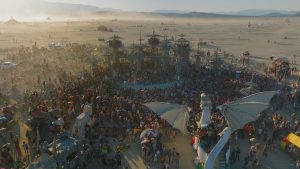
The scale of what Goodell is actually managing is banana town. Burning Man Project says Black Rock City cost $58.1 million to produce in 2024, or roughly $840 per attendee. That same year, the nonprofit reported about $56 million in revenue against $66.7 million in expenses, a deficit of more than $10 million. This thing may have started with a few freaks burning a wooden man on a beach. Still, it is now an enormous organization trying to keep a temporary city — and the mythology surrounding it — alive.
Omitted are some of the issues beyond affordability, including the increasingly sisyphean task of pretending this is still an egalitarian freak festival rather than an expensive vacation for a disproportionately moneyed white crowd. Burning Man’s own 2023 census found that 78.2% of attendees were non-Hispanic white and only 2.1% were Black. More than 60% came from households earning at least six figures, while nearly one in five reported household incomes north of $300,000. Sure, you can dig up a broke artist here or there, but come on: most working artists can’t disappear into the Nevada desert for a week to get cocaine blown into their asses for funsies. They gotta hustle like the rest of us.
Is the series pure propaganda? Sure is. There is basically no mention of the drug culture synonymous with Burning Man, nor is there much acknowledgment of the event’s famously horny side. The Orgy Dome, for example, isn’t some urban legend dreamed up by people making fun of Burners: it appears in Burning Man’s own camp directory, advertising an air-conditioned space for couples and “moresomes.” (Can you just fathom what that dome smells like? Talk about funky. That’s a lot of sweaty butts.)
Not here to judge. But if you tell me you’ve spent a week in the Nevada desert wearing fake-fur boots and a lizard mask as your temporary persona, I’m allowed to think you probably got into some shit. The funny thing is that The Man Will Burn spends four hours wrestling with whether Burning Man can preserve its countercultural soul while largely avoiding some of the very excesses that made the rest of America think Burners were freakazoids in the first place.
Watch it if you want. Otherwise, go blow cocaine in someone’s butt the good ole’ fashioned way, after meeting a sketchy stranger in a dive bar after a shitty art gallery opening.
You May Also Like
-
 October 26, 2018
 -
 September 23, 2022
 -
 June 6, 2023
