
When Yuri Gagarin Solves Who Killed Romeo and Juliet
Alastair Reynolds has a surprising amount of fun with a generation ship noir
For my last review of 2025 I looked at an escape room mystery that took the form of a SF adventure novel with a trip to Mars. For my first review of 2026, it turns out I read a hard-boiled noir novel that took the form of a generation ship SF novel.
Generation ships are, usually, massive ships designed to last for generations (hence the name) to take humans to another habitable planet. Often they are a Hail Mary attempt to save a sustainable community from a dying planet or dying species. Often the vessels have some cryogenic capacity as another means of surviving the length of time it takes to cross the galaxy to habitable planets if you are not zipping around on convenient warp drives or hyperdrives, avoiding the time duration and time distortions of real space. The 50 kilometre-long Halcyon, which gives its name to Alastair Reynolds’ new novel Halcyon Years, is the latest such vessel.
Halcyon Years
By Alastair Reynolds
Orbit; 336 pages
Often, as with Rivers Solomon’s recent classic An Unkindness of Ghosts, where the spirit of the antebellum South is encapsulated in the generation ship, the sealed nature of the vessel — combined with the length of time taken by the journey — leads to specific jargons, cultures, hierarchies, and corruptions. Since the Earth itself, is a form of generation ship, the way that plots play out can be less space opera and more social critique. That is, though, more true of Ghosts; less true of Halcyon Years.
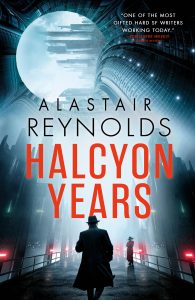 On Halcyon, bizarrely, the specific culture on the ship seems like a highly-stylized 1950s movie America. While the ship was launched to head at one tenth of light speed to Vanderdecken’s Star, the contents of the ship include a bad cop called Lemmy Litz, a few dames including a female client called Ruby Blue, and a landscape complete with bad coffee, solid state dialphones, and Dynaflow cars, but with new geographical names that make sense for a spaceship: Bluff City, Belt City, Prowtown, Midlake. Unlike Ghosts, or many other spaceship dramas, though, there is no sense of a shortage of space for the occupants. On Halcyon they are truly residents, driving around to see each other in different towns or country houses.
To make things one step stranger, though, the protagonist is, with all directness and transparency, Yuri Gagarin, history’s most famous cosmonaut.
One of the reasons, perhaps, for why onboard feels more like the Bay Area than the Enterprise is that, as well as having 11 trillion tonnes of mass. Halcyon stores a number of its occupants in the cryogenic facility known locally as Sleepy Hollow. Gagarin is a “Jack,” an unusual individual who has been randomly stored and randomly revived in order — we are told — to liven up what might otherwise be a stultifyingly homogenous world and boringly evolving culture. We meet no other Jacks in the course of the book, and so little notice is taken of Gagarin that this mechanism feels, towards the middle of the book, as though it’s convenient for the plot rather than an actual tenet of Halcyon.
I hadn’t realized before I reached the first “labour” of the book, quite a few pages in, that this is a British book. I knew that Reynolds had been a finalist for the Arthur C. Clarke and Hugo Awards but I didn’t know that he was Welsh and had actually won the British Science Fiction Association and European Science Fiction Society Awards. I mention this because, to my eyes at least, the noir pastiche of the narrative opening was spotless even though it was by a Welsh writer, about a multinational far future spaceship, featuring a heavily-accented Russian protagonist.
“He opened the door. His visitor was a tall woman, and well-dressed. She wore a jacket of angular cut, a long narrow skirt, and a hat with a wide brim and a veil. Her face was shrouded behind it, like the moon slipping through trees. Shadows stuck to her like roosting birds.”
Clearly Reynolds is having fun.
And from here, especially if he hadn’t included Gagarin, he could have continued to narrate a Space Sam Spade mystery that would have solved the Romeo and Juliet death of the two 17-year-old scions — Randall and Juliana — of the feuding, but duopolistic families the Urrys and the DelRossos.

But Halcyon Years is better than it seems, though as fun as it promises. As Gagarin keeps tugging on loose ends he finds out that everything is more confusing than it seems: not only for him, but for many of the elements of the book that we have been asked to trust. While staying well away from meta-fiction or breaking any virtual fourth walls of audience address, Reynolds makes us question the very tropes of narrative that he has set up: why, how, and cui bono — who benefits from them.
While Gagarin is actually identified with the Soviet cosmonaut who was the first human to orbit the Earth, the destination is implicitly named for the captain of the legendary Flying Dutchman. There are a number of these Easter Eggs that are both fun on their own as well as revealing of whole other levels of mystery in the book. The Urry robot is called Montague in a nod to Shakespeare, Lemmy Litz is really Lemuel, just like Lemuel Gulliver of Gulliver’s Travels. There are more and, to avoid spoilers, I’ll leave it to you to decide whether they are nods or clues.
Although, like Romeo and Juliet, there is a potentially revolutionary message to the resolution of a plot where two young lovers end up dead, this is not a political book in the slightest, However, as it veers from noir into illuminating detective adventure, it shows — just like its protagonist — a surprising amount of doubt about its identity that gives it a pleasing depth and self-consciousness.
You May Also Like
-
 December 30, 2025
 -
 September 17, 2018
 -
 May 6, 2024
